⚡ Official CBSE Academic Release
Academic Session 2026-27 | Board Exams 2027
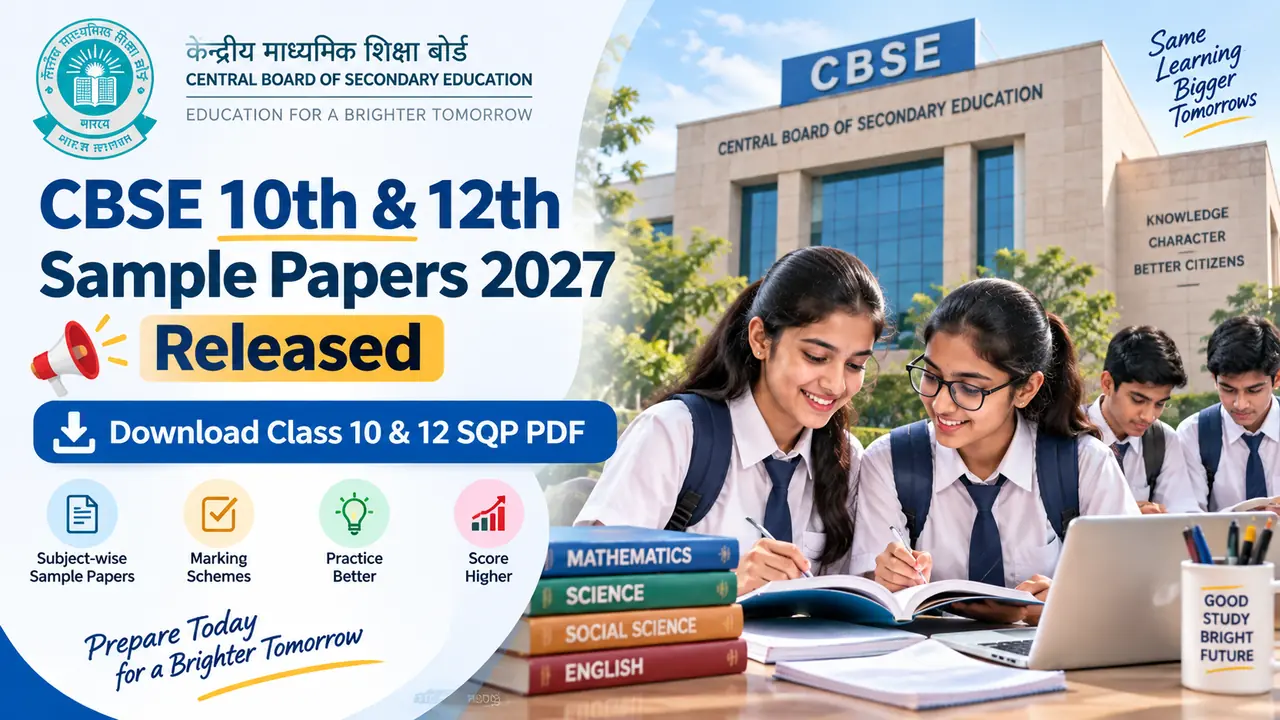
CBSE Sample Papers 2027 for Class 10 & 12 Released: Download Subject-Wise SQP, Marking Scheme & Complete Board Exam Strategy Guide
The Central Board of Secondary Education (CBSE) has officially published the Sample Question Papers (SQPs) and official step-by-step Marking Schemes (MS) for Classes 10 and 12 for the 2026–27 academic session (Board Exams 2027). Below, find direct, verified PDF download links for all major subjects across Science, Commerce, Humanities, and Vocational streams, along with full structural blueprints, competency weightages, and evaluator marking criteria.
📌 Table of Contents: Complete 2027 Board Exam Guide
1. CBSE Sample Papers 2027: Overview & Official Announcement
The release of the annual Sample Question Papers by the Central Board of Secondary Education (CBSE) is universally acknowledged as the single most critical milestone in a student’s academic calendar. For students appearing in the Class 10 and Class 12 Board Examinations in 2027 (academic session 2026-27), the official publication of subject-wise SQPs and Marking Schemes at cbseacademic.nic.in provides the definitive architectural blueprint for the actual question papers to be administered in February–March 2027.
Every year, lakhs of secondary and senior secondary students across India and affiliated schools abroad prepare for their board evaluations. While textbooks, NCERT exemplars, and classroom notes establish the conceptual foundation, the official CBSE Sample Papers reveal the board's exact mind: how questions are framed, what balance exists between direct recall and higher-order thinking skills, how internal choices are distributed, and how marks are awarded by evaluators step-by-step.
Conducting Authority
CBSE (Academic Branch)
Target Academic Session
2026–2027 (Board Exams 2027)
Competency Weightage
Minimum 50% (NEP 2020)
Official Portal
cbseacademic.nic.in
2. Key Blueprint Changes: The 50% Competency-Based Assessment Mandate
In strict alignment with the directives of the National Education Policy (NEP) 2020 and the National Curriculum Framework for School Education (NCF-SE), the Central Board of Secondary Education has completed its systematic transition from memory-centric assessments to competency-grounded evaluations. In the 2027 board examinations, students will encounter a test design crafted to test analytical mastery, conceptual synthesis, logical deduction, and the application of textbook concepts to unfamiliar real-world contexts.
Under this framework, traditional questions that merely required memorizing textbook paragraphs or repeating standard proofs word-for-word have been curtailed. Instead, a minimum of 50% of the total question paper weightage in both Class 10 and Class 12 is dedicated to Competency-Based Questions (CBQs).
| Assessment Dimension |
Traditional Examination Model |
CBSE 2027 Competency Model |
| Primary Learning Focus |
Rote memorization, theoretical definitions, regurgitation |
Critical thinking, practical problem-solving, analytical synthesis |
| Question Formats |
Direct textbook questions, standard theorems, predictable numericals |
Case studies, data interpretation, source analysis, assertion-reasoning |
| Competency Weightage |
Approximately 20% to 30% |
Mandatory 50% Minimum (Class 10 & Class 12) |
| Evaluation Criteria |
Length of answers and reproduction of textbook wording |
Value points, logic chain, scientific accuracy, step execution |
3. Detailed Question Typology & Section-Wise Weightage Breakdown
The 2027 Sample Papers demonstrate a highly calibrated structural harmony across all academic subjects. Whether preparing for secondary board exams in Class 10 or senior secondary subjects in Class 12, students must familiarize themselves with the three major question blocks that constitute the typical 80-mark (or 70-mark for practical sciences) paper:
Core Typological Distribution (Theory Papers)
50%
Competency-Focused Questions (40 Marks out of 80 / 35 Marks out of 70)
Features Multiple Choice Questions (MCQs), Case-Based Integrated Units of Assessment, Source-Based Analysis, Data/Chart Interpretation, and Assertion-Reasoning questions. These evaluate whether a student can extrapolate classroom theory into dynamic scenarios.
20%
Select Response Questions / Objective MCQs (16 Marks out of 80 / 14 Marks out of 70)
Direct single-option correct MCQs designed to test fundamental clarity, scientific facts, definitions, terminology, and quick arithmetic without lengthy subjective elaboration.
30%
Constructed Response Questions / Short & Long Answer (24 Marks out of 80 / 21 Marks out of 70)
Traditional subjective questions including Short Answer (SA-I: 2 marks, SA-II: 3 marks) and Long Answer (LA: 5 marks). These evaluate structured expression, mathematical derivations, chemical equations, diagrammatic accuracy, and comprehensive essay synthesis.
4. CBSE Class 10 Sample Papers 2027: Direct Subject PDF & Marking Scheme Links
Below is the verified master index of official CBSE Class 10 Sample Question Papers (SQP) and Marking Schemes (MS) for the 2026-27 session. Click the direct download links below to open and save the official PDFs directly from the Central Board's academic servers (cbseacademic.nic.in).
5. In-Depth Subject-Wise Analysis for Class 10 (Maths, Science, SST, Languages)
For Class 10 candidates, the board exam represents their maiden nationwide competitive assessment. The 2027 sample papers present a well-structured division of questions that tests depth over breadth. Let us examine the subject-wise blueprints:
Mathematics (Standard vs. Basic)
CBSE continues its two-tier assessment model in Class 10 Mathematics:
- Mathematics Standard (Code 041): Designed for students planning to pursue Mathematics, Physics, Chemistry, Economics, or Computer Science in Class 11 & 12. The 2027 SQP features multi-concept linking (e.g., combining Trigonometry with Surface Areas, or Quadratic Equations with Arithmetic Progressions) and rigorous 4-mark case studies.
- Mathematics Basic (Code 241): Tailored for students opting for non-mathematical career paths (Humanities, Medical, Fine Arts). The questions focus on direct formula application, textbook theorems, basic arithmetic, and straightforward statistical computations without intricate algebraic twists.
Science (Physics, Chemistry & Biology)
The Class 10 Science paper (Code 086) carries 80 marks distributed across 39 questions in 5 sections. Key highlights of the 2027 paper include:
- Section A (20 Marks): 16 MCQs and 4 Assertion-Reason questions testing fundamentals across Chemical Reactions, Acids & Bases, Life Processes, and Light Reflection & Refraction.
- Section B & C (SA-I & SA-II): Emphasizes balanced chemical equations, ray diagrams with proper arrow directions, and genetic cross problems using Punnett squares.
- Section D (Long Answer - 5 Marks): In-depth questions with internal choices. Evaluators expect labeled biological diagrams and step-wise derivations of lens/mirror formulas.
- Section E (Case-Based - 12 Marks): 3 integrated case studies (4 marks each) drawn from everyday phenomena, such as renewable energy setups, chemical corrosion in bridges, and ecological food chains.
Social Science (History, Geography, Political Science & Economics)
The Social Science paper (Code 087) allocates 20 marks equally to each of the four branches. The 2027 sample paper emphasizes critical historiography and contemporary policy awareness:
- Map Skills (5 Marks): 2 marks from History (Indian National Congress sessions, Satyagraha centers) and 3 marks from Geography (Major dams, airports, thermal power plants, and soil types).
- Source-Based Analytical Paragraphs: Students must extract inferences from historical speeches, excerpts from constitutional debates, and statistical tables on poverty or agricultural production.
6. CBSE Class 12 Sample Papers 2027: Direct Subject PDF & Marking Scheme Links
Download the authentic CBSE Class 12 Sample Question Papers and official step-wise Marking Schemes for all streams directly from the verified table below. Each link accesses the official PDF hosted on cbseacademic.nic.in.
7. In-Depth Stream-Wise Analysis for Class 12 (Science, Commerce & Humanities)
In Class 12, performance serves as the critical bridge for admission into premier undergraduate universities, engineering colleges (via JEE Main/Advanced), medical institutes (via NEET-UG), and central universities (via CUET-UG). The 2027 Class 12 sample papers reflect high rigorous academic discipline across all streams:
🔬 Science Stream: Physics, Chemistry, Mathematics & Biology
Physics (042 - 70 Marks): Demands absolute conceptual clarity on Ray & Wave Optics, Electromagnetic Induction, Modern Physics (Photoelectric Effect, Atoms, Nuclei), and Semiconductor Devices. Approximately 40% of the paper involves multi-step numericals and derivations. Case-based questions frequently center on real-world engineering setups like transformers, solar cells, and MRI magnetic fields. Review the official Physics Marking Scheme PDF to understand how ½ marks are assigned for formula statements and SI units.
Chemistry (043 - 70 Marks): Perfectly balanced between Physical Chemistry (Electrochemistry, Solutions, Chemical Kinetics numericals with log/antilog calculations), Inorganic Chemistry (Coordination compounds nomenclature, Crystal Field Theory, d & f block trends), and Organic Chemistry (Named reactions, IUPAC rules, conversions, and mechanism roadmaps).
Mathematics (041 - 80 Marks): Calculus reigns supreme, commanding over 35 marks across Continuity, Differentiability, Application of Derivatives, Integrals, Differential Equations, and Area Under Curves. Vectors and 3D Geometry form the secondary scoring pillar.
Biology (044 - 70 Marks): Heavily oriented toward Molecular Basis of Inheritance, Biotechnology Principles & Processes, and Human Health & Disease. Questions mandate precision diagrams, enzyme names, and experimental conclusions.
📊 Commerce Stream: Accountancy, Business Studies & Economics
Accountancy (055 - 80 Marks): Focuses on Partnership Accounting (Dissolution, Admission, Retirement adjustments), Company Accounts (Issue and Forfeiture of Shares, Pro-Rata Allotment tables), and Cash Flow Statements conforming to Accounting Standard-3 (Revised).
Business Studies (054 - 80 Marks): Over 65% of the paper consists of realistic business vignettes and case scenarios. Students are tasked with diagnosing leadership styles, marketing mix strategies, and financial management decisions from corporate excerpts.
Economics (030 - 80 Marks): Evenly split between Macroeconomics (National Income computation, Aggregate Demand, Central Bank credit control tools) and Indian Economic Development (Comparative study of India, China, Pakistan; rural development; employment trends).
🏛️ Humanities / Arts Stream: History, Political Science & Geography
History (027 - 80 Marks): Rigorous evaluation of Themes in Indian History (Vols I, II, III). Demands source-based analytical deduction, archaeological artifact analysis (Harappan seals), and precise timeline attribution.
Political Science (028 - 80 Marks): Features cartoon-based interpretations, passage-based questions on post-Cold War politics, globalization, and coalition politics in India.
Geography (029 - 70 Marks): Topographical maps, human settlement dynamics, resource distribution graphs, and environmental sustainability case studies.
8. Decoding the CBSE Marking Scheme 2027: Step-Marking & Value Points
The most common pitfall among students is practicing hundreds of questions without reviewing the accompanying Marking Scheme (MS). CBSE examiners are guided by strict, standardized evaluation keys designed to eliminate evaluator bias and ensure pan-India parity. Understanding how marks are allocated transforms average students into top scorers:
1. Step-Wise Marks Allocation
In numerical and mathematical problems, full marks are broken down into granular stages: formula statement (½ mark), correct substitution of given data with units (1 mark), calculation manipulation (1 mark), and final numerical answer with appropriate SI units (½ mark). An arithmetic error at the final stage results in only a ½-mark penalty, provided all prior steps are mathematically valid.
2. Mandatory "Value Points"
In theoretical subjects (Biology, Business Studies, Social Science, History), evaluators do not measure the physical length of your paragraph. They scan specifically for bolded "Value Points" or critical terminology (e.g., "allopatric speciation", "delegation of authority", "fiscal stimulus", "per capita income"). Omitting the designated value point will forfeit the mark regardless of how long the paragraph is.
3. Diagrammatic Precision & Labels
In Science, Physics, and Biology, unlabelled diagrams receive zero credit. Arrows indicating the direction of electric current, incident and reflected light rays, or metabolic flow are essential. Ensure sharp pencil diagrams with neat, horizontal right-hand annotations.
4. Word-Count Adherence & Time Waste
Writing 200 words for a 2-mark question yields the same maximum 2 marks as a crisp 30-word response containing both value points, but costs you precious time needed for 5-mark long answers. Strict adherence to word limits preserves stamina for the final sections.
9. How to Download Official Sample Papers from cbseacademic.nic.in
Follow this verified step-by-step procedure to access official, virus-free PDF downloads directly from the official Central Board of Secondary Education server:
10. 3-Hour Board Exam Time Management & 15-Minute Reading Blueprint
Knowledge without disciplined execution leads to incomplete answer sheets. In a 3-hour examination (180 minutes), every single minute must be budgeted with military precision.
The 15-Minute Reading Window (10:15 AM to 10:30 AM)
CBSE grants a mandatory 15-minute question paper reading window before writing commences at 10:30 AM. How top performers utilize this golden quarter:
- Analyze Internal Choices First: Scan questions featuring an "OR" choice. Decide immediately which option you will answer so you don't waste mid-exam writing time debating alternatives.
- Pre-Read Case Studies & Comprehensions: Read the long case-study passages in Section E and English Reading Comprehension. Highlight key clues mentally.
- Do NOT Start Calculating: Avoid doing rough pencil calculations during reading time as it creates unnecessary cognitive fatigue before the 3-hour clock starts.
| Section & Question Type |
Target Marks |
Recommended Time Allocation |
Strategic Objective |
| Section A: MCQs & Objective |
16–20 Marks |
25–30 Minutes |
Rapid-fire execution; write both option letter and text answer. |
| Section B: Very Short Answer (2M) |
10–12 Marks |
20 Minutes |
Strict 2–3 sentence limit; hit both value points directly. |
| Section C: Short Answer (3M) |
18–21 Marks |
35–40 Minutes |
Bullet-point format with clear subheadings and formulas. |
| Section D: Long Answer (5M) |
15–20 Marks |
45 Minutes |
Comprehensive derivations, diagrams, balanced equations. |
| Section E: Case-Based / Integrated |
12 Marks |
25 Minutes |
Relate passage data directly to textbook principles. |
| Final Buffer: Proofreading & Check |
All Sections |
15–20 Minutes |
Check question numbering, tie supplement sheets, verify units. |
11. Topper-Tested 90-Day Strategy: How to Maximize SQPs to Score 95%+
Solving sample papers haphazardly days before the examination produces minimal retention. Top board exam scorers treat sample papers as iterative diagnostic tools. Adopt this systematic 3-phase roadmap:
PHASE 1: DAYS 1 TO 30
Diagnostic Benchmark & Chapter-Wise Competency Drilling
Print the official 2027 SQP. Attempt it immediately without open books. Evaluate your answers using the official Marking Scheme. Segregate every lost mark into three distinct categories: Conceptual Gap (did not know the concept), Analytical Failure (knew the formula but misapplied it to the case), or Careless Oversight (calculation/unit error). Devote the next 25 days to revisiting NCERT textbooks and exemplar problems specifically targeting your identified weak chapters.
PHASE 2: DAYS 31 TO 60
Timed Sectional Drills & Error Log Maintenance
Isolate specific sections. Dedicate Mondays and Wednesdays to rapid 30-minute Section A MCQ sprints (testing speed and accuracy). Dedicate Tuesdays and Thursdays to solving 4-mark case-based integrated questions from previous years (2023–2026) and 2027 SQPs. Maintain an active "Mistake Notebook" documenting tricky organic reactions, misleading geometry diagrams, and deceptive historical dates. Review this notebook every Sunday morning.
PHASE 3: DAYS 61 TO 90
Simulated Exam Hall Conditions (10:30 AM to 1:30 PM)
Administer full-length mock examinations strictly between 10:30 AM and 1:30 PM to synchronize your body clock with actual board exam conditions. Silence mobile phones, sit at a proper study desk, use standard ruled board-style answer booklets, and set a hard stopwatch. Complete at least 5 to 8 full-length papers per subject before stepping into the examination hall.
12. Boost Preparation with TargetExams Free Chapter Tests & CBT Mocks
At TargetExams, our mission is to empower students with world-class, curriculum-grounded learning tools completely free of cost. To support your journey toward securing 95%+ marks in the CBSE 2027 Board Exams, we have built a comprehensive suite of digital test series and study resources:
🎯 Chapter-Wise Competency MCQs
Practice thousands of verified, curriculum-aligned MCQs and Assertion-Reason questions with instant scoring, detailed step-by-step explanations, and real-time performance analytics.
⏱️ Real Exam Hall Timers
Simulate real board and competitive CBT environments (JEE, NEET, CUET) to sharpen time management, prevent negative marks, and build examination composure.
📚 Comprehensive Study Notes & PYQs
Access curated previous year question papers, high-yield revision summaries, formula sheets, and mind maps designed for last-minute review.
13. Frequently Asked Questions (FAQs)
Q1: Has CBSE changed the exam pattern for the 2027 board exams?
Yes. Under the National Education Policy (NEP) 2020 guidelines, the 2027 board exams mandate a minimum of 50% competency-focused questions (case studies, source-based scenarios, real-life problem solving, and assertion-reasoning). The weightage of traditional rote-learning descriptive questions has been reduced to 30%, with 20% dedicated to objective MCQs.
Q2: Will the questions in the actual board exam be identical to the Sample Papers?
No, the sample paper questions will not appear verbatim in the final board exam. However, the exact structure, section layout, marks distribution, difficulty gradient, and internal choice proportion will mirror the sample question papers 100%. Practicing the official SQP guarantees that no question format in the board exam surprises you.
Q3: How many sample papers should a student solve before the board exams?
Academic experts and past toppers recommend solving a minimum of 6 to 10 full-length sample papers per subject under strict 3-hour timed conditions. Begin with the official 2027 CBSE SQP, followed by the preceding three years' board papers (2024, 2025, and 2026), and then quality mock series from reliable educational portals like TargetExams.
Q4: Are there overall choices in the CBSE 2027 board exam question papers?
No, CBSE does not offer overall choices (such as "attempt any 5 questions out of 8"). However, approximately 33% internal choices are provided within specific questions across all sections. You will find internal choices in selected 2-mark, 3-mark, and all 5-mark long-answer questions.
Q5: Why is the official CBSE Marking Scheme so important?
The Marking Scheme provides the exact answer key, step-wise marks allocation, and designated "value points" that evaluators use across India. Reviewing the marking scheme teaches you how to structure your answers, which keywords are mandatory, how derivations are awarded step marks, and how to avoid losing marks on minor formatting errors.
Q6: Where can I find the official direct link for Class 12 Physics Marking Scheme?
The official Class 12 Physics Marking Scheme is directly available at Physics-MS.pdf. All other subject PDFs are cataloged in our direct tables above.
Q7: How does TargetExams help students prepare for CBSE 2027 Board Exams?
TargetExams provides 100% free chapter-wise online mock tests, competency MCQ banks, previous year question papers with detailed solutions, and comprehensive study notes across Classes 6 to 12. Students can practice with real-time timers and performance analytics to build confidence and speed.
Ready to Supercharge Your CBSE 2027 Board Exam Preparation?
Practice chapter-wise online mock tests, solve competency MCQs, and master the 2027 pattern with TargetExams free interactive question banks.
Start Free Practice on TargetExams.com →

0 Comments
Leave a ReplyNo comments published yet. Be the first to share your thoughts or questions!