Follow Us
Select Medium:
National Institute of Open Schooling (NIOS) Class XII Physics (312) Set 01 (Foundation Level) English Medium 100% Free Practice Test

National Institute of Open Schooling (NIOS) Class XII Physics (312): Nuclei and Radioactivity Online Test (Set 01 (Foundation Level)) | TargetExams

Nuclei and Radioactivity — Set 01 (Foundation Level)

Take free online mock test for National Institute of Open Schooling (NIOS) Class XII Physics (312) chapter 'Nuclei and Radioactivity'. 20 MCQs, 20 minutes, detailed solutions & score analysis.

📝
20 MCQs
Questions
⏱️
20 Mins
Duration
🎯
20 Marks
Total Marks
➕
+1.0
Per Correct
🛡️
0.0
Negative Mark
🌐
English
Language
Start Test Now (English Medium)
Instant Scorecard Step-by-Step Solutions NIOS Self-Learning Material (SLM) Pattern

Chapter Study Guide & In-Depth Notes

Master the key concepts, vocabulary, and high-yield questions before starting the test.

3 Sections

Chapter Overview & Core Concepts: Nuclei and Radioactivity

Class 12 Study Guide

Mastering Nuclei and Radioactivity in Class 12 provides critical subject intuition, analytical skills, and examination readiness.

Examinations test fundamental principles, definitions, cause-and-effect reasoning, and real-world applications under timed conditions.

Core Moral & Key Takeaway:

Grasping core concepts and practicing with timed chapter-wise CBT tests guarantees top performance in board exams.

Key Terminology, Definitions & Principles

Glossary & Concepts
Term / Formula Type Definition / Meaning Explanation / Notes Example / Usage
Core Concept Principle Primary concept governing Nuclei and Radioactivity. मुख्य सिद्धांत "Understand and apply the principle accurately."
Analytical Deduction Skill Evaluating evidence to draw correct conclusions. तार्किक विश्लेषण "Examine question clues systematically."

Key Features & Devices Explored:

Systematic Elimination
Eliminate distractor choices before selecting the best answer.
Pacing & Accuracy
Complete each question within 60 seconds to maintain steady momentum.

High-Yield Revision Points & Solved Board Exam Q&A

Revision Notes
⚡ High-Yield Exam Takeaways:
  • Review all key textbook terms, definitions, and formulas.
  • Pay attention to units, boundary values, and key keywords in questions.
  • Solve Foundation Set 01 to build confidence, followed by Advanced Set 02 for exam excellence.
Frequently Asked Questions & Model Answers:
Q1 How should students prepare for Nuclei and Radioactivity exams?
Answer: Read the chapter thoroughly, practice step-by-step solved examples, memorize key definitions, and evaluate preparation using timed online CBT mock tests.

Sample Questions Preview

Free Sneak Peek

Here is a sneak peek of the questions included in this test set. Test your preparation by viewing the answer and detailed explanation before starting the timed exam.

Q1
Rutherford Scattering and Bohr Model
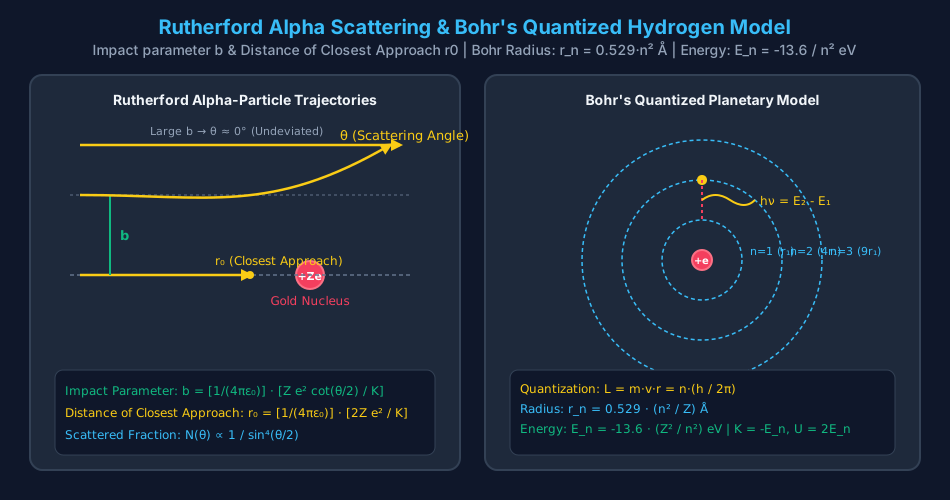
Refer to the schematic diagram illustrating the Geiger-Marsden $\alpha$-particle scattering experiment and Rutherford's nuclear model of the atom:
In this experiment, a collimated beam of $5.5\text{ MeV}$ $\alpha$-particles is directed at a thin gold foil of thickness $\sim 2.1 \times 10^{-7}\text{ m}$. What fraction of incident $\alpha$-particles were observed to deflect through angles greater than $90^\circ$?
गाइगर-मार्सडेन $\alpha$-कण प्रकीर्णन प्रयोग और रदरफोर्ड के परमाणु के नाभिकीय मॉडल को दर्शाने वाले आरेख को देखें:
इस प्रयोग में, $5.5\text{ MeV}$ ऊर्जा वाले $\alpha$-कणों के किरण-पुंज को $2.1 \times 10^{-7}\text{ m}$ मोटाई की सोने की पतली पन्नी पर आपतित किया जाता है। आपतित $\alpha$-कणों का लगभग कितना अंश $90^\circ$ से अधिक कोण पर विक्षेपित होता पाया गया?
A
About 1 in 8000 (roughly 0.0125%)लगभग 8000 में से 1 (लगभग 0.0125%)
B
About 1 in 100 (roughly 1%)लगभग 100 में से 1 (लगभग 1%)
C
About 1 in 10 (roughly 10%)लगभग 10 में से 1 (लगभग 10%)
D
About 1 in 2 (roughly 50%)लगभग 2 में से 1 (लगभग 50%)
Correct Answer: Option A
Explanation:
According to the Geiger-Marsden experimental observations recorded in NCERT: 1. Most of the $\alpha$-particles (more than 99%) passed straight through the gold foil with practically no deflection ($\\theta \approx 0^\circ$). 2. Only about 0.14% of the incident $\alpha$-particles scattered by more than $1^\circ$. 3. About 1 in 8000 (roughly 0.0125%) $\alpha$-particles suffered deflection through an angle greater than $90^\circ$, and extremely few rebounded backwards ($\\theta \approx 180^\circ$). This led Rutherford to conclude that the entire positive charge and almost all mass of the atom is concentrated in a tiny central nucleus.
एनसीईआरटी में दर्ज गाइगर-मार्सडेन के प्रायोगिक प्रेक्षणों के अनुसार: 1. अधिकांश $\alpha$-कण (99% से अधिक) बिना किसी विक्षेपण के सोने की पन्नी से सीधे पार निकल गए ($\theta \approx 0^\circ$)। 2. केवल लगभग 0.14% आपतित $\alpha$-कण $1^\circ$ से अधिक कोण पर प्रकीर्णित हुए। 3. लगभग 8000 में से 1 कण (लगभग 0.0125%) $90^\circ$ से अधिक कोण पर विक्षेपित हुआ, और अत्यंत कम कण लगभग विपरीत दिशा ($\theta \approx 180^\circ$) में वापस लौटे। इससे रदरफोर्ड ने यह निष्कर्ष निकाला कि परमाणु का संपूर्ण धनावेश और लगभग सारा द्रव्यमान केंद्र में एक अत्यंत सूक्ष्म नाभिक में केंद्रित होता है।
Q2
In Rutherford's $\alpha$-particle scattering experiment, the number of $\alpha$-particles $N(\theta)$ scattered per unit area at a scattering angle $\theta$ is proportional to:
रदरफोर्ड के $\alpha$-कण प्रकीर्णन प्रयोग में, प्रकीर्णन कोण $\theta$ पर प्रति इकाई क्षेत्रफल में प्रकीर्णित $\alpha$-कणों की संख्या $N(\theta)$ किसके समानुपाती होती है?
A
$\sin^4(\theta / 2)$
B
$\frac{1}{\sin^4(\theta / 2)}$
C
$\frac{1}{\cos^4(\theta / 2)}$
D
$\sin^2(\theta / 2)$
Correct Answer: Option B
Explanation:
According to Rutherford's scattering formula: $$N(\theta) = \frac{N_i n t Z^2 e^4}{(8 \pi \varepsilon_0 r)^2 K^2} \cdot \frac{1}{\sin^4(\theta / 2)}$$ where: - $N_i$ = total number of incident $\alpha$-particles - $n$ = number of target atoms per unit volume - $t$ = thickness of foil - $Z$ = atomic number of target nucleus - $K$ = kinetic energy of $\alpha$-particles - $\theta$ = scattering angle Thus, the number of particles detected at angle $\theta$ is inversely proportional to $\sin^4(\theta/2)$, i.e., $N(\theta) \propto \frac{1}{\sin^4(\theta/2)}$.
रदरफोर्ड के प्रकीर्णन सूत्र के अनुसार: $$N(\theta) = \frac{N_i n t Z^2 e^4}{(8 \pi \varepsilon_0 r)^2 K^2} \cdot \frac{1}{\sin^4(\theta / 2)}$$ यहाँ: - $N_i$ = आपतित $\alpha$-कणों की कुल संख्या - $n$ = प्रति इकाई आयतन में लक्ष्य परमाणुओं की संख्या - $t$ = पन्नी की मोटाई - $Z$ = लक्ष्य नाभिक का परमाणु क्रमांक - $K$ = $\alpha$-कणों की गतिज ऊर्जा - $\theta$ = प्रकीर्णन कोण अतः, कोण $\theta$ पर संसूचित कणों की संख्या $\sin^4(\theta/2)$ के व्युत्क्रमानुपाती होती है, अर्थात् $N(\theta) \propto \frac{1}{\sin^4(\theta/2)}$।

Ready to attempt all 20 questions in exam environment?

Get real-time countdown timer, question palette navigator, and instant analytics.

How Chapter-Wise Online CBT Tests Build Winning Habits for Future Competitive Exams

Focused chapter-wise CBT practice builds the speed, mental stamina, and analytical discipline required to ace CUET, JEE Main, NEET UG, NDA, CA Foundation, and College Entrance Exams.

Competitive Edge

Real-Time Clock Awareness & Pacing

समय प्रबंधन एवं गति नियंत्रण

In school examinations, students write answers without active pacing. In national entrance tests, students have barely 45-60 seconds per MCQ. Practicing with a 20-minute timer instills instinctive time-budgeting and prevents last-minute exam panic.

Mastery of the Elimination Technique

विकल्प निष्कासन विधि में दक्षता

Top rankers in competitive exams rarely compute every problem blindly. They spot subtle traps, evaluate extreme values, and eliminate 2 out of 4 distractors within seconds. Our 4-option sets teach critical distractor analysis.

CBT Screen Stamina & Digital Comfort

कंप्यूटर आधारित परीक्षा का सहज अभ्यास

Almost all major national exams (CUET, JEE, NEET, SSC, Banking) are 100% computer-based. Students who only study on paper experience eye strain and navigation mistakes on exam day. Early CBT practice creates effortless digital fluency.

Immunity to Negative Marking

सटीकता और नकारात्मक अंकन से सुरक्षा

Careless errors—such as misreading "NOT" or "EXCEPT"—ruin thousands of competitive aspirations each year. Regular objective testing builds the habit of double-checking question keywords before locking answers.

Instant Diagnostic Feedback Loop

तत्काल त्रुटि निवारण एवं आत्म-मूल्यांकन

Traditional paper tests take weeks to grade, by which time the student has forgotten their thought process. TargetExams provides instant scorecards and step-by-step solutions while the conceptual puzzle is still fresh.

Start Building Your Competitive Edge from Class

Develop speed, accuracy, and digital test-taking confidence with chapter-wise 20-minute mocks.

Syllabus Concepts Evaluated in this Chapter

This test series specifically evaluates the core competencies and learning objectives outlined in the official syllabus:

  • Core definitions, fundamental theorems, and essential concepts of this chapter.
  • Step-by-step mathematical reasoning and deductive problem-solving.
  • Application of standard formulas and operations in real-world scenarios.
  • Critical examination of common exam pitfalls and misleading options.
  • Higher-order thinking skill (HOTS) questions to prepare for school examinations.
  • Speed and accuracy mastery under standard timed CBT exam conditions.

Exam Rules & Test Taking Guidelines

  • Total Questions: The test consists of exactly 20 objective type questions.
  • Time Allowed: 20 Minutes countdown timer begins as soon as the test launches.
  • Marking Scheme: +1.0 mark is awarded for each correct answer.
  • Zero Penalty: There is 0.0 negative marking for incorrect or unattempted questions.
  • Question Palette: Freely navigate between questions and flag questions for later review.
  • Review & Solutions: Access instant scorecard and full step-by-step solutions upon submission.

Frequently Asked Questions (FAQs)

Yes! Foundation Practice Set 01 for every chapter in National Institute of Open Schooling (NIOS) Class XII Physics (312) is 100% free to attempt. Students can test their knowledge without any payment or hidden fees.
This page is dedicated to English Medium. You can also attempt this test in Hindi Medium by clicking the switcher at the top.
Absolutely. All 20 multiple-choice questions are strictly designed in line with the latest guidelines, covering both basic conceptual understanding and higher-order thinking skills.
The test contains 20 MCQs to be solved in 20 minutes. Each question carries +1.0 mark for a correct answer, and there is zero (0.0) negative marking for incorrect answers.
Yes. Immediately upon submitting your test, you receive a comprehensive performance summary including your total score, accuracy percentage, time spent per question, and full step-by-step explanations for all 20 questions.

🎯 Start Preparation

Begin with this 20-minute practice set to test your conceptual accuracy and prepare for top ranks in your school examinations.

Nuclei and Radioactivity (Set 01 (Foundation Level))
20 MCQs • 20 Mins • 100% Free Practice Test

Select Test Language Medium

Choose the language medium you want to attempt this online test in:

हिन्दी माध्यम (Hindi Medium) NIOS Curriculum
Displays questions, options, and explanations in the regional medium.
English Medium
Displays questions, options, and explanations in English medium.
Both (English + Regional)
Displays questions and options in English & Regional side-by-side.