
Follow Us
झारखण्ड बोर्ड के छात्रों के लिए: क्या आप इस पाठ को सम्पूर्ण हिन्दी अनुवाद, सारांश और शब्दार्थ के साथ पढ़ना चाहते हैं?
हिन्दी में पढ़ें (Read in Hindi) →
JAC • Class 6 • English (Daisy) • Ch 1a
Estimated Time: 45 Mins
Study Progress: In Progress

The Emperor and the Nightingale

“The Emperor and the Nightingale” is a classic fairy tale by Hans Christian Andersen, adapted for JCERT Class 6 English (Daisy) under Unit 1: “Self”. Set in ancient China, the story describes a powerful Emperor living in an exquisite porcelain palace surrounded by vast gardens that stretch toward the blue sea. In the royal forest lives a little gray nightingale whose melodious singing enchants travellers and fishermen alike. When the Emperor discovers that this humble bird is considered the greatest treasure of his empire, he summons her to court. Moved to tears by her song, he keeps her in a golden cage. Later, an artificial nightingale decorated with diamonds, sapphires, and rubies arrives as a gift from the Emperor of Japan. Charmed by its glittering exterior and predictable tunes, the court neglects the real bird, who quietly escapes back to her forest and is subsequently banished. When the toy bird breaks down and the Emperor falls deathly ill, only the true nightingale’s selfless return and heartfelt song can melt the heart of Death, restore the Emperor’s health, and teach him the eternal value of natural beauty, humility, and genuine freedom.

Can a glittering toy with rubies and gears ever replace the soulful song of a living bird?

Imagine ruling the wealthiest empire on Earth, dining in a palace of delicate porcelain, only to find that the greatest wonder in your realm is a modest, gray bird singing freely in the deep woods. When you receive a diamond-studded mechanical toy that sings on command, would you discard the living singer? And when illness brings you to the brink of the grave, which bird will have the power to save your soul?

Why This Chapter Matters

This story introduces young learners to fundamental human values: humility over arrogance, the supremacy of natural beauty over superficial mechanical splendour, and the true meaning of friendship and freedom. It encourages students to reflect on the concept of the “Self”—understanding that real worth comes from genuine feeling and inner virtue, not outward ornamentation or artificial praise.

Before You Begin (Prerequisites)

  • Basic reading comprehension of narrative fiction and fairy tales.
  • Familiarity with foundational story elements: characters, setting, conflict, climax, and resolution.
  • Understanding of simple literary concepts like contrast (natural vs artificial) and symbolism.

What You Will Learn (Core Objectives)

  • Understand and articulate the plot, central themes, and moral message of Hans Christian Andersen’s story in JCERT Daisy.
  • Contrast the living nightingale with the artificial mechanical bird across beauty, freedom, reliability, and emotional depth.
  • Analyse character motivations: the Emperor’s awakening, the courtiers’ superficiality, and the nightingale’s forgiving loyalty.
  • Master key Unit 1 vocabulary including: “magnificent”, “porcelain”, “melodious”, “courtier”, “banished”, “mechanical”, and “splendour”.
  • Apply grammatical concepts: determiners (articles and demonstratives), abstract vs concrete nouns, and simple past tense narrative verbs.

Chapter Roadmap & Progression

1 1. The Porcelain Palace and the Woo...
2 2. The Royal Invitation and the Gol...
3 3. The Mechanical Rival and the Ban...
4 4. The Sickness of the Emperor and...
5 5. True Friendship and the Gift of...

Complete Concept Guide (100% Curriculum Coverage)

1. The Porcelain Palace and the Woodland Singer

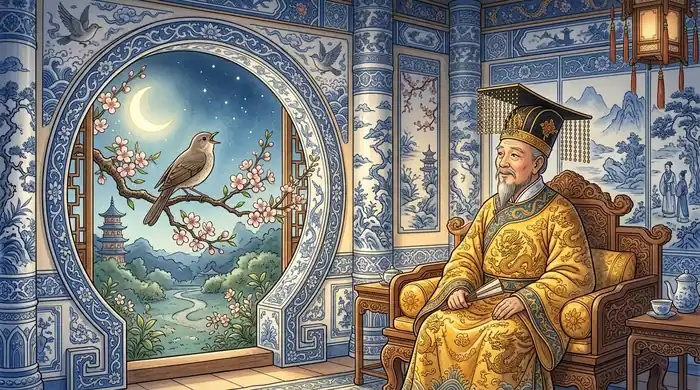
The Emperor of China in his Porcelain Palace listening in awe to the Nightingale
Scene 1: The Porcelain Palace & The Woodland Singer Imperial China

The Emperor of China lived in the most magnificent palace in the world, crafted entirely of precious porcelain. It was extraordinarily fragile and surrounded by a vast garden filled with exquisite flowers tied with silver bells that tinkled softly in the breeze. Beyond the garden stretched a dense, tranquil forest extending all the way to the deep blue sea.

Delicate Porcelain Palace
Made of fragile porcelain; anyone stepping inside had to tread carefully to avoid breaking its treasures.
Silver Bells & Flowers
Precious blooms were strung with silver bells so no passerby would miss their delightful presence.
Deep Forest & Fishermen
Poor fishermen forgot their weary nets to listen spellbound to the sweet melody echoing across the waves.

A. The Fame of the Little Gray Bird

Travellers from across the globe visited the imperial capital and admired the palace and gardens. However, poets and scholars who walked into the quiet forest were moved beyond words by a modest, plain gray nightingale that sang perched high in the branches. Even the poor fishermen, burdened by nighttime labor, would pause their nets to listen, whispering, “How beautifully she sings!” When books written about China reached the Emperor, he was astonished to read that the little nightingale was acclaimed as the finest jewel of his entire realm.
2. The Royal Invitation and the Golden Cage

Perplexed that he had never heard of this wonder in his own woods, the Emperor commanded his Court Chamberlain to find the nightingale immediately or face severe imperial punishment. A humble kitchen maid led the courtiers into the forest. When the courtiers first heard a cow lowing and frogs croaking, they foolishly mistook them for the legendary bird until the kitchen maid pointed out the little gray creature nestled among the leaves.

Kitchen Maid: Only one who knew the bird Courtiers: Mistook cows & frogs for nightingales Emperor’s Tears: The singer’s highest reward

B. Tears in the Emperor’s Eyes

Invited to the palace, the nightingale agreed willingly to sing for the sovereign. Dressed in full imperial grandeur, the Emperor listened as the nightingale began her song. Her melody was so tender and poignant that large tears rolled down the Emperor’s cheeks. The Emperor offered her his golden slipper to wear around her neck, but the bird gently refused, saying: “I have seen tears in the Emperor’s eyes; that is my highest and sweetest reward.” She was placed in a luxurious golden cage, allowed to venture outside only with twelve silken ribbons attached to her delicate legs.

3. The Mechanical Rival and the Banishment

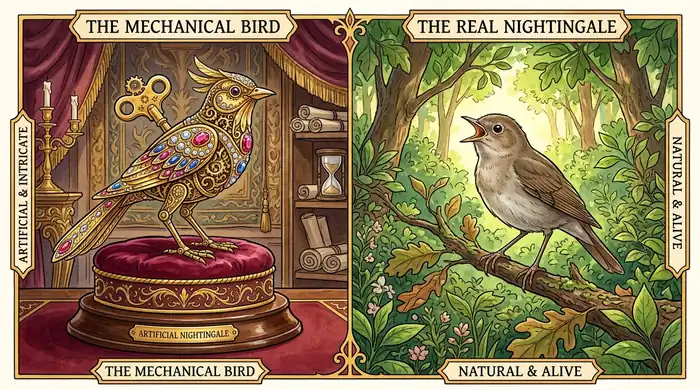
Visual Comparison of Real Woodland Nightingale vs Jewelled Mechanical Bird
Scene 2: Visual Comparison — Mechanical Toy Bird vs Living Woodland Singer Contrast of Values

One morning, a large package arrived with the label: “The Nightingale”. It was an artificial bird sent by the Emperor of Japan, crafted of solid gold and completely covered in sparkling diamonds, rubies, and sapphires. When wound up with a golden key, it could sing one of the waltzes performed by the real nightingale, fluttering its tail with radiant glitter.

The Real Living Nightingale
  • Appearance: Plain, modest gray woodland feathers.
  • Music: Sings freely from heart, emotion, and soul.
  • Freedom: Cannot live inside cages or silken cords.
  • Loyalty: Returns unconditionally when life is in danger.
The Artificial Jewelled Bird
  • Appearance: Solid gold, diamonds, rubies, & sapphires.
  • Music: Predictable, fixed mechanical waltz tunes.
  • Power: Helpless without manual clockwork winding.
  • Durability: Broken springs after five years; silence.

C. Predictability vs True Soul

The court music master declared the mechanical bird superior because its songs were perfectly predictable, mathematically orderly, and never varied. While the courtiers listened enraptured to the toy, the real nightingale slipped through an open window and flew back to her green woodland. Feeling slighted, the Emperor declared the live bird ungrateful and banished her from the empire forever. But five years later, inside the toy bird, a loud whir-r-r sounded, springs snapped, and the clockwork machinery ground to a halt. The palace clockmaker could only repair it enough to be played once a year, and even then, its music sounded worn and stiff.

4. The Sickness of the Emperor and the Defeat of Death

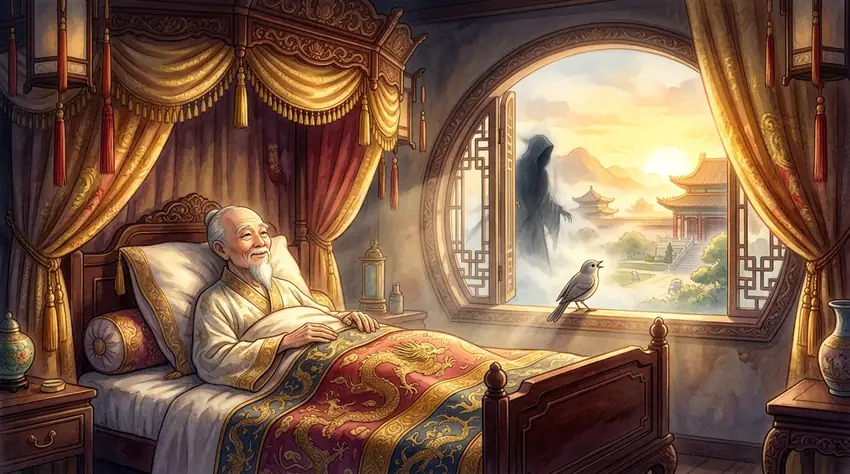
The loyal Nightingale singing on the imperial window sill banishing Death at sunrise
Scene 3: The Song of Life Dispelling the Shadow of Death at Sunrise Loyalty & Redemption

Several years later, the Emperor fell gravely ill. His skin turned pale and cold, and the doctors believed he would not survive the night. He lay helpless in his grand bed beneath heavy velvet curtains.

D. The Arrival of Cold Death

As the Emperor lay alone, he looked up and saw Death sitting heavily upon his chest, wearing his golden imperial crown in one hand and wielding the imperial sword in the other. From the folds of the bed curtains peered ghostly faces—the Emperor’s past deeds, good and bad, whispering his forgotten promises and sins. Desperate to escape the agonizing silence, the Emperor cried out to the mechanical bird: “Sing, precious golden bird, sing!” But the toy remained silent, for there was no one to wind it up.

E. The Song of the Silent Churchyard

Suddenly, from the open window came a burst of exquisite, heavenly music. The little living nightingale, having heard of the Emperor’s plight in her forest, had returned to sing of solace and hope. As she sang of the quiet cemetery where white roses bloom and elder trees scent the night air, Death was filled with longing for his peaceful resting grounds and glided away into the cold mist like a vanishing shadow. Strength and color returned to the Emperor’s body.

5. True Friendship and the Gift of Freedom

Overwhelmed with gratitude, the Emperor wept again and promised to smash the mechanical bird to pieces. The nightingale stopped him, saying the toy had done the best it could and should remain in the palace.

Compassion
Spares the mechanical bird because it did what it was built to do.
Wild Freedom
Song blossoms only in liberty, perched freely outside the windowsill.
Voice of the People
Sings of the hidden joys and struggles of the humblest citizens.

F. The Nightingale’s Moral Creed

The nightingale explained that she could never live inside a cage or a palace: “I love your heart more than your crown. But you must let me come and go as I please. Every evening I will sit on the spray outside your window and sing to you of those who are happy and those who suffer; of the good and evil that is hidden around you. Only promise me one thing: tell no one that you have a little bird who tells you everything.” With that, she flew freely into the dawn, and when the courtiers entered expecting to find their master dead, the Emperor stood tall in his royal robes and cheerfully wished them: “Good morning!”

Key Grammatical Rules, Literary Devices & Core Principles

Determiners (Articles & Demonstratives)
Articles: a, an, the | Demonstratives: this, that, these, those
JCERT Unit 1 Grammar Focus: “A” and “an” are indefinite; “the” points to specific entities (the Emperor, the porcelain palace).
Abstract Nouns vs Concrete Nouns
Concrete: cage, bird, crown, sword | Abstract: freedom, grief, pride, loyalty, beauty
The story contrasts concrete objects of power with abstract virtues that bring true fulfillment.
Simple Past Tense Narrative Verbs
Regular: watched, lived, escaped, arrived | Irregular: sang, flew, wept, heard, spoke
Fairy tales and narratives are primarily driven by simple past tense verbs to describe chronological actions.
Literary Device: Symbolism
Live Nightingale = Freedom & True Art | Mechanical Bird = Superficial Vanity
The contrast between the two birds symbolizes the struggle between natural sincerity and artificial imitation.
Literary Device: Personification
Death sitting on the chest, wearing the crown and sword
Death is depicted as an actual character who listens to music and experiences emotions.

Conceptual Solved Examples & Case Studies

Example 1
Why did the Emperor weep when he first heard the real nightingale sing?
Step-by-Step Solution:
The Emperor was deeply moved because the nightingale’s song possessed profound emotional warmth, purity, and spiritual beauty that touched his inner conscience, something no imperial wealth or material luxury had ever achieved.
Example 2
How did the courtiers react to the mechanical bird, and why did the real nightingale leave the palace?
Step-by-Step Solution:
The courtiers were fascinated by the mechanical bird because it was covered in sparkling jewels and its song was strictly predictable and uniform. The real nightingale slipped away because true art and song require freedom; she could not thrive in a cage bound by ribbons.
Example 3
Why was the mechanical bird unable to sing when the Emperor lay on his deathbed?
Step-by-Step Solution:
The mechanical bird operated solely on clockwork springs and gears that required manual winding. When its internal mechanism wore out, and with no one present to wind it, the inanimate machine was completely powerless.
Example 4
How did the living nightingale save the Emperor from Death?
Step-by-Step Solution:
The nightingale returned to the palace window and sang of the quiet, peaceful cemetery with white roses and whispering trees. The song moved Death so deeply that he yearned for his quiet garden and departed like a cold mist, restoring the Emperor’s life.
Example 5
Identify the determiners in this sentence: “The Emperor received a precious gift from an eastern sovereign.”
Step-by-Step Solution:
The determiners are: “The” (definite article modifying Emperor), “a” (indefinite article modifying gift), and “an” (indefinite article modifying eastern sovereign).

Common Misconceptions & Examiner Traps

Common Misconception

Thinking the real nightingale flew away because she was jealous of the toy bird.

Scientific Reality & Correction

She did not leave out of petty jealousy; she left because she is a creature of the wild who cannot survive or create authentic song when confined to a gilded cage.

Common Misconception

Believing the Emperor demanded revenge against the mechanical bird after his recovery.

Scientific Reality & Correction

The Emperor did offer to smash the toy, but the noble nightingale urged him to spare it, demonstrating compassion and understanding even toward an artificial object.

Common Misconception

Assuming Death was defeated through physical force or royal command.

Scientific Reality & Correction

The Emperor’s royal power and sword were useless against Death; Death was persuaded and softened solely through the spiritual power of sweet, heartfelt melody.

Chapter Summary & 10 Key Takeaways

Takeaway 1
In “The Emperor and the Nightingale” (JCERT Class 6 Daisy, Unit 1), Hans Christian Andersen shows that true beauty, loyalty, and artistry cannot be bought, imprisoned, or duplicated by machines. The living nightingale chooses freedom over royal slippers and golden cages, yet returns unconditionally in the hour of greatest need to rescue the repentant Emperor from Death itself.

Check Your Understanding (Diagnostic Practice Questions)

Diagnostic questions testing core conceptual clarity. Answers are hidden initially — solve each problem first, then click to reveal the step-by-step verified solution.

1
What was the Emperor’s palace made of in the story?
Reveal Answer & Explanation
Answer: Porcelain
The palace was constructed entirely of delicate, precious porcelain that required great care.
2
Who guided the courtiers into the forest to find the nightingale?
Reveal Answer & Explanation
Answer: A poor kitchen maid
None of the high-ranking courtiers knew where the bird lived; only a humble kitchen maid knew the way.
3
What reward did the nightingale ask for after singing for the Emperor?
Reveal Answer & Explanation
Answer: She considered the tears in the Emperor’s eyes her greatest reward.
The bird declined gold slippers, stating that seeing genuine emotion in the Emperor’s eyes was her true reward.
4
What gift did the Emperor of Japan send to China?
Reveal Answer & Explanation
Answer: A jewel-encrusted mechanical nightingale
It was made of gold and covered in diamonds, rubies, and sapphires that sang one waltz tune.
5
On what condition did the nightingale agree to visit the Emperor in the end?
Reveal Answer & Explanation
Answer: That she remain free to fly in the forest and that her visits remain a secret.
She needed the freedom of the forest to sing about both the joys and sufferings of all common people.
Finished Studying This Chapter?
READY TO PRACTICE?

Timed CBT Practice Tests (Exam Simulator)

Put your concepts to the test with official curriculum-aligned Foundation and Advanced practice tests. Get instant accuracy scores, time metrics, and step-by-step verified explanations.

STAY UPDATED

Get the Latest Updates

New test series, syllabus updates, exam notifications and more.

Syllabus
Updates
Exam
Alerts
Study
Resources