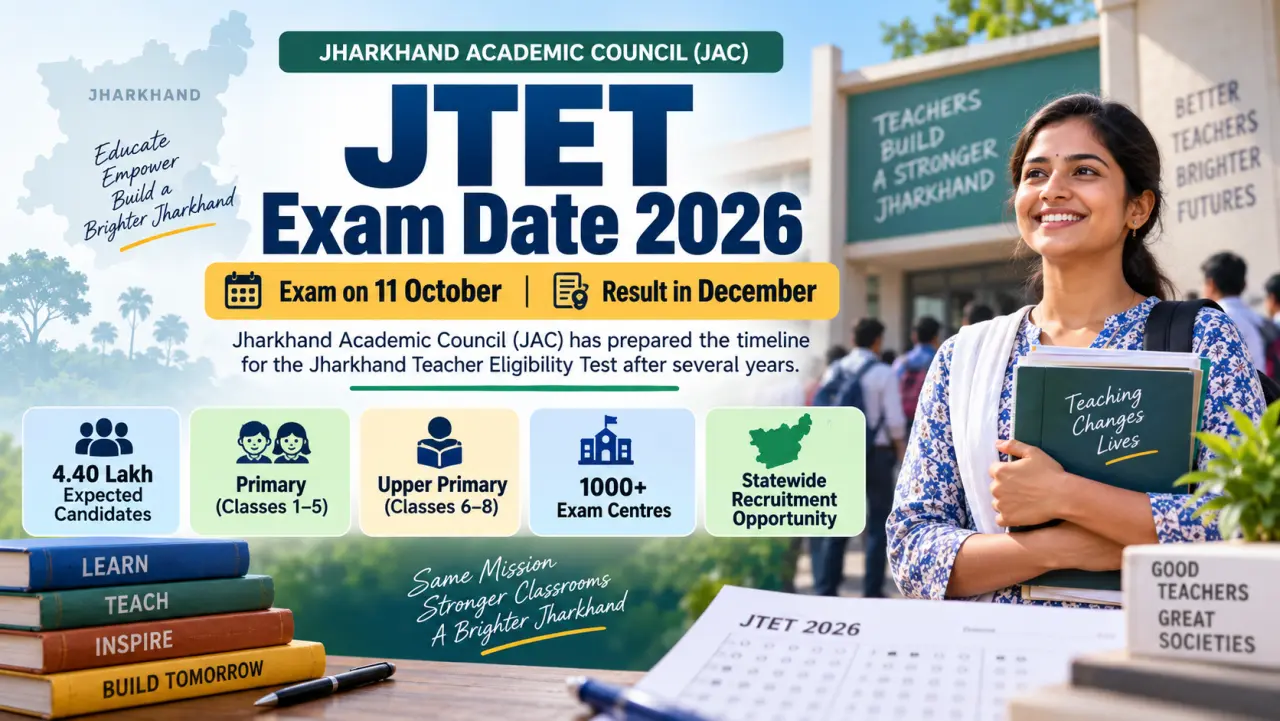
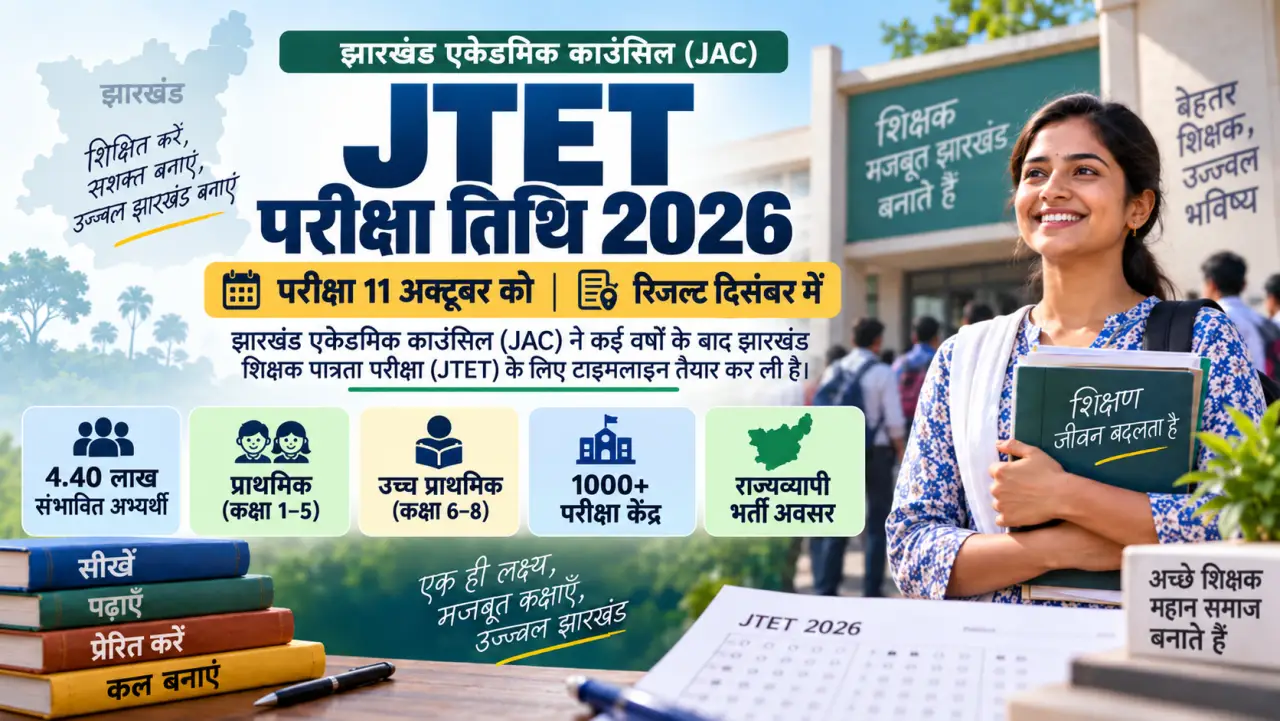
Major Teaching Notification Update: The Jharkhand Academic Council (JAC), Ranchi has officially announced the definitive exam schedule for the long-awaited Jharkhand Teacher Eligibility Test (JTET 2026). The state-level teacher certification examination is scheduled to be conducted on Sunday, 11 October 2026 in two separate offline shifts across more than 1,000 designated examination centres in Jharkhand. Over 4.40 lakh teaching aspirants are set to appear for Level-1 (Classes 1–5 Primary Teachers) and Level-2 (Classes 6–8 Upper Primary Teachers), marking the biggest recruitment qualifying milestone in Jharkhand's academic history after an unprecedented gap of eight years.
Conducting Body
JAC Ranchi, Jharkhand
Official Exam Date
11 October 2026
Candidates Appearing
4.40 Lakh+ Aspirants
Certificate Validity
Lifetime (NCTE Norms)
1. Introduction: Why JTET 2026 is a Historic Watershed for Teaching Aspirants
The Jharkhand Teacher Eligibility Test (JTET / झारखंड शिक्षक पात्रता परीक्षा) is the mandatory statutory eligibility benchmark established by the Department of School Education and Literacy, Government of Jharkhand, in accordance with the National Council for Teacher Education (NCTE) guidelines framed under Section 23 of the Right to Education (RTE) Act, 2009. The primary objective of JTET is to ensure that individuals entering the teaching profession possess the requisite foundational pedagogic acumen, linguistic mastery, child psychology orientation, and subject-matter competency essential for nurturing future generations.
The significance of JTET 2026 cannot be overstated. Jharkhand last conducted the state Teacher Eligibility Test in 2016. For eight long years, hundreds of thousands of candidates who completed their Teacher Training courses—including Diploma in Elementary Education (D.El.Ed), Bachelor of Education (B.Ed), and Bachelor of Elementary Education (B.El.Ed)—were left waiting in uncertainty. Meanwhile, the state government launched substantial recruitment drives, most notably the Jharkhand Elementary School Trained Assistant Acharya Combined Competitive Examination (JSSC Sahayak Acharya Recruitment) aiming to fill over 26,000 primary and middle school teacher vacancies. However, thousands of meritorious graduates who graduated after 2016 were previously ineligible simply because the state had not organized the prerequisite JTET examination.
Following high-level judicial directives and sustained advocacy by student unions, the Government of Jharkhand revised the Jharkhand Primary School Teacher Eligibility Test Examination Rules and officially delegated the complete examination responsibility to the Jharkhand Academic Council (JAC), Ranchi. With district administrative authorities having submitted their final infrastructure allocation reports across all 24 districts by August 31, the stage is set for the seamless execution of JTET 2026 on October 11, 2026.
2. Key Highlights & Official Examination Timeline
The entire administrative apparatus of the Jharkhand Academic Council and district commissionerates has been galvanized to organize this colossal examination. Below is the comprehensive timeline of the JTET 2026 examination cycle:
| Event / Stage |
Official Dates / Timeline |
Important Specifics |
| Official Notification Release |
July 2026 |
Issued jointly by Department of School Education & JAC Ranchi |
| Online Registration Window |
July – August 2026 |
Processed via official portal (jactet.com / jac.jharkhand.gov.in) |
| District Centre Allocation Reports |
31 August 2026 |
District Commissioners verified 1,000+ school & college venues |
| Release of JTET Admit Card 2026 |
10 to 12 Days Prior to Exam |
Available for download using Application Number and Date of Birth |
| JTET 2026 Examination Date |
Sunday, 11 October 2026 |
Shift 1: Level-1 (Morning) | Shift 2: Level-2 (Afternoon) |
| Provisional Answer Key Release |
Late October 2026 |
Candidates permitted to file online objections with evidence |
| Final Result & Scorecard Declaration |
December 2026 |
Final merit list and lifetime eligibility certificates issued |
Official Exam Hub & Mocks
JTET Online Practice Hub
Master Level-1 and Level-2 with official pattern mock tests, CDP quizzes, tribal language models, and previous year solved questions on TargetExams.
Explore JTET Exam Hub →
Recruitment Calendar
6-Month Govt Exam Calendar
Track all upcoming teaching, state board, defence, and central recruitment schedules with verified dates, pattern analysis, and free CBT practice.
View Exam Calendar →
3. Exhaustive Eligibility Criteria for JTET 2026
Prospective applicants must carefully scrutinize the academic, professional, and age parameters mandated under the revised Jharkhand TET service manual. The qualifications are demarcated into two distinct tiers based on the intended teaching level:
A. Level-1: Primary School Teachers (Classes I to V)
Candidates applying for Level-1 must fulfill any one of the following minimum educational benchmarks:
- Senior Secondary (or equivalent 10+2) with at least 50% marks and passed or appearing in the final year of a 2-year Diploma in Elementary Education (D.El.Ed) by whatever name known.
- Senior Secondary (10+2) with at least 45% marks and passed or appearing in the final year of a 2-year D.El.Ed in accordance with the NCTE (Recognition Norms and Procedure) Regulations, 2002.
- Senior Secondary (10+2) with at least 50% marks and passed or appearing in the final year of a 4-year Bachelor of Elementary Education (B.El.Ed).
- Senior Secondary (10+2) with at least 50% marks and passed or appearing in the final year of a 2-year Diploma in Education (Special Education).
- Graduation and passed or appearing in the final year of a 2-year Diploma in Elementary Education (D.El.Ed).
- Important Judicial Precedent Note: In compliance with the landmark ruling of the Hon'ble Supreme Court of India in Devesh Sharma vs. Union of India, candidates possessing solely a Bachelor of Education (B.Ed) degree are no longer eligible to teach Classes I to V. B.Ed qualifications are exclusively reserved for Level-2 (Upper Primary) and higher teaching cadres.
B. Level-2: Upper Primary School Teachers (Classes VI to VIII)
Candidates applying for Level-2 must possess higher educational degrees coupled with professional teacher pedagogy training:
- Graduation (Bachelor's Degree) and passed or appearing in the final year of a 2-year Diploma in Elementary Education (D.El.Ed).
- Graduation with at least 50% marks and passed or appearing in 1-year or 2-year Bachelor in Education (B.Ed).
- Graduation with at least 45% marks and passed or appearing in 1-year or 2-year B.Ed in accordance with NCTE Regulations.
- Senior Secondary (10+2) with at least 50% marks and passed or appearing in the final year of 4-year Bachelor in Elementary Education (B.El.Ed).
- Senior Secondary (10+2) with at least 50% marks and passed or appearing in the final year of 4-year B.A./B.Sc.Ed or B.A.Ed/B.Sc.Ed.
- Graduation with at least 50% marks and passed or appearing in 1-year or 2-year B.Ed (Special Education).
C. Reservation & Relaxation in Minimum Marks
A relaxation of up to 5% in the minimum academic qualifying marks in Senior Secondary or Graduation is granted to candidates belonging to reserved categories, including Scheduled Castes (SC), Scheduled Tribes (ST), Other Backward Classes (OBC - Non-Creamy Layer), Economically Weaker Sections (EWS), and Persons with Benchmark Disabilities (PwD) possessing Jharkhand domicile.
D. Age Criteria & Domicile Guidelines
The minimum entry age for appearing in the Jharkhand Teacher Eligibility Test is 21 years as on the prescribed cutoff date. While there is no rigid upper age ceiling for earning the qualifying JTET eligibility certificate itself, candidates must adhere to the state government recruitment age ceilings (typically 40 years for Unreserved, 42 years for OBC, 43 years for Women, and 45 years for SC/ST) when subsequently applying for substantive Sahayak Acharya recruitment vacancies announced by JSSC.
4. Detailed Examination Pattern & Marking Scheme
JTET 2026 will be administered in an offline pen-and-paper mode using Optical Mark Recognition (OMR) answer sheets. The test papers are strictly objective with multiple-choice questions (MCQs), where each question offers four alternative answers with exactly one correct option.
Question Format
100% Objective MCQs
Marks per Correct
+1.00 Mark
Negative Marking
Zero (No Penalty)
Test Duration
150 Minutes (2.5 Hours)
A. Paper Pattern for Level-1 (Primary Stage: Classes I to V)
Level-1 comprises five compulsory sections totaling 150 multiple-choice questions carrying 150 marks. Every candidate must attempt all five domains within the allocated 150 minutes:
| Section Number |
Subject Domain |
Number of MCQs |
Total Marks |
Time Allocation |
| Section I |
Child Development & Pedagogy (CDP)
Child psychology, learning theories, inclusive education |
30 Questions |
30 Marks |
30 Minutes |
| Section II |
Language I (Hindi / English or Urdu / English)
Language comprehension, applied grammar, pedagogic communication |
30 Questions |
30 Marks |
30 Minutes |
| Section III |
Language II (Regional or Tribal Language)
Selected from 9 recognized Jharkhand languages (Santhali, Mundari, Khortha, etc.) |
30 Questions |
30 Marks |
30 Minutes |
| Section IV |
Mathematics & Quantitative Pedagogy
Arithmetic, geometry, measurements, mathematical logic |
30 Questions |
30 Marks |
30 Minutes |
| Section V |
Environmental Studies (EVS)
Natural ecosystem, environmental conservation, Jharkhand ecology & resources |
30 Questions |
30 Marks |
30 Minutes |
| Total Composite Scheme for Level-1 |
150 Questions |
150 Marks |
2 Hours 30 Minutes |
B. Paper Pattern for Level-2 (Upper Primary Stage: Classes VI to VIII)
Level-2 caters to specialized middle school instruction. Candidates choose their core subject specialization based on their graduation stream (Mathematics & Science for STEM graduates; Social Studies for Humanities & Commerce graduates; or Specialized Languages):
| Section |
Domain / Core Specialization |
Number of MCQs |
Total Marks |
Target Candidates |
| Section I |
Child Development & Pedagogy |
30 Questions |
30 Marks |
Compulsory for All |
| Section II |
Language I (Hindi / English / Urdu) |
30 Questions |
30 Marks |
Compulsory for All |
| Section III |
Language II (Regional or Tribal Language) |
30 Questions |
30 Marks |
Compulsory for All |
| Section IV (Option A) |
Mathematics & Science
30 MCQs Mathematics + 30 MCQs Science (Physics, Chemistry, Biology) |
60 Questions |
60 Marks |
Science & Maths Teachers |
| Section IV (Option B) |
Social Studies / Social Science
History, Geography, Polity & Jharkhand Heritage and Culture |
60 Questions |
60 Marks |
Social Science Teachers |
| Total Composite Scheme for Level-2 |
150 Questions |
150 Marks |
2 Hours 30 Minutes |
5. Comprehensive Subject-Wise Syllabus Analysis
To qualify with distinction, candidates must navigate the rigorous curriculum outlined by the Jharkhand Academic Council. Below is the in-depth syllabus breakdown across all major examination segments:
A. Child Development and Pedagogy (30 Marks)
This section evaluates the applicant's cognitive understanding of young learners, educational psychology, and classroom facilitation dynamics:
- Child Development: Concept of growth and development; Principles of development; Influence of heredity and environment on child intelligence; Socialization processes (Parents, Teachers, Peer groups).
- Cognitive & Moral Theories: Jean Piaget’s Cognitive Development Stages; Lev Vygotsky’s Zone of Proximal Development (ZPD) and Social Constructivism; Lawrence Kohlberg’s Moral Development Stages; Howard Gardner’s Theory of Multiple Intelligences.
- Inclusive Education: Addressing learners from diverse socio-cultural, economic, and linguistic backgrounds; Identifying and scaffolding Children with Special Needs (CWSN), learning disabilities (Dyslexia, Dysgraphia, Dyscalculia), and gifted or creative learners.
- Learning & Motivation: How children think and learn; Intrinsic vs extrinsic motivation; Teacher-student classroom rapport; Constructivist approach to instruction; Right to Education (RTE) Act, 2009 provisions; NEP 2020 pedagogical integration.
B. Language I (Hindi / English / Urdu - 30 Marks)
This paper tests functional communicative aptitude and pedagogical methods of teaching first languages:
- Reading Comprehension: Prose passages and poetic verses with questions assessing inference, contextual vocabulary, title identification, and thematic synthesis.
- Applied Grammar: Varna-Vichar, Sandhi, Samas, Kriya (Verbs), Karak (Cases), Kaal (Tenses), Ling (Gender), Vachan (Number), Paryayvachi (Synonyms), Vilom (Antonyms), Anekarthi Shabd, Muhavare aur Lokoktiyan (Idioms and Proverbs).
- Language Pedagogy: Principles of language teaching; Role of listening and speaking; Challenges of teaching language in diverse classrooms; Remedial teaching methods and diagnostic evaluation tools.
C. Language II: Approved Regional & Tribal Languages (30 Marks)
Jharkhand boasts rich tribal cultural roots. Candidates must select one language from the 9 officially recognized regional and tribal vernaculars of the state:
| Language Category |
Approved Official Languages |
Core Examination Focus |
| Tribal Languages (जनजातीय भाषाएं) |
Santhali (संथाली - Ol Chiki), Mundari (मुंडारी), Ho (हो), Kudukh / Oraon (कुडुख), Khadia (खड़िया) |
Tribal folklore, oral traditions, indigenous syntax, regional idioms, and local cultural context |
| Regional Languages (क्षेत्रीय भाषाएं) |
Khortha (खोरठा), Nagpuri (नागपुरी / सादरी), Kurmali (कुरमाली), Panchpargania (पंचपरगनिया) |
Folk songs, traditional poetry, regional grammar, vocabulary of the Chota Nagpur and Santhal Pargana belts |
D. Mathematics (30 Marks in Level-1 / 30 Marks in Level-2)
Designed to test mathematical reasoning, numerical computation, and pedagogical approaches:
- Number System: Natural numbers, whole numbers, integers, prime and composite numbers, divisibility tests, fractions and decimals, LCM and HCF.
- Arithmetic Operations: Unitary method, ratio and proportion, percentage, profit and loss, simple interest, unitary calculation of work and time.
- Geometry & Mensuration: Basic geometric shapes (point, line, angle, triangle, quadrilateral, circle); Symmetry; Perimeter and Area of 2D shapes (rectangles, triangles, squares); Volume of 3D solids (cube, cuboid).
- Data Handling & Pedagogy: Bar graphs, pictographs, tally marks, mean/median/mode; Nature of mathematics, place of mathematics in curriculum, error analysis, diagnostic and remedial instruction.
E. Environmental Studies (EVS - 30 Marks in Level-1)
Contextualized around the natural ecology and cultural tapestry of Jharkhand:
- Family & Social Environment: Family structures, community living, societal relationships, work and play, shelter and shelter design.
- Food, Nutrition & Health: Balanced diet, major nutrients, vitamins and deficiency diseases, food preservation, cleanliness and sanitation.
- Water & Natural Resources: Sources of water, water cycle, rain-water harvesting, conservation of water bodies in Jharkhand (Subarnarekha, Damodar, Koel rivers).
- Jharkhand Specific Ecology: Chota Nagpur plateau topography, Saranda forest, Dalma wildlife sanctuary, Parasnath hill sanctuary, mineral belts, tribal lifestyle in harmony with nature.
- EVS Pedagogy: Concept and scope of EVS, environmental education principles, classroom activities, experiments, field trips, Continuous and Comprehensive Evaluation (CCE).
F. Science & Social Studies (Level-2 Specializations - 60 Marks)
Level-2 candidates delve deeply into secondary school subject concepts:
- Science (For STEM stream):
- Physics: Force and Motion, Laws of Gravitation, Work and Energy, Sound and Waves, Light (reflection, refraction, mirrors, lenses), Electric current and magnetic effects.
- Chemistry: Structure of Atom, Periodic classification, Metals and Non-metals, Acids, Bases and Salts, Carbon and its allotropes, Chemical reactions.
- Biology: Plant and Animal cell architecture, Tissues, Human organ systems, Plant physiology (photosynthesis, transpiration), Diseases and Immunity, Ecology and Food chains.
- Social Studies (For Humanities & Commerce stream):
- History: Ancient civilizations (Indus Valley, Vedic era, Mauryas, Guptas), Medieval India (Delhi Sultanate, Mughal Empire), Freedom Struggle (1857 Revolt to 1947). Special emphasis on Jharkhand tribal revolts: Santhat Hool (1855) led by Sidho-Kanho, Birsa Munda’s Ulgulan, Tilka Manjhi’s resistance, Tana Bhagat movement.
- Geography: Physical geography of India, climate, soils, natural vegetation, minerals and industries. Geographical zones of Jharkhand (Ranchi plateau, Hazaribagh plateau, Santhal Pargana plain).
- Polity: Indian Constitution, Preamble, Fundamental Rights & Duties, Directive Principles, Parliamentary system, Judiciary, Panchayati Raj and 73rd/74th Constitutional amendments.
6. Minimum Qualifying Cutoff Marks by Category
To be declared "JTET Qualified", candidates must secure the minimum threshold percentage prescribed by the state regulatory board. The qualifying marks are calibrated based on social reservation categories:
| Candidate Category |
Minimum Qualifying % |
Minimum Cutoff Marks (Out of 150) |
Certificate Entitlement |
| General / Unreserved (UR) |
60% |
90 Marks |
JTET Qualified |
| Backward Classes (OBC - BC-I / BC-II) |
55% |
82.5 Marks (82) |
JTET Qualified |
| Economically Weaker Sections (EWS) |
55% |
82.5 Marks (82) |
JTET Qualified |
| Scheduled Castes (SC) |
50% |
75 Marks |
JTET Qualified |
| Scheduled Tribes (ST) |
50% |
75 Marks |
JTET Qualified |
| Persons with Benchmark Disabilities (PwD) |
50% |
75 Marks |
JTET Qualified |
7. Lifetime Validity & Career Progression of JTET Certificate
In accordance with the landmark policy resolution issued by the National Council for Teacher Education (NCTE) on 9 June 2021 and duly notified by the Jharkhand state government, the validity of the JTET Eligibility Certificate is valid for LIFETIME. Once a candidate achieves the minimum qualifying cutoff in Level-1 or Level-2, their certification remains permanently valid without requiring periodic recertification.
A. Role in Jharkhand Sahayak Acharya Recruitment (26,000+ Vacancies)
Acquiring a JTET qualification certificate is the non-negotiable gateway to participate in official state recruitment examinations conducted by the Jharkhand Staff Selection Commission (JSSC). Qualifying candidates become directly eligible for:
- Intermediate Trained Assistant Acharya (Classes 1–5): Appointed as permanent primary school teachers in government-run institutions across Jharkhand districts.
- Graduate Trained Assistant Acharya (Classes 6–8): Appointed across middle schools in specialized capacities: Science & Maths Teachers, Social Science Teachers, and Language Teachers.
B. Salary Structure & Allowances (Pay Matrix Levels)
Appointed Assistant Acharyas enjoy competitive salary packages under the 7th Central Pay Commission recommendations adopted by Jharkhand:
| Teaching Post |
Pay Matrix Level |
Pay Scale Band |
Gross Monthly Salary (Approx.) |
| Primary Teacher (Classes 1–5) |
Level-4 |
Rs 25,500 – Rs 81,100 |
Rs 38,000 – Rs 44,000 + DA/HRA |
| Upper Primary Teacher (Classes 6–8) |
Level-5 |
Rs 29,200 – Rs 92,300 |
Rs 43,000 – Rs 50,000 + DA/HRA |
8. 30-Day Master Preparation Strategy for JTET 2026
With more than 4.40 lakh candidates vying for qualification across 1,000+ exam centres, excelling in JTET demands a structured, phased revision regimen:
Phase 1 (Days 1 to 7): Child Pedagogy & Core Educational Concepts
Devote the initial week to mastering the cornerstone of the exam—Child Development and Pedagogy. Solidify the developmental stages of Piaget, Vygotsky, and Kohlberg. Solve 50+ pedagogical situational questions daily. Review the salient clauses of RTE Act 2009 and inclusive education frameworks.
Phase 2 (Days 8 to 15): Language Mastery & Regional Dialects
Strengthen Hindi and English grammar fundamentals (Sandhi, Samas, Karak, Voice, and unseen comprehension passages). Simultaneously, dedicate at least 2 hours daily to your chosen Language II (Santhali, Khortha, Nagpuri, or Kurmali). Review regional vocabulary, idioms, and local literature.
Phase 3 (Days 16 to 22): Quantitative Math & Science/Social Studies Drills
For Level-1 aspirants, solve NCERT Mathematics exercises up to Class 8, focusing on arithmetic formulas, fractions, ratios, and basic mensuration. Revise environmental topics, focusing on national parks and environmental geography of Jharkhand. Level-2 candidates must complete thorough chapter revisions of their 60-mark specialization (Maths/Science or Social Science).
Phase 4 (Days 23 to 30): Full-Length OMR Mock Simulations & Speed Tuning
During the final week, sit for full 150-minute timed mock tests on TargetExams.com under actual exam conditions. Practice darkening OMR bubbles on printed sheets to eliminate bubbling errors. Analyze score reports, address recurring mistakes, and avoid studying new topics during the final 48 hours.
9. Step-by-Step Guide to Download JTET Admit Card 2026
Candidates can download their official hall tickets approximately 10 to 12 days prior to the examination date by following this verified procedure:
- Visit the official portal of Jharkhand Academic Council at jac.jharkhand.gov.in or the designated testing portal at jactet.com.
- On the homepage notice board, locate and click on the link titled "Download JTET 2026 Admit Card / Hall Ticket".
- Select your applied paper: Level-1 (Classes 1–5), Level-2 (Classes 6–8), or Both Papers.
- Enter your Application Registration Number and Date of Birth (DD-MM-YYYY) in the credential fields.
- Click on the "Submit" button to generate your digital hall ticket.
- Carefully verify all printed details: Candidate Name, Roll Number, Photograph, Signature, Examination Centre Address, Reporting Time, and Subject Stream.
- Download the PDF and print at least two clean copies on A4 paper for presentation at the examination venue.
10. Frequently Asked Questions (FAQs)
1. What is the exact exam date for JTET 2026?
The Jharkhand Academic Council (JAC) has scheduled the JTET 2026 examination for Sunday, 11 October 2026. The exam will be conducted in two shifts for Level-1 and Level-2.
2. Is there negative marking in JTET 2026?
No. There is strictly NO negative marking in the Jharkhand Teacher Eligibility Test. Candidates receive 1 mark for every correct response, and zero marks for unattempted or incorrect answers.
3. What are the minimum qualifying cutoff marks for JTET?
General (UR) category candidates must score at least 60% (90 out of 150 marks). OBC and EWS candidates need 55% (82.5 marks), while SC, ST, and PwD candidates require 50% (75 out of 150 marks) to qualify.
4. What is the validity of the JTET qualifying certificate?
In alignment with NCTE guidelines, the JTET certificate has lifetime validity. Once qualified, you do not need to reappear for the exam in subsequent years.
5. Are B.Ed degree holders eligible for JTET Level-1 (Classes 1 to 5)?
No. Following the Supreme Court judgment in Devesh Sharma vs Union of India, candidates with only a B.Ed qualification are eligible exclusively for Level-2 (Classes 6 to 8). Level-1 requires a D.El.Ed, B.El.Ed, or equivalent primary teacher diploma.
6. How many regional/tribal languages are available in Language II?
Candidates can choose from 9 recognized regional and tribal languages of Jharkhand: Santhali, Mundari, Ho, Kudukh, Khadia, Khortha, Nagpuri, Kurmali, and Panchpargania.
7. Can candidates from outside Jharkhand apply for JTET?
Yes, Indian citizens from any state may apply under the Open / Unreserved category, provided they satisfy the requisite academic qualifications and select an approved Language II paper.
8. What is the mode of examination for JTET 2026?
The examination will be conducted in offline mode using OMR sheets. Candidates must darken circles using a blue or black ballpoint pen.
9. How many candidates are expected to appear in JTET 2026?
Approximately 4.40 lakh candidates are expected to take the exam across more than 1,000 examination centres set up by JAC across Jharkhand's 24 districts.
10. When will the JTET 2026 results be declared?
Official results and scorecards are scheduled to be published by JAC Ranchi in December 2026 following the evaluation of answer sheets and resolution of provisional key objections.
11. Where can I practice authentic JTET mock tests?
You can access syllabus-aligned, authentic bilingual mock tests, sectional practice papers, and previous year question banks on TargetExams.com under the Government Exams section.





0 Comments
Leave a ReplyNo comments published yet. Be the first to share your thoughts or questions!