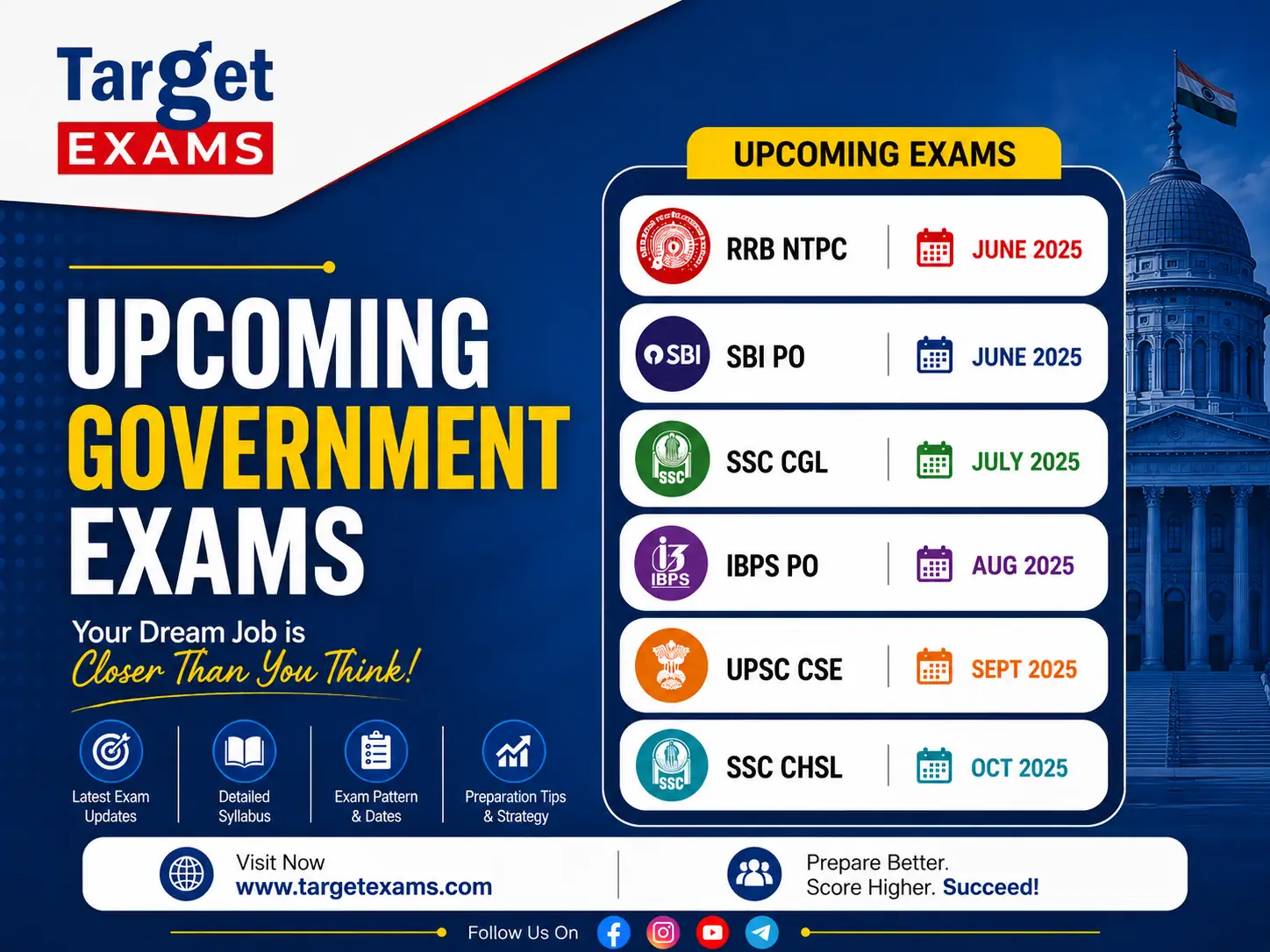
The next few months could be extremely important for lakhs of government job aspirants across India. From SBI PO and SBI Clerk to IBPS PO, IBPS Clerk, RRB NTPC, SSC MTS, CTET, SSC GD and State PSC examinations, several major recruitment tests are scheduled or expected during the upcoming 2026–2027 examination cycle.
If you are preparing for a government job, this is not the time to wait for the next notification before starting your preparation. The smartest approach is to know which examinations are coming, when they are expected, what they test, and how much preparation time you have left.
Why the Next Six Months Matter for Government Job Aspirants
Government recruitment in India is spread across many organisations — SSC, RRB, SBI, IBPS, UPSC, State PSCs and teaching authorities. Many aspirants make one major mistake: preparing for only one exam while ignoring several others with overlapping syllabi.
For example, someone preparing Quantitative Aptitude, Reasoning, English and General Awareness for a banking exam may already be covering a large part of what several other competitive exams require. The same applies to SSC and Railway aspirants.
Instead of thinking "I am preparing only for one exam", a better approach is: "I am building a competitive-exam foundation and then adapting it to each examination." You can explore the full upcoming government exams calendar to plan this foundation.
Major Exams: September 2026 to February 2027
The current calendar covers a busy recruitment period from September 2026 through February 2027. September is especially important for banking and railway candidates — SBI PO Mains on 12 September and RRB NTPC Undergraduate CBT-2 on 17 September, with SBI Clerk Prelims on 26–27 September. A CTET autumn session is also listed.
October brings IBPS PO Mains on 4 October, IBPS Clerk Prelims on 10–11 October, the SSC MTS & Havaldar window across October–November, and Railway ALP/Technician activity. November and December continue with IBPS SO Mains, IBPS RRB Officer Scale I, SBI Clerk Mains and IBPS RRB Office Assistant.
Early 2027 is already relevant too — IBPS RRB Clerk Mains, CTET Winter Session, possible RBI recruitment, SSC GD Constable 2027, State PSC exams and the RRB Group D/Level-1 cycle.
Build a Common Foundation
Instead of restarting from zero for every exam, build a strong common foundation. In Quantitative Aptitude, focus on arithmetic, simplification, percentages, ratios, averages, profit and loss, time and work, and data interpretation. In Reasoning, practise puzzles, seating arrangements, syllogisms, coding-decoding, blood relations and direction problems. In English, work on reading comprehension, grammar, vocabulary, cloze tests and error detection. For General and Banking Awareness, build a gradual daily revision habit rather than cramming at the last minute.
A Simple Three-Phase Preparation Strategy
Phase 1: Build the Foundation
Focus on conceptual clarity first. Learn the fundamental rules and methods. Chapter-wise practice helps you identify whether you actually understand a topic.
Phase 2: Develop Speed and Accuracy
Once the basics are covered, practise against the clock. Measure questions attempted, accuracy percentage, average solving time and repeated mistakes. The goal is to become faster without sacrificing accuracy.
Phase 3: Full Exam Simulation
As the exam approaches, take full-length mock tests seriously — sit in one place, follow the real time limit, avoid interruptions, and analyse every mistake afterwards. Classify errors as conceptual, calculation, reading, time-management or guessing mistakes.
Prepare for Multiple Exams with One Plan
A major advantage of competitive exam preparation is syllabus overlap. Banking, SSC and Railway preparation all share quantitative aptitude, reasoning, English and general awareness pillars. Maintain a master preparation plan with four broad pillars — Quantitative Ability, Reasoning, English/Language, and General Awareness/General Studies — then add exam-specific topics when required.
Before choosing an exam, always verify the educational qualification, age requirement, job profile, selection process, location and preparation overlap from the official notification.
Make Every Wrong Answer Useful
One of the biggest differences between effective and ineffective practice is what happens after the test. Review every incorrect question and ask why you got it wrong. If it was conceptual, revise the topic. If it was a calculation error, practise similar calculations. If it was rushing, improve reading discipline. If it was guessing, rethink your attempt strategy.
Waiting for an official notification before beginning preparation is a common mistake. Build your fundamentals early — quantitative aptitude basics, reasoning practice, English comprehension and grammar, general knowledge and current affairs — then adjust your plan once the notification arrives.
Related Reading
For more helpful study material and exam tips, check out more government exam study guides on a partner site dedicated to competitive exam preparation.