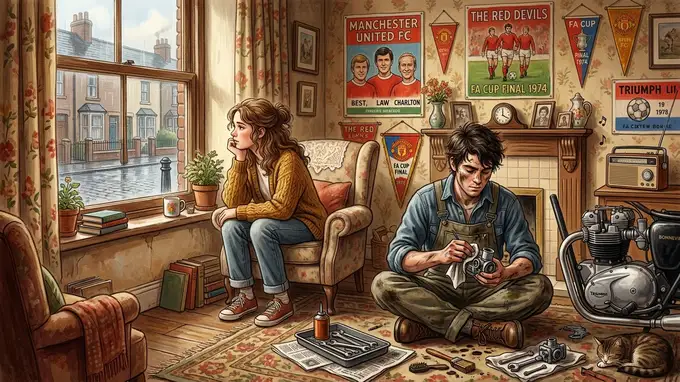
“Going Places” by English author A.R. Barton is a poignant, sensitive exploration of adolescent psychology, hero-worship, and the painful clash between escapist daydreams and working-class reality. Set in an industrial English town, the story centers on Sophie, a teenage schoolgirl from an impoverished working-class family who habitually escapes her dreary circumstances through grandiose, romantic fantasies. While her pragmatic, down-to-earth classmate Jansie accepts that their destiny is earmarked for the local biscuit factory, Sophie daydreams of opening the city’s most luxurious boutique or becoming an actress and fashion designer like Mary Quant. Her longing for glamour culminates in an elaborate fabrication that she has met Danny Casey—a dazzling young Irish football prodigy playing for United. Seeking validation from her taciturn elder brother Geoff, Sophie constructs an intricate narrative of a romantic rendezvous by the canal. The story reaches an aching emotional climax as Sophie sits waiting on a solitary bench beneath an elm tree, confronting the crushing weight of disillusionment and the inevitable intrusion of harsh reality.
⚽ What happens when a teenage girl’s desperate fantasy collides with the freezing silence of reality?
Imagine living in a cramped, steamy kitchen earmarked for a biscuit factory, while your mind lives in Parisian fashion boutiques and private meetings with a football superstar. In “Going Places,” A.R. Barton explores the delicate, heartbreaking boundary between youthful fantasy and cold reality.
Why This Chapter Matters
Prescribed as Chapter 8 of NCERT Class 12 English (Flamingo), “Going Places” provides deep insights into adolescent hero-worship, socio-economic entrapment, and familial dynamics. It offers students a mirror to examine how escapist fantasies often serve as a coping mechanism for youth trapped in mundane, limited environments. The text frequently appears in board exams for character contrasts (Sophie vs Jansie), the role of brother Geoff, and the symbolism of the canal scene.
Cultural context: British football fandom (United, Danny Casey, stadium culture).
Literary concepts: adolescent romanticism, character foils, dramatic irony, psychological disillusionment.
What You Will Learn (Core Objectives)
Contrast Sophie’s escapist fantasies with Jansie’s grounded, practical realism.
Analyze the working-class domestic atmosphere of Sophie’s home (father, mother, Geoff, Derek).
Examine Sophie’s deep emotional bond with her taciturn elder brother, Geoff.
Deconstruct the psychological mechanics behind Sophie’s fabricated encounter with Danny Casey.
Analyze the symbolic setting of the canal bench and the emotional anguish of waiting in vain.
Evaluate hero-worship as an adolescent search for identity and escape from socio-economic limits.
Chapter Roadmap & Progression
11. Sophie and Jansie: Dreamer versu...
22. The Working-Class Domestic Reali...
33. Brother Geoff: The Gateway to th...
44. The Fabricated Encounter with Da...
55. The United Football Match: A Fam...
66. The Solitary Wait by the Canal:...
Complete Concept Guide (100% Curriculum Coverage)
1. Sophie and Jansie: Dreamer versus Realist
Walking home from school, two teenage friends, Sophie and Jansie, discuss their imminent transition into adult working life. The contrast between them is immediate and striking:
Sophie: The Hopeless Romantic
Sophie daydreams of opening the finest boutique in the city, becoming an actress on the side to earn money, or becoming a top fashion designer like Mary Quant. She refuses to acknowledge her financial constraints.
Jansie: The Grounded Realist
Jansie knows that both of them are earmarked for the local biscuit factory. She wishes Sophie would be sensible, warning her that boutiques take immense capital and that her father would never allow such fantasies.
2. The Working-Class Domestic Reality
Entering her home, Sophie is immediately confronted by the stifling atmosphere of working-class domesticity. The small room is hot and stuffy with stove steam and dirty laundry. Her father, a heavy-set man with a sweaty, grime-caked neck, sits scooping shepherd’s pie into his mouth. Her mother bends wearily over the kitchen sink, her back crooked under an apron tied with a crooked bow. The physical setting highlights the grim economic trap that Sophie is desperately attempting to escape in her mind.
3. Brother Geoff: The Gateway to the Unknown World
In the adjoining room, Sophie seeks out her elder brother, Geoff, an apprentice mechanic working on greasy motorcycle engine parts. Geoff is tall, taciturn, and speaks very little. Sophie is deeply fascinated by his silence, suspecting that he travels to mysterious, exotic parts of the city that she has never seen.
Desperate for Geoff’s Acceptance:
Sophie longs to be admitted into Geoff’s private world. To capture his elusive attention and elevate herself in his eyes, she drops a bombshell: “I met Danny Casey.”
Adolescent escapism: Sophie confiding her imaginary meeting with Danny Casey to silent brother Geoff.
4. The Fabricated Encounter with Danny Casey
Danny Casey is the sensational young Irish football prodigy playing for the local football club, United. Sophie weaves an elaborate narrative: she was looking at clothes in the window of Royce’s arcade when Casey came and stood right beside her.
She claimed they spoke casually. When she asked for an autograph for little Derek, neither had a pen or paper. She added vivid personal details: his soft, gentle Irish accent, his freckles, his quiet green eyes, and his polite demeanor. To crown the tale, she told Geoff that Casey promised to meet her again the following week to give her an autograph in person!
5. The United Football Match: A Family Pilgrimage
On Saturday, the family undertakes their regular weekly pilgrimage to watch United play. Thousands of passionate supporters fill the stadium. United wins two-nil, with Danny Casey scoring a breathtaking second goal—dodging defenders with fluid Irish wizardry and driving the ball home with crisp perfection. Her father roars with celebratory pride; Geoff is ecstatic; and Sophie glows with intense personal pride, feeling an intimate connection to the stadium’s idol.
6. The Solitary Wait by the Canal: The Agony of Disillusionment
The following week, on the appointed evening, Sophie slips away to a sheltered path along the canal. She sits on a wooden bench beneath a solitary elm tree near the wharf—a secluded spot where lovers traditionally meet.
The Crushing Weight of Silence:
She waits with eager anticipation, imagining his approaching footsteps. But the minutes drag into an hour. The evening air turns freezing; no one appears. A deep, agonizing sadness settles over her—not just because Casey has not come, but because of the unbearable humiliation of going home to face Geoff and her father’s skepticism: “I can see the doubt in their eyes, and I know I will never be able to show them.” The fantasy has collapsed under the weight of cold, unyielding reality.
The solitary vigil: Sophie waiting on the canal bench at dusk, facing the cold sorrow of disillusionment.
Fabricating glamorous fantasies to cope with working-class drabness.
Sophie’s internal resistance to the preordained fate of the biscuit factory.
Character Contrast: Sophie vs Jansie
Sophie = Romantic daydreamer | Jansie = Grounded realist.
Demonstrates two opposing adolescent responses to socio-economic boundaries.
Sociological Symbol: The Steamy Kitchen
Stove steam, dirty washing, tired parents, heavy silence.
Symbolizes the claustrophobic domestic trap of working-class domesticity.
Symbolic Setting: The Canal Bench beneath the Elm Tree
The liminal space where romantic illusion is confronted by cold silence.
Represents the painful threshold between childhood daydreams and mature disillusionment.
Adolescent Motif: Hero-Worship
Danny Casey as the idealized avatar of talent, fame, and youth.
Sports stars serving as emotional anchors for youthful identity and dreams.
Brother-Sister Dynamic: The Search for Connection
Sophie seeking Geoff’s silent world through the Casey story.
Fantasies used as currency to purchase emotional validation from family members.
Conceptual Solved Examples & Case Studies
Example 1
Where was it most likely that the two girls would find work after school? (Think as you read)
Step-by-Step Solution:
It was virtually preordained and expected that both Sophie and Jansie would find work in the local biscuit factory after leaving school. Both girls came from working-class industrial families with severely limited financial resources, and their community offered few employment opportunities beyond the local manufacturing factory.
Example 2
What were the options that Sophie was dreaming of? Why does Jansie discourage her from having such dreams? (Think as you read)
Step-by-Step Solution:
Sophie’s Dreams: Sophie daydreamed of opening the most luxurious fashion boutique in the city. Alternatively, she dreamed of becoming an actress, a manager, or a top-tier fashion designer like Mary Quant to earn enough money to establish her boutique.
Jansie’s Discouragement: Jansie discouraged her because she was a realistic, sensible girl who understood their socioeconomic reality. She knew that opening a boutique required substantial financial capital, which Sophie’s family completely lacked. Jansie gently urged her friend to be sensible and accept that they were destined for the biscuit factory.
Example 3
Why did Sophie wriggle when Geoff told her father that she had met Danny Casey? (Think as you read)
Step-by-Step Solution:
Sophie wriggled with acute discomfort and dread because:
She had confided the secret exclusively to Geoff, hoping it would remain an intimate bond between them, and was dismayed that he blurted it out to their father.
She knew her father was a harsh, cynical realist who would immediately scorn and ridicule her story, warning her that her wild imagination would land her in serious trouble.
Example 4
Did Geoff believe what Sophie says about her meeting with Danny Casey? (Think as you read)
Step-by-Step Solution:
Geoff was initially deeply skeptical, replying dryly: *“I don’t believe it.”* However, as Sophie provided vivid, sensory details—such as looking into Casey’s green eyes, describing his soft Irish accent, and explaining that neither of them had a pen or paper to write an autograph—Geoff began to entertain the slender possibility that she might have encountered the footballer, though he remained cautious and questioned whether Casey would truly meet her again.
Example 5
How does Sophie describe Danny Casey’s appearance and manners? (Think as you read)
Step-by-Step Solution:
Sophie describes Danny Casey as a polite, quiet, and modest youth:
Facial Features: He had green eyes that looked gentle, freckles across his nose and cheeks, and was not quite as tall as people imagined from watching him on the pitch.
Voice and Manner: He spoke with a soft, gentle Irish accent, appearing shy and bashful, entirely devoid of arrogance despite being an internationally celebrated football prodigy.
Example 6
Sophie and Jansie were classmates and friends. What were the differences between them that show up in the story? (Understanding the text)
Step-by-Step Solution:
Sophie and Jansie serve as diametrically opposed character foils:
Dreamer vs Realist: Sophie lives entirely in a world of romantic escapism and impossible daydreams (boutiques, Hollywood stardom, Danny Casey), refusing to accept her limitations. Jansie is thoroughly grounded, sensible, and reconciled to working in the biscuit factory.
Discretion vs Gossip: Sophie is intensely private, keeping her inner world hidden within the family. Jansie, as Sophie notes with dread, is an incurable gossip who cannot keep a secret and would broadcast any rumor to the entire neighborhood.
Coping Mechanism: Sophie copes with poverty through fabrication; Jansie copes through mature acceptance of reality.
Example 7
How does Sophie’s father react to her story of meeting Danny Casey? What does this reveal about his character? (Understanding the text)
Step-by-Step Solution:
Reaction: Sophie’s father turns his heavy, sweaty face with disdain, dismissing her claim as another wild fabrication (“It’s completely impossible”). He sharply cautions her: “One of these days you’re going to talk yourself into a load of trouble.”
Character Traits: This reaction reveals him as a cynical, weary, hard-working realist. Crushed by years of manual labor, he possesses zero patience for teenage romantic daydreams, viewing them as dangerous delusions that bring humiliation to a poor family.
Example 8
Discuss the scene at the canal where Sophie waits for Danny Casey. How does the author convey her emotional journey from hope to despair? (Understanding the text)
Step-by-Step Solution:
The canal scene is the psychological and emotional climax of the story:
The Romantic Setting: Sophie selects a tranquil, secluded wooden bench beneath a solitary elm tree along the canal, where lovers traditionally meet, investing the setting with romantic fantasy.
The Wave of Anticipation: Initially, she sits with eager, breathless excitement, imagining Casey stepping out of the shadows.
The Creeping Disillusionment: As time elapses and the freezing evening deepens, cold reality begins to intrude upon her delusion. Barton describes the physical sensations of sorrow: “She sat waiting, and with it came the sadness.”
The Humiliation of Return: The true heartbreak is not merely that Casey does not appear, but the agonizing realization of returning home to face the mocking, doubting eyes of her father and Geoff. The dream has irrevocably shattered.
Common Misconceptions & Examiner Traps
Common Misconception
Assuming Sophie actually met Danny Casey in the arcade.
Scientific Reality & Correction
The meeting was entirely a product of Sophie’s vivid, escapist imagination; she never met him in person.
Common Misconception
Believing Jansie was malicious or wished harm upon Sophie.
Scientific Reality & Correction
Jansie was a genuine, caring friend who worried that Sophie’s unrealistic daydreams would lead to severe heartbreak and embarrassment.
Common Misconception
Thinking Geoff was wealthy and lived in luxury.
Scientific Reality & Correction
Geoff was an apprentice mechanic with grease under his fingernails, living in the same cramped house as Sophie, though he rode an old motorcycle.
Chapter Summary & 10 Key Takeaways
Takeaway 1
Sophie vs Jansie: Romantic daydreamer longing for boutiques vs practical realist accepting the biscuit factory.
Takeaway 2
Stifling Working-Class Home: Steamy kitchen, father eating shepherd’s pie, weary mother with crooked apron bow.
Takeaway 3
Geoff’s Allure: Taciturn elder apprentice mechanic whose silent world Sophie desperately longs to penetrate.
Takeaway 4
The Casey Fantasy: Sophie fabricates a chance arcade encounter with Irish football prodigy Danny Casey.
Takeaway 5
Father’s Warning: Cynical realist warns that wild daydreams will land her in serious trouble.
Takeaway 6
The United Match: Family pilgrimage watching Danny Casey score a brilliant goal in a 2-0 victory.
Takeaway 7
The Solitary Canal Wait: Sophie waits alone beneath an elm tree, experiencing the bitter, crushing heartbreak of disillusionment.
Takeaway 8
Enduring Fantasy: Despite reality, Sophie clings to her radiant memory of Casey under the stadium lights.
Check Your Understanding (Diagnostic Practice Questions)
Diagnostic questions testing core conceptual clarity. Answers are hidden initially — solve each problem first, then click to reveal the step-by-step verified solution.
1
What factory were Sophie and Jansie both earmarked to work in after school?
Reveal Answer & Explanation
Answer: The local biscuit factory. Biscuit factory.
2
What prominent real-world fashion designer did Sophie dream of emulating?
Reveal Answer & Explanation
Answer: Mary Quant. Mary Quant.
3
What was the trade of Sophie’s elder brother, Geoff?
Reveal Answer & Explanation
Answer: He was an apprentice mechanic. Apprentice mechanic.
4
Which football club did Danny Casey play for, and what nationality was he?
Reveal Answer & Explanation
Answer: He played for United and was Irish. United, Irish.
5
Outside which arcade shop window did Sophie claim she first met Danny Casey?
Reveal Answer & Explanation
Answer: Royce’s window in the arcade. Royce’s arcade window.
6
Where did Sophie wait in vain for Danny Casey on the appointed evening?
Reveal Answer & Explanation
Answer: On a wooden bench beneath a solitary elm tree along the canal path near the wharf. Canal bench beneath the elm tree.
Finished Studying This Chapter?
READY TO PRACTICE?
Timed CBT Practice Tests (Exam Simulator)
Put your concepts to the test with official curriculum-aligned Foundation and Advanced practice tests. Get instant accuracy scores, time metrics, and step-by-step verified explanations.