Follow Us
झारखण्ड बोर्ड के छात्रों के लिए: क्या आप इस पाठ को सम्पूर्ण हिन्दी अनुवाद, सारांश और शब्दार्थ के साथ पढ़ना चाहते हैं?
हिन्दी में पढ़ें (Read in Hindi) →
JAC • Class XII • English • Ch 17
Estimated Time: 45 Mins
Study Progress: In Progress

The Enemy

“The Enemy” by Nobel and Pulitzer Prize-winning American novelist Pearl S. Buck (1892–1973) is a gripping, ethically complex wartime drama set along the rugged coast of Japan during World War II. The narrative follows Dr. Sadao Hoki, a distinguished Japanese surgeon and scientist who had trained in the United States and was retained in Japan because the ailing Old General might require emergency surgery. One misty evening, an unconscious, severely wounded white man washes ashore on the beach below Sadao’s house—an escaped American prisoner of war (POW) shot in the back. Dr. Sadao and his wife Hana are plunged into a harrowing moral dilemma: their patriotic duty as Japanese citizens demands they hand the enemy sailor over to the military police, while their universal Hippocratic Oath as healers compels them to save a dying human life. Despite open rebellion and desertion from their domestic servants, Sadao performs a perilous operation to extract the bullet. When the Old General forgets his promise to send private assassins due to self-absorption, Sadao secretly arranges the young American’s escape to an uninhabited island, proving that universal human compassion transcends national borders and wartime hatred.

⚔️ When the enemy washes ashore at your doorstep bleeding to death, do you heal him or execute him?

Imagine being a Japanese surgeon during World War II, discovering an escaped American prisoner of war dying on your private beach. Harboring him is high treason; throwing him back is murder. In “The Enemy,” Pearl S. Buck crafts an unforgettable masterpiece on the supreme triumph of human empathy over wartime propaganda.

Why This Chapter Matters

Prescribed as Chapter 4 of NCERT Class 12 English (Vistas), “The Enemy” is a world-class exploration of medical ethics, nationalism, and humanism. It forces readers to confront the tension between our duties as private moral individuals and our obligations as patriotic citizens. It is a dominant theme in board examinations for extract questions on Sadao’s surgical dilemma, Hana’s moral fortitude, the domestic servants’ rebellion, and the Old General’s self-absorption.

Before You Begin (Prerequisites)

  • Historical backdrop: World War II, the Pacific War between Imperial Japan and the United States.
  • Medical ethics: The Hippocratic Oath and physician duty in wartime.
  • Literary concepts: moral dilemma, suspense, character foil, situational irony, universal humanism.

What You Will Learn (Core Objectives)

  • Analyze Dr. Sadao’s central moral dilemma: citizen patriotism versus medical duty to save life.
  • Contrast the compassionate resolve of Sadao and Hana with the narrow nationalism of their domestic servants.
  • Examine the surgical operation scene and the removal of the bullet from near the American’s kidney.
  • Deconstruct the Old General’s character: self-absorption and his forgotten promise of assassination.
  • Trace the meticulous logistics of Tom’s escape in a private boat to the uninhabited island.
  • Evaluate the final epiphany: why Sadao could not kill the enemy despite racial conditioning.

Chapter Roadmap & Progression

1 1. Dr. Sadao Hoki & The Misty Shore...
2 2. The Washed-up Enemy & The Moral...
3 3. The Servants’ Revolt & Hana’s Fo...
4 4. The Surgery: Extracting the Bull...
5 5. The Old General’s Promise & The...
6 6. The Secret Escape & The Final Ep...

Complete Concept Guide (100% Curriculum Coverage)

1. Dr. Sadao Hoki & The Misty Shoreline

THE SURGEON’S CRUCIBLE: HIPPOCRATIC OATH VS. NATIONAL LOYALTY Pearl S. Buck’s WWII drama: Dr. Sadao Hoki and the wounded American prisoner of war 🇯🇵 1. Imperial Duty & Threat Wartime Treason • Harboring an escaped US soldier • Death penalty for treason in WWII The Domestic Mutiny • Yumi refuses to wash the white man • Gardener & cook quit the household General Takima’s Secret • Promises private assassins • Forgets due to personal illness 🩺 2. The Medical Sanctity Trained to Heal • Studied 8 years in America • Surgeon cannot let a man die The Surgical Feat • Bullet near the kidney • Hana administers anesthetic Transcending Hatred • Subconscious calls him "my friend" • Human life above political identity 🕊️ 3. The Compassionate Escape The Secret Nocturnal Plan • Fishing boat, food, water & quilts • Japanese kimono disguise The Uninhabited Island • Flashlight signal protocol • Rescued by Korean fishing boat The Final Epiphany "I wonder why I could not kill him." • Universal human brotherhood

Dr. Sadao Hoki lived with his wife Hana in a low, square stone house set on the rocky Japanese coast. Sadao was an eminent surgeon and scientist who had studied for eight years in America. He had not been sent abroad with the Imperial troops because he was perfecting a major discovery to render wounds entirely clean, and because the ailing Old General might require an emergency operation at any moment. Sadao’s marriage to Hana was strictly traditional, blessed by his conservative father.

2. The Washed-up Enemy & The Moral Dilemma

One misty twilight, Sadao and Hana see a figure crawl out of the crashing surf and collapse on the sand. Rushing down, they discover an unconscious white man with blonde hair and a battered cap bearing faint lettering: “U.S. Navy.” An escaped American prisoner of war, he had been shot in the lower back near his right kidney, bleeding profusely against the jagged rocks.

The Agonizing Choice:

If they sheltered a white man, they faced execution for treason; if they turned him over to the police, he would certainly be put to death. Unable to throw a dying man back into the sea, Dr. Sadao resolves: “The man is wounded. I must operate to save him.”

3. The Servants’ Revolt & Hana’s Fortitude

Carrying the American into his father’s traditional bedroom, Sadao and Hana encounter fierce resistance from their domestic staff. Yumi, the children’s nurse, refuses to wash the white man; the old gardener and the cook declare that the master is committing a crime against Japan by rescuing an American. When Sadao persists, all three servants pack their belongings and leave in protest. Demonstrating extraordinary courage, Hana washes the patient herself and assists during surgery by administering anesthetic.

4. The Surgery: Extracting the Bullet

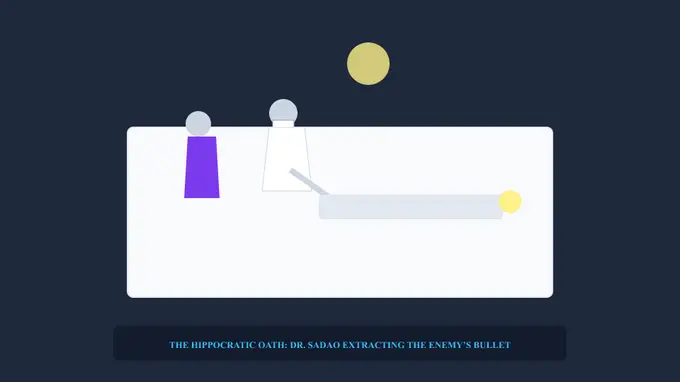
Operating with flawless surgical precision, Dr. Sadao explores the bullet wound near the patient’s right kidney. Despite viewing the man as an enemy of his nation, his trained surgeon’s fingers instinctively treat him with gentle care, addressing him unconsciously as “my friend.” With a masterstroke of his scalpel, Sadao extracts the bullet. The young American, named Tom, survives and begins to recover.

Dr. Sadao performing surgery on the wounded American soldier while Hana administers anesthetic

The Hippocratic duty: Dr. Sadao extracting the bullet near the kidney while Hana tends the anesthetic.

5. The Old General’s Promise & The Sleepless Nights

Conscious of treason, Sadao confesses the truth to the ailing Old General. The General, terrified that Sadao might be arrested before performing his own emergency heart surgery, promises to send his private assassins to quietly murder Tom at night and dispose of the body. For three consecutive nights, Sadao endures agonizing sleepless vigils, expecting the assassins. But nobody arrives—the General, completely self-absorbed in his own medical crisis, simply forgot his promise!

6. The Secret Escape & The Final Epiphany

Realizing he cannot live with the constant terror of murder, Dr. Sadao devises Tom’s escape:

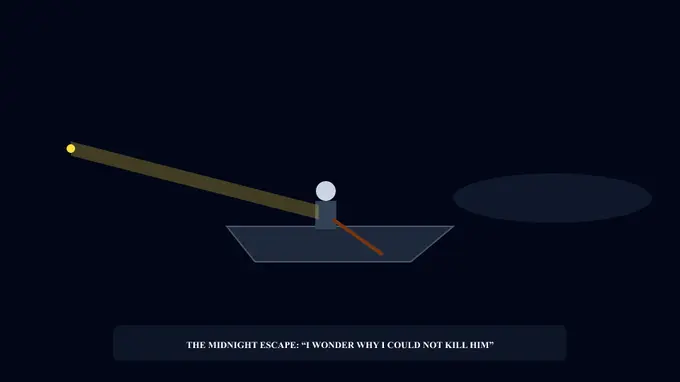
He equips Tom with a sturdy boat, bottled water, food, warm quilts, and a flashlight, directing him to row under cover of night to a nearby uninhabited island until a Korean fishing boat rescues him. Days later, no flashlight signal appears—Tom has safely escaped. Standing on his veranda gazing into the sea, Sadao reflects on all the white faces he had known in America, wondering with quiet bewilderment: “I wonder why I could not kill him.”

Tom in Japanese kimono disguise rowing into the midnight mist with flashlight signal from shore

The humanitarian escape: Tom rowing toward safety into the misty sea — “I wonder why I could not kill him.”

Key Grammatical Rules, Literary Devices & Core Principles

Ethical Paradox: Healer vs Patriot
Physician’s Hippocratic Oath (Universal Life) vs Wartime National Loyalty (State Security).
Pearl S. Buck’s core thematic conflict exploring the limits of national boundaries.
Character Contrast: Hana vs Domestic Servants
Hana = Moral courage, human dignity | Servants = Narrow racial superstition and fear.
Illustrates how true education fosters empathy beyond tribal nationalism.
Political Satire: The Old General’s Dereliction
General’s selfish hypochondria outweighs his military duty to execute an enemy POW.
Reveals how powerful military leaders prioritize personal survival over state ideology.
Metaphor of the Sea Fog
Misty coastal fog concealing the wounded soldier and the moral dilemmas of the house.
Symbolizes the ambiguity of human morality during the darkness of war.
Universal Motif: The Korean Fishing Boat
Escaping to international waters away from warring imperial empires.
Represents the possibility of human survival through solidarity beyond battle lines.
Closing Philosophical Soliloquy
“I wonder why I could not kill him.”
The triumphant realization that human empathy is deeper than learned wartime prejudice.

Conceptual Solved Examples & Case Studies

Example 1
There are moments in life when we have to make hard choices between our roles as private individuals and as citizens with a sense of national loyalty. Discuss with reference to the story. (Reading with Insight)
Step-by-Step Solution:

Dr. Sadao Hoki faces this ultimate moral crossroads when an injured American prisoner of war washes ashore on his private beach:

  1. As a Citizen: His patriotic loyalty to wartime Japan required him to report the American sailor to the military police, where the prisoner would face execution, or throw him back into the sea to drown. Harboring an enemy was treason punishable by death.
  2. As a Doctor & Private Individual: His professional medical training and human conscience compelled him to preserve human life regardless of race or nationality.
  3. Resolution: Sadao chose the universal duty of humanity. He operated, nursed the enemy back to health, and facilitated his escape, proving that when universal human sanctity clashes with artificial wartime nationalism, the preservation of life must triumph.
Example 2
Dr Sadao was compelled by his duty as a doctor to help the enemy soldier. What made Hana, his wife, sympathetic to him in the face of open defiance from the domestic staff? (Reading with Insight)
Step-by-Step Solution:

Hana supported and assisted her husband despite the servants’ revolt due to her innate human dignity and moral partnership with Sadao:

  1. Like Sadao, Hana had lived in America and understood that white people were flesh-and-blood human beings, not abstract monsters.
  2. When the servants abandoned the house in terror, Hana recognized that allowing a wounded man to bleed to death in their home was morally unthinkable. Despite nausea and fear, she cleaned the filthy soldier herself, stood beside Sadao in the operating room, and administered anesthetic, embodying unconditional empathy.
Example 3
What explains the attitude of the General in the matter of the enemy soldier? Was it human consideration, lack of national loyalty, dereliction of duty or simply self-absorption? (Reading with Insight)
Step-by-Step Solution:

The Old General’s attitude was driven almost entirely by extreme self-absorption and hypochondriacal fear:

  1. He trusted no other surgeon in Japan except Dr. Sadao to perform his delicate heart operation. Therefore, he could not afford to have Sadao arrested or executed for treason.
  2. He promised to send private assassins to kill Tom purely to relieve Sadao of the burden. However, when his health deteriorated, he completely forgot about the assassins because he was consumed with his own suffering. His failure was not humanitarian mercy, but pure selfish dereliction of duty.

Common Misconceptions & Examiner Traps

Common Misconception

Assuming Dr. Sadao supported America against Japan in the war.

Scientific Reality & Correction

Sadao was a loyal, patriotic Japanese citizen; he harbored the sailor purely out of medical ethics to prevent a wounded human being from dying.

Common Misconception

Thinking the domestic servants reported Dr. Sadao to the military police.

Scientific Reality & Correction

The servants packed their belongings and left in protest, but remained loyal enough not to inform the police, returning to the house after the American escaped.

Common Misconception

Believing the General spared the American soldier out of humanitarian mercy.

Scientific Reality & Correction

The General explicitly confessed that he forgot to send the assassins due to his own personal illness and self-absorption.

Chapter Summary & 10 Key Takeaways

Takeaway 1
Dr. Sadao Hoki: Eminent Japanese surgeon kept in Japan during WWII because the Old General might require surgery.
Takeaway 2
The Wounded Sailor: American Navy POW washes ashore bleeding from a bullet wound near his kidney.
Takeaway 3
The Moral Dilemma: Healer’s duty to save a life vs citizen’s duty to turn the enemy over for execution.
Takeaway 4
Servants’ Revolt: Domestics refuse to touch the American and desert the house; Hana bravely washes the patient.
Takeaway 5
Successful Surgery: Sadao extracts the bullet with surgical mastery, saving the young American’s life.
Takeaway 6
The General’s Lapse: General promises private assassins to kill the POW, but forgets due to self-absorbed illness.
Takeaway 7
The Secret Escape: Sadao provides Tom with a boat, food, and clothes to reach a rescue island safely.
Takeaway 8
Triumph of Humanity: Sadao looks out to sea, marveling that empathy conquered learned wartime hatred.

Check Your Understanding (Diagnostic Practice Questions)

Diagnostic questions testing core conceptual clarity. Answers are hidden initially — solve each problem first, then click to reveal the step-by-step verified solution.

1
Where did Dr. Sadao first meet his wife, Hana?
Reveal Answer & Explanation
Answer: In America, at Professor Harley’s house.
Professor Harley’s house in America.
2
What words were faintly written on the cap of the wounded American soldier?
Reveal Answer & Explanation
Answer: “U.S. Navy”.
U.S. Navy.
3
Which organ of the body was the bullet lodged near in the wounded soldier?
Reveal Answer & Explanation
Answer: Near his right kidney.
Right kidney.
4
Why did the domestic servants leave Dr. Sadao’s house?
Reveal Answer & Explanation
Answer: Because they refused to serve or shelter a white American enemy, viewing it as treason.
Refused to help the enemy.
5
How did the American soldier escape from Dr. Sadao’s house?
Reveal Answer & Explanation
Answer: In a private boat provided by Sadao with food, water, and clothing, rowing to an uninhabited island.
Private boat to an island.
Finished Studying This Chapter?
READY TO PRACTICE?

Timed CBT Practice Tests (Exam Simulator)

Put your concepts to the test with official curriculum-aligned Foundation and Advanced practice tests. Get instant accuracy scores, time metrics, and step-by-step verified explanations.

STAY UPDATED

Get the Latest Updates

New test series, syllabus updates, exam notifications and more.

Syllabus
Updates
Exam
Alerts
Study
Resources