Follow Us
झारखण्ड बोर्ड के छात्रों के लिए: क्या आप इस पाठ को सम्पूर्ण हिन्दी अनुवाद, सारांश और शब्दार्थ के साथ पढ़ना चाहते हैं?
हिन्दी में पढ़ें (Read in Hindi) →
JAC • Class XII • English • Ch 19
Estimated Time: 45 Mins
Study Progress: In Progress

Memories of Childhood

“Memories of Childhood” presents two deeply moving autobiographical episodes by two marginalized women writers from vastly different cultures and continents, united by their early awakening to institutional oppression and their fierce resistance against injustice. Part I, “The Cutting of My Long Hair” by Native American writer and activist Zitkala-Sa (Gertrude Simmons Bonnin, 1876–1938), recounts her traumatic assimilation ordeal at the Carlisle Indian Industrial School in Pennsylvania. Subjected to the militaristic regimentation of eating by bells and wearing stiff, immodest dresses, she is informed that her long, heavy hair will be shingled. In her Dakota culture, short hair was worn only by cowards and shingled hair by mourners. Despite hiding under a bed in defiance, she is dragged out, bound to a chair, and her braids are sheared off, reducing her to a beaten animal. Part II, “We Too are Human Beings” by acclaimed Tamil Dalit writer Bama (Faustina Soosairaj, born 1958; author of “Karukku”), recounts a formative childhood encounter with untouchability in a rural Indian village. Watching an elderly Dalit community member carry a packet of fried vadai by a string to avoid polluting the upper-caste Naicker landlord, Bama is initially amused. Her elder brother Annan shatters her innocence, explaining that Dalits are stripped of human dignity by caste discrimination. Annan imparts the life-altering advice that education is the ultimate weapon to destroy caste indignities. Bama studies with fierce determination, stands first in her class, and wins respect and equality.

✊ How can a child’s quiet rebellion shatter centuries of cultural and caste oppression?

From a Native American girl hiding under a boarding school bed to preserve her sacred braids, to an eight-year-old Tamil Dalit girl discovering that her people are forbidden to touch food packets. In “Memories of Childhood,” Zitkala-Sa and Bama prove that while tyranny crushes innocence, the seeds of rebellion are planted early in life.

Why This Chapter Matters

Prescribed as the final chapter of NCERT Class 12 English (Vistas), this paired text is an indispensable study in subaltern literature, post-colonial trauma, and social justice. It connects Native American cultural erasure with the systemic violence of India’s caste hierarchy. It regularly appears in board exams for questions comparing the two narratives, the symbolism of hair-cutting, Annan’s advice to Bama, and the transformative power of education.

Before You Begin (Prerequisites)

  • Historical context of Native American residential schools and cultural erasure policies in the US.
  • Socio-cultural structure of the Indian caste system and the stigma of untouchability.
  • Literary concepts: subaltern autobiography, comparative narratives, symbolism, cultural identity.

What You Will Learn (Core Objectives)

  • Analyze Zitkala-Sa’s experience of cultural dislocation at the Carlisle Indian Industrial School.
  • Deconstruct the cultural sanctity of long hair in Dakota tradition versus forced shingling.
  • Examine the regimentation of “eating by formula” through the tyranny of school bells.
  • Contrast Bama’s innocent childhood journey home from school with the sudden trauma of untouchability.
  • Evaluate Annan’s transformative counsel: education as the supreme vehicle for Dalit emancipation.
  • Synthesize the common thread of resistance uniting two distant subaltern cultures.

Chapter Roadmap & Progression

1 1. Zitkala-Sa: The Carlisle School...
2 2. The Cutting of the Long Hair: Cu...
3 3. Bama: The Innocent Walk Home fro...
4 4. The Packet of Vadai & The Realit...
5 5. Annan’s Counsel: Education as Em...

Complete Concept Guide (100% Curriculum Coverage)

1. Zitkala-Sa: The Carlisle School & Eating by Formula

VOICES OF RESISTANCE: MARGINALIZATION & REBELLION Zitkala-Sa’s cultural desecration vs. Bama’s realization of caste untouchability ✂️ Zitkala-Sa: The Cutting of My Long Hair The Carlisle Indian School Rigid regimentation; "eating by formula" with three bells; harsh squeaking shoes. Cultural Significance of Hair In Dakota tradition, shingled hair was worn only by cowards and captured mourners. The Desperate Rebellion Hiding under the bed in a dark corner; dragged out, tied to a chair, braids severed. Loss of Human Dignity: "I felt like one of many animals driven by a herder... tossed in the blanket." ✊ Bama: We Too Are Human Beings The Child’s Innocent Delight 10-minute walk stretched to 30 minutes; watching snake charmers, monkeys and sweets. The Packet of Vadai Elder carrying packet by string without touching; child laughs, then learns the horror. The Degradation of Untouchability Upper-caste belief in physical pollution; humiliating treatment of honest laborers. Annan’s Advice: Education as Freedom "Study hard, make progress, and people will attach themselves to you of their own accord."

The first day at the Carlisle Indian Industrial School was cold and bitter. Zitkala-Sa felt stripped of her dignity, forced to wear stiff shoes that clattered and tight-fitting, immodest dresses instead of soft moccasins and loose tribal robes. In the dining room, she experienced the humiliating absurdity of “eating by formula”: a small bell rang and pupils drew out their chairs; a second bell rang and they sat; a third bell rang and only then could they begin eating. Unfamiliar with this regimented discipline, she sat down on the first bell and felt acutely humiliated.

2. The Cutting of the Long Hair: Cultural Desecration

Her friend Judewin warned her that the pale-faced matrons intended to cut her long, heavy hair. In Native American Dakota culture, hair carried sacred spiritual significance: short hair was worn only by captured cowards, and shingled hair was the mark of mourners. Long hair was an emblem of brave warriors and cultural pride.

Defiance and Desecration:

Declaring she would not submit without a struggle, Zitkala-Sa slipped away and hid under a bed in a dark corner of an upstairs room. When discovered, she was dragged out, carried downstairs kicking and scratching, and tied fast to a chair. As the cold shears gnawed through her thick braids, she wept in agony: “I had lost my mother, and now I had lost my hair... I was only one of many little animals driven by a herder.”

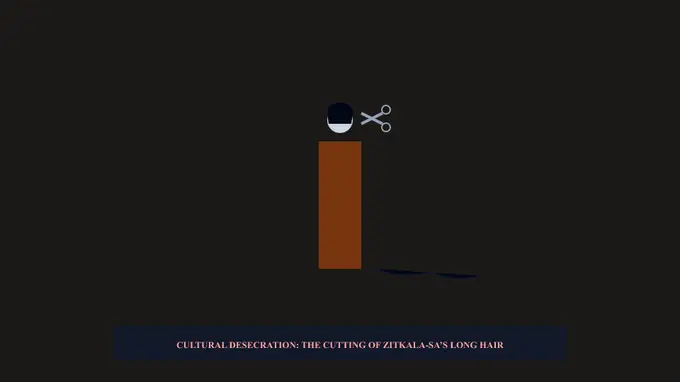
Zitkala-Sa tied to the chair, cold scissors severing her long Dakota braids on the floor

Cultural desecration: the cutting of Zitkala-Sa’s long hair, stripping her of native identity and dignity.

3. Bama: The Innocent Walk Home from School

In the second account, young Tamil Dalit schoolgirl Bama describes her daily walk home from school. Although the distance took only ten minutes, Bama would dawdle for thirty minutes to an hour, utterly enthralled by the vibrant street spectacles: performing monkeys, snake charmers with cobras, cycling cyclists demonstrating feats, pongal offerings, roadside puppet shows, and bazaar vendors selling mangoes, sugarcane, and halva.

4. The Packet of Vadai & The Reality of Untouchability

One afternoon, near the threshing floor, Bama saw an elderly, respected man from her community carrying a small parcel containing fried vadai by its string, holding it far away from his body without touching the wrapping. He bowed servilely before the upper-caste Naicker landlord seated on a stone ledge. Bama found his comical posture hilarious and recounted it to her elder brother, Annan, expecting him to laugh.

Annan did not laugh. He explained with quiet solemnity that the landlord belonged to an upper caste, and believed that if a Dalit touched the packet, the food would be polluted. Hearing the truth, Bama’s amusement dissolved into searing indignation: “Why should we have to fetch and carry for these people? We too are human beings!”

Young Bama in school uniform watching an elder carry a packet of vadai by a string without touching

The shock of untouchability: Bama watching an elder carry vadai by a string, learning of caste humiliation.

5. Annan’s Counsel: Education as Emancipation

Annan gave Bama life-defining advice on how to overcome caste indignities:

“Study with Care, Learn All You Can”:

“Because we are born into this community, we are never given any honour or dignity. But if we study and make progress, we can throw away these indignities. Study with care, learn all you can. If you are always ahead in your lessons, people will come to you of their own accord.” Annan’s words became Bama’s guiding light. She studied with fierce, tireless devotion, stood first in her class, and won the friendship and respect of everyone.

Key Grammatical Rules, Literary Devices & Core Principles

Cultural Motif: Sacred Braids vs Shingling
Long hair = Dakota warrior honor | Shingled hair = Mourners & cowards.
Forced hair shearing symbolized the violent erasure of Native American cultural identity.
Sociological Stigma: Untouchability via String
Carrying the vadai packet by its string to prevent caste pollution.
Visual manifestation of the dehumanizing ritual purity dogma of the caste system.
Institutional Oppression: Eating by Formula
Three bells regulating chairs, sitting, and eating at Carlisle school.
Symbolizes imperial boarding schools imposing mechanical conformity onto indigenous children.
Subaltern Assertion: “We Too are Human Beings”
Bama’s declaration of intrinsic human dignity against caste hierarchy.
The foundational realization driving Dalit rights movements and literature.
Emancipatory Formula: Annan’s Lesson
Education + Academic Excellence = Eradication of social indignities.
B.R. Ambedkar’s philosophy echoed in Bama’s personal educational triumph.
Comparative Subaltern Paradigm
Native American cultural assimilation (US) + Dalit caste discrimination (India).
Demonstrates that marginalization and resistance share universal psychological patterns.

Conceptual Solved Examples & Case Studies

Example 1
The two accounts that you read above are based in two distant cultures. What is the commonality of theme found in both of them? (Reading with Insight)
Step-by-Step Solution:

Despite originating in completely different cultures (Native American Dakota society in the United States and Dalit Tamil society in rural India), the two autobiographical accounts share profound thematic commonalities:

  1. Early Childhood Encounters with Systemic Oppression: Both Zitkala-Sa and Bama experience social injustice, marginalization, and humiliation at a very tender age.
  2. Dehumanizing Imposition: Zitkala-Sa is victimized by cultural assimilation, where the white boarding school strips her of her sacred hair, clothes, and dignity. Bama is victimized by the ancient, dehumanizing stigma of untouchability, watching elders forced to carry food by strings.
  3. Instinctive Moral Rebellion: Neither girl passively accepts her subjugation. Zitkala-Sa resists by hiding under the bed; Bama responds by channeling her indignation into fierce academic excellence, proving that subaltern resistance begins early in life.
Example 2
It may take a long time for oppression to be resisted, but the seeds of rebellion are sowed early in life. Do you agree that injustice in any form cannot escape being noticed even by children? (Reading with Insight)
Step-by-Step Solution:

Yes, children possess a pure, instinctive sense of fairness and natural dignity that immediately detects injustice:

  1. Zitkala-Sa immediately recognized that cutting her braids was not a haircut, but a violent assault on her tribal identity. Even though older pupils counseled submission, her spirit rebelled.
  2. Bama initially laughed at the spectacle of the elder carrying the vadai by a string, but the moment her brother explained the underlying caste prejudice, her laughter turned to righteous anger and defiance (“We too are human beings!”).
  3. Injustice cannot hide behind adult traditions; children perceive its cruelty clearly, planting the psychological seeds that blossom into lifelong activism.
Example 3
Bama’s experience is that of a victim of the caste system. What kind of discrimination does Zitkala-Sa’s experience depict? What are their responses to their respective situations? (Reading with Insight)
Step-by-Step Solution:

Zitkala-Sa’s Discrimination: Her experience depicts racial discrimination, cultural erasure, and forced assimilation. The white authorities at Carlisle systematically stripped indigenous children of their native language, religious practices, traditional clothing, and sacred hair to force them into European conformity.

Their Respective Responses:

  1. Zitkala-Sa’s Physical Defiance: She responded through direct physical resistance—refusing to submit, hiding under a bed in the dark, and fighting with kicks and scratches before being overpowered.
  2. Bama’s Intellectual Defiance: Guided by her brother Annan, Bama responded through academic excellence. She recognized that acquiring education was the most potent weapon to shatter caste barriers. She studied tirelessly, stood first in her class, and earned universal respect.

Common Misconceptions & Examiner Traps

Common Misconception

Assuming Zitkala-Sa willingly cut her hair to look like the other schoolgirls.

Scientific Reality & Correction

Zitkala-Sa resisted fiercely, hid under a bed, was dragged out, and had her hair forcibly shingled against her will.

Common Misconception

Thinking the elder carrying the vadai was playing a game or joking.

Scientific Reality & Correction

The elder was forced to hold the parcel by a string out of terrifying caste rules that dictated upper-caste food would be polluted by Dalit contact.

Common Misconception

Believing Annan advised Bama to fight the landlord physically.

Scientific Reality & Correction

Annan counseled Bama that education and academic progress were the only true, permanent ways to throw off caste indignities.

Chapter Summary & 10 Key Takeaways

Takeaway 1
Zitkala-Sa’s Carlisle Ordeal: Eating by three bells and forced to wear clattering stiff shoes and tight dresses.
Takeaway 2
Sacred Long Hair: In Dakota culture, short hair was for cowards and shingled hair for mourners.
Takeaway 3
Defiance Under the Bed: Hiding in the dark; dragged out, tied to a chair, weeping as her braids are sheared.
Takeaway 4
Bama’s Innocent Walk: Dawdling on the way home from school, captivated by street performers and bazaars.
Takeaway 5
The Vadai Packet: Watching an elder carry a food parcel by its string to prevent caste pollution of the landlord.
Takeaway 6
Righteous Indignation: Bama’s shock upon learning about untouchability: “We too are human beings!”
Takeaway 7
Annan’s Advice: Study with care, stand ahead in lessons, and use education to dismantle caste indignities.
Takeaway 8
Triumph Through Learning: Bama studies fiercely, stands first in class, and wins respect and equality.

Check Your Understanding (Diagnostic Practice Questions)

Diagnostic questions testing core conceptual clarity. Answers are hidden initially — solve each problem first, then click to reveal the step-by-step verified solution.

1
What was the name of the boarding school Zitkala-Sa was sent to?
Reveal Answer & Explanation
Answer: Carlisle Indian Industrial School.
Carlisle Indian Industrial School.
2
Who wore short hair in Zitkala-Sa’s Native American Dakota culture?
Reveal Answer & Explanation
Answer: Captured cowards (and shingled hair was worn by mourners).
Cowards and mourners.
3
Where did Zitkala-Sa hide when she learned they were going to cut her hair?
Reveal Answer & Explanation
Answer: Under a bed in a dark corner of a large room upstairs.
Under a bed.
4
What food item was the village elder carrying by a string in Bama’s narrative?
Reveal Answer & Explanation
Answer: A packet of fried vadai (or green banana bhajji).
Vadai packet.
5
What did Annan advise Bama was the only way to throw away caste indignities?
Reveal Answer & Explanation
Answer: To study with care, make progress, and learn all she could through education.
Study and education.
Finished Studying This Chapter?
READY TO PRACTICE?

Timed CBT Practice Tests (Exam Simulator)

Put your concepts to the test with official curriculum-aligned Foundation and Advanced practice tests. Get instant accuracy scores, time metrics, and step-by-step verified explanations.

STAY UPDATED

Get the Latest Updates

New test series, syllabus updates, exam notifications and more.

Syllabus
Updates
Exam
Alerts
Study
Resources