“Poets and Pancakes” by eminent Tamil author Asokamitran (1931–2017) is an affectionate, satirical, and richly detailed memoir of his years working at Gemini Studios in Madras (now Chennai). Founded in 1940 by movie mogul S.S. Vasan, Gemini Studios was one of the most influential film production houses in newly independent India. Through gentle irony and observant wit, Asokamitran peels back the glamorous facade of Indian cinema to expose the eccentric personalities, backstage hierarchy, and comedic absurdities of studio life. The narrative introduces readers to “Pancake”—the thick cosmetic brand imported by truckloads—and the make-up department housed in Robert Clive’s former stables, where actors endured “fiery misery” under blazing mirrors. Key figures include the embittered, middle-aged “office boy” who dreams of literary stardom; Kothamangalam Subbu, the versatile, sycophantic No. 2 whose boundless improvisational genius made him indispensable; the aloof Legal Adviser who inadvertently ended a talented actress’s career; and the surreal visits of Frank Buchman’s anti-communist Moral Re-Armament Army and English poet Stephen Spender.
🎬 What happens when truckloads of make-up and high English poetry collide in a 1950s Madras film studio?
Imagine sitting in an old stable cubicle cutting newspaper clippings all day while movie stars are plastered with truckloads of orange “Pancake” make-up and British poets deliver baffling lectures to Tamil stagehands. In “Poets and Pancakes,” Asokamitran delivers a masterclass in gentle humour, exposing the chaotic, warm-hearted machinery of India’s golden age of cinema.
Why This Chapter Matters
Prescribed as Chapter 6 of NCERT Class 12 English (Flamingo), “Poets and Pancakes” is a brilliant demonstration of prose satire, workplace caricature, and cultural commentary. It explores the interplay between cinema, politics, and post-war international propaganda (the Cold War cultural rivalries between Communism and the Congress for Cultural Freedom). It is a staple of board examinations for character sketches (Kothamangalam Subbu vs the Office Boy), the role of the Legal Adviser, and the mystery surrounding Stephen Spender’s visit.
Before You Begin (Prerequisites)
Historical context: Indian cinema in the 1940s–1950s, Gemini Studios, S.S. Vasan.
Cold War cultural politics: Moral Re-Armament (MRA), anti-communism, The God That Failed.
Literary concepts: memoir, satire, gentle irony, character foil, situational humour.
What You Will Learn (Core Objectives)
Analyze the functioning and strict hierarchy of the Gemini Studios make-up department.
Examine Kothamangalam Subbu’s multifaceted genius, loyalty, and role as the ultimate film troubleshooter.
Contrast Subbu’s cheerful success with the bitter, frustrated ambition of the middle-aged Office Boy.
Evaluate the tragicomic role of the Legal Adviser (the “story department lawyer”) in ending an actress’s career.
Deconstruct the visits of international groups: Frank Buchman’s MRA and English poet Stephen Spender.
Trace Asokamitran’s eventual discovery of Stephen Spender’s identity through the book “The God That Failed”.
Chapter Roadmap & Progression
11. The Make-Up Department & The “Pa...
22. The Strict Hierarchy and Nationa...
33. The Frustrated “Office Boy”
44. Kothamangalam Subbu: The No. 2 a...
55. The Legal Adviser & The Crushed...
66. The Moral Re-Armament (MRA) Army...
77. Stephen Spender’s Visit & The My...
Complete Concept Guide (100% Curriculum Coverage)
1. The Make-Up Department & The “Pancake” Brand
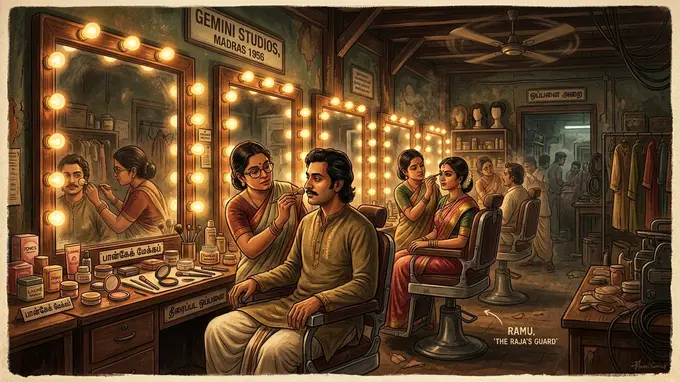
The title refers to Pancake, the famous brand-name of cosmetic foundation that Gemini Studios bought by the truckload. Stars like Greta Garbo and Vyjayanthimala used it, and the studio’s make-up team turned decent-looking people into hideous, crimson-hued monsters to look presentable on black-and-white celluloid. The make-up department was housed in the upstairs of a building believed to have been Robert Clive’s stables in Madras.
“Fiery Misery” in the Stables:
The make-up room was equipped with large mirrors reflecting dozens of incandescent lamps at all angles. The actors undergoing make-up endured literal “fiery misery” under the scorching heat of blazing lights.
The fiery misery of Robert Clive’s stables: technicians applying thick layers of Pancake makeup under scorching bulbs.
2. The Strict Hierarchy and National Integration
The make-up department was an early pioneer of national integration long before national broadcasting existed. Initially headed by a Bengali, succeeded by a Maharashtrian assisted by a Dharwar Kannadiga, an Andhra, a Madras Indian Christian, an Anglo-Burmese, and local Tamils.
Chief Make-up Man
Responsible for making the chief actors (heroes and heroines) look presentable.
Senior & Junior Assistants
The senior assistant handled the second hero; junior assistant worked on the main comedian.
The Office Boy
Assigned to slap paint on crowd players during crowd shooting using giant mixing vats.
3. The Frustrated “Office Boy”
The “office boy” was not a boy at all, but a man in his early forties. He had entered Gemini Studios decades earlier hoping to become a star actor, a top screen-writer, director, or lyricist. Embittered by failure, he viewed himself as an unappreciated literary genius and directed all his venom, jealousy, and anger toward one man: Kothamangalam Subbu.
4. Kothamangalam Subbu: The No. 2 at Gemini Studios
Subbu was the indisputable Number 2 at Gemini Studios, ranking right below the Boss (S.S. Vasan). A Brahmin by birth, he was perpetually cheerful, deeply loyal, and exceptionally creative:
The Master Troubleshooter:
Whenever a director was stuck saying, “I don’t know how to shoot this scene where a tigress comes out of the water,” Subbu would instantly offer four brilliant alternatives. If rejected, he would produce fourteen more within minutes! He wrote genuine poetry, a sprawling novel (Thillana Mohanambal), acted in difficult subsidiary roles, fed scores of relatives at his home, and never had a harsh word for anyone.
5. The Legal Adviser & The Crushed Actress
The studio’s Story Department included an official Legal Adviser (lawyer). While everyone wore white khadi dhotis and loose shirts, the lawyer wore pants, a tie, and a Western coat, looking lonely and coldly logical in a crowd of dreamers.
Unconscious Destruction of a Talent:
Once, a brilliant, highly emotional young actress threw a violent temper tantrum on set against the producer. The lawyer quietly switched on the recording equipment. When she finished exhausted, he played the tape back through the loudspeakers. Hearing her own shrill, unhinged fury echoing cold and naked struck her dumb with humiliation; she never acted again. The lawyer had effectively terminated her career unconsciously.
6. The Moral Re-Armament (MRA) Army Visit
In 1952, Frank Buchman’s Moral Re-Armament Army (MRA)—numbering some 200 persons from twenty nationalities—visited Madras. They were hosted lavishly at Gemini Studios. They staged two simple moral plays: Jotham Valley and The Forgotten Factor.
Though their moral messages were basic, their theatrical sets and stagecraft—especially the sunrise and sunset scenes with a bare stage, white background, and flute melody—mesmerized Madras theatre. For years, all Tamil plays imitated their sunrise scenes. Only later did Asokamitran realize the MRA was a counter-movement to international communism, and S.S. Vasan had played straight into their political hands.
7. Stephen Spender’s Visit & The Mystery of “The God That Failed”
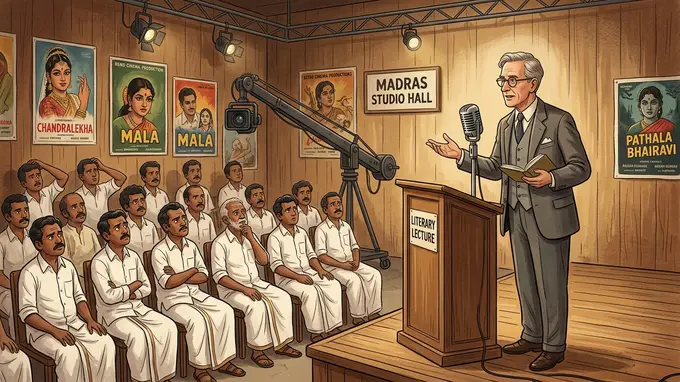
Soon after, another English visitor arrived: an English poet named Stephen Spender. Boss Vasan gave a welcoming speech praising poetry, and Spender addressed the crowd of Tamil technicians and clerks. His accent was so refined and British that no one understood a single syllable; the audience was left completely bewildered as to why an English poet was addressing Tamil stagehands making Tamil films.
Years later, out of Gemini Studios and low on money, Asokamitran saw low-priced paperback copies of “The God That Failed”—essays by six eminent writers (André Gide, Richard Wright, Ignazio Silone, Arthur Koestler, Louis Fischer, and Stephen Spender) describing their disillusionment with Communism. Seeing Spender’s name, the mystery snapped shut: Spender’s visit had been funded by the Congress for Cultural Freedom to warn artists away from Communism!
A study in bewilderment: English poet Stephen Spender lecturing an audience of Tamil film technicians dressed in khadi.
Shows Indian diversity cooperating harmoniously in an era before mass media unity.
Cold War Propaganda Paradigm
MRA & Stephen Spender = Western anti-communist cultural diplomacy in post-colonial Asia.
Studios were innocent playgrounds for global ideological warfare.
Symbolic Revelation: “The God That Failed”
The book resolving the enigma of Stephen Spender’s surreal visit to Madras.
Binds the localized world of Gemini Studios to 20th-century geopolitical literature.
Conceptual Solved Examples & Case Studies
Example 1
What does the writer mean by “the fiery misery” of those subjected to make-up? (Think as you read)
Step-by-Step Solution:
The phrase “fiery misery” refers to the extreme physical discomfort endured by actors in the make-up department of Gemini Studios. The make-up room was equipped with large mirrors reflecting dozens of incandescent lamps burning at all angles. The combined glare and intense heat radiating from these incandescent bulbs subjected the actors undergoing make-up to scorching heat and intense physical torture while cosmetic mixtures were applied to their faces.
Example 2
What is the example of national integration that the author refers to? (Think as you read)
Step-by-Step Solution:
The make-up department of Gemini Studios was an exemplary showcase of national integration long before All India Radio and Doordarshan began broadcasting national unity programs. The department was initially headed by a Bengali, who was succeeded by a Maharashtrian, assisted by a Dharwar Kannadiga, an Andhra, a Madras Indian Christian, an Anglo-Burmese, and usual local Tamils. People from diverse regions and religions collaborated seamlessly in crafting cinema.
Example 3
What work did the “office boy” do in the Gemini Studios? Why did he join the studios? Why was he disappointed? (Think as you read)
Step-by-Step Solution:
Work: On days when crowd shooting took place, the office boy mixed large quantities of Pancake make-up in a giant vat and slapped it onto the faces of crowd players.
Reason for Joining: He entered Gemini Studios decades earlier with grand ambitions of becoming a top actor, a leading screen-writer, director, or lyricist.
Disappointment: Despite possessing some literary talent, he remained relegated to the menial status of a 40-year-old make-up boy. He felt his creative genius was wasted on people who only knew how to paint faces.
Example 4
Why was the office boy frustrated? Who did he show his anger on? (Think as you read)
Step-by-Step Solution:
The office boy was bitterly frustrated because his lifelong dreams of becoming a prominent screen star, director, or writer were crushed, leaving him performing the mundane chore of slapping paint on crowd players. He directed all his jealousy, bitterness, and anger toward Kothamangalam Subbu, the No. 2 at Gemini Studios, whom he held solely responsible for all his misfortunes and neglect.
Example 5
Subbu is described as a many-sided genius. List four of his special abilities. (Think as you read)
Step-by-Step Solution:
Kothamangalam Subbu was an extraordinary, multifaceted creative talent:
Improvisational Troubleshooter: Whenever a director faced a creative roadblock, Subbu could instantly generate a dozen ingenious camera angles and scene solutions.
Accomplished Writer & Poet: He composed genuine, intricate Tamil poetry and authored the sprawling, highly acclaimed novel Thillana Mohanambal.
Talented Character Actor: He performed challenging subsidiary roles with far greater nuance and authenticity than the main lead actors.
Boundless Philanthropy: He had an open house where he fed and sheltered dozens of relatives and acquaintances without any expectation of reward.
Example 6
Why was the legal adviser referred to as the opposite of what he should have been? (Think as you read)
Step-by-Step Solution:
A legal adviser is traditionally employed to defend clients, resolve disputes, and protect people from legal and professional harm. In contrast, the lawyer at Gemini Studios inadvertently destroyed the promising career of a gifted young actress. By surreptitiously recording her hysterical emotional outburst against the producer and playing it back, he subjected her to unbearable humiliation that abruptly ended her acting career. Thus, he proved to be an instrument of destruction rather than legal protection.
Example 7
What caused the lack of communication between the Englishman and the people at Gemini Studios? (Understanding the text)
Step-by-Step Solution:
The complete failure of communication between Stephen Spender and the Gemini Studios staff was caused by a profound linguistic and cultural divide:
Language Barrier: Spender spoke in a sophisticated, upper-class British English accent, whereas the studio audience comprised simple Tamil-speaking stagehands, technicians, and clerks who barely understood conversational English.
Irrelevance of Subject: Spender was speaking passionately about the struggles and angst of high English modernist poetry and anti-communist ideology—topics utterly remote from the lives of people whose sole concern was making popular Tamil films.
Example 8
How does the author discover who the English visitor to the Studios was? (Understanding the text)
Step-by-Step Solution:
Years after leaving Gemini Studios, Asokamitran noticed a pile of low-priced paperbacks outside the Madras General Post Office selling for fifty paise each. The book was titled “The God That Failed,” containing six essays by distinguished writers (including Arthur Koestler, André Gide, Richard Wright, and Stephen Spender) detailing their initial attraction and subsequent disillusionment with Communism. Seeing Stephen Spender’s name on the cover, the puzzle snapped into place: the mysterious Englishman at Gemini Studios had been Stephen Spender, participating in a global cultural campaign against Communism!
Common Misconceptions & Examiner Traps
Common Misconception
Assuming Asokamitran was an actor or director at Gemini Studios.
Scientific Reality & Correction
Asokamitran worked in a cubicle tearing up newspaper clippings on all subjects to store in reference files, leading others to think he did no real work.
Common Misconception
Thinking the “office boy” was a teenager or young boy.
Scientific Reality & Correction
The office boy was an embittered man in his early forties who had spent decades at the studio hoping to become a star.
Common Misconception
Believing Gemini Studios was a political communist organization.
Scientific Reality & Correction
Gemini Studios was entirely non-political; staff members wore khadi out of simple patriotic habit without deep political convictions, which made them innocent hosts for both the MRA and Spender.
Chapter Summary & 10 Key Takeaways
Takeaway 1
Pancake Make-Up: Truckloads of cosmetic foundation used in Robert Clive’s stables under scorching incandescent lights.
Takeaway 2
National Integration: Make-up team composed of Bengalis, Maharashtrians, Kannadigas, Andhras, and Tamils working harmoniously.
Kothamangalam Subbu: Cheerful, loyal No. 2 with inexhaustible creative solutions for film directors and genuine literary talent.
Takeaway 5
The Legal Adviser: Lawyer who wore Western suits among khadi dreamers and inadvertently crushed an actress’s career.
Takeaway 6
The MRA Visit: 200-member anti-communist group whose scenic sunrise and sunset staging influenced Tamil theatre for years.
Takeaway 7
Stephen Spender’s Enigma: English poet delivering high-brow lectures to bewildered Tamil stagehands.
Takeaway 8
The God That Failed: Years later, Asokamitran solves the mystery of Spender’s visit through an essay collection on Communism.
Check Your Understanding (Diagnostic Practice Questions)
Diagnostic questions testing core conceptual clarity. Answers are hidden initially — solve each problem first, then click to reveal the step-by-step verified solution.
1
What was the brand name of the make-up material bought in truckloads by Gemini Studios?
Reveal Answer & Explanation
Answer: Pancake. Pancake.
2
Who founded Gemini Studios, and in which city was it located?
Reveal Answer & Explanation
Answer: S.S. Vasan, located in Madras (now Chennai). S.S. Vasan in Madras.
3
What novel did Kothamangalam Subbu write?
Reveal Answer & Explanation
Answer: Thillana Mohanambal. Thillana Mohanambal.
4
How did the Legal Adviser destroy the career of the talented young actress?
Reveal Answer & Explanation
Answer: He surreptitiously recorded her emotional temper tantrum and played the recording back over the loudspeakers, humiliating her so deeply that she quit acting. Recorded and replayed her tantrum.
5
Which international group presented the plays “Jotham Valley” and “The Forgotten Factor” in Madras?
Reveal Answer & Explanation
Answer: Frank Buchman’s Moral Re-Armament Army (MRA). Moral Re-Armament Army (MRA).
6
What was the title of the book that finally revealed Stephen Spender’s identity to Asokamitran?
Reveal Answer & Explanation
Answer: The God That Failed. The God That Failed.
Finished Studying This Chapter?
READY TO PRACTICE?
Timed CBT Practice Tests (Exam Simulator)
Put your concepts to the test with official curriculum-aligned Foundation and Advanced practice tests. Get instant accuracy scores, time metrics, and step-by-step verified explanations.