Follow Us
CBSE • Class XII • English • Ch 3
Estimated Time: 45 Mins
Study Progress: In Progress

Deep Water

“Deep Water” by William O. Douglas (1898–1980)—former Justice of the US Supreme Court and ardent environmentalist—is a stirring autobiographical testament to the indomitable human spirit. Excerpted from his acclaimed memoir “Of Men and Mountains,” the essay recounts Douglas’s terrifying childhood misadventure in the YMCA swimming pool in Yakima, Washington, where he narrowly escaped drowning after being hurled into the deep end by an older boy. The narrative vividly captures the psychological horror of asphyxiation, the paralyzing grip of hydrophobia, and the agonizing process of conquering panic through relentless, piece-by-piece discipline under a master instructor. Concluding with Franklin D. Roosevelt’s profound philosophical dictum—“All we have to fear is fear itself”—the chapter transcends personal trauma to become a universal meditation on courage, the illusion of death’s terror, and the triumphant reclamation of life.

🌊 Can you stare into the black abyss of death and train your mind to conquer terror?

Imagine being a frail eleven-year-old child thrown into nine feet of water, sinking into a silent, yellow void while your lungs burst and your limbs turn to stone. In “Deep Water,” William Douglas reveals how he overcame a near-fatal drowning experience to prove that terror exists only in the fear of death, while in true death there is peace.

Why This Chapter Matters

Prescribed in NCERT Class 12 English (Flamingo), “Deep Water” is celebrated for its masterful psychological realism, sensory imagery, and inspiring message of grit. It teaches students that fear is an acquired psychological impediment that can be dismantled methodically through perseverance. It is a recurring favourite in board examinations for analytical questions on the YMCA misadventure, the instructor’s pedagogy, and the philosophical significance of Roosevelt’s quotation.

Before You Begin (Prerequisites)

  • Geographical setting: Yakima River, YMCA pool, Cascade Mountains, Lake Wentworth.
  • Psychological awareness of phobias, childhood trauma, and somatic responses to near-drowning.
  • Literary appreciation of first-person introspective memoirs and motivational autobiographies.

What You Will Learn (Core Objectives)

  • Analyze the origins of Douglas’s aversion to water: the early California surf trauma at age 3–4.
  • Reconstruct the terrifying chronology of the YMCA misadventure and the 3 distinct underwater descent cycles.
  • Evaluate the somatic and psychological manifestations of extreme panic (paralysis, yellow light, suffocation, blacking out).
  • Deconstruct the instructor’s systematic, step-by-step methodology in “building a swimmer piece by piece.”
  • Follow Douglas’s independent validation across Lake Wentworth and Warm Lake to eliminate the last vestiges of fear.
  • Interpret the deeper philosophical dimension: Roosevelt’s maxim “All we have to fear is fear itself” and the sanctity of the will to live.

Chapter Roadmap & Progression

1 1. The Genesis of Aversion: The Cal...
2 2. The YMCA Pool & The Bully’s Misa...
3 3. The Three Descents: An Underwate...
4 4. The Traumatic Aftermath and Ruin...
5 5. The Instructor’s Craft: Building...
6 6. Independent Conquest: Lake Wentw...
7 7. Roosevelt’s Dictum: The Philosop...

Complete Concept Guide (100% Curriculum Coverage)

1. The Genesis of Aversion: The California Surf (Age 3–4)

Douglas’s deep-seated aversion to water began when he was just three or four years old. His father took him to the beach in California. As they stood together in the surf, a massive wave knocked young Douglas down and swept completely over him. Buried underwater, his breath was gone and he was gripped by terror. Though his father laughed reassuringly, the overpowering force of the ocean left a permanent scar on the boy’s psyche.

2. The YMCA Pool & The Bully’s Misadventure (Age 10–11)

Years later, Douglas decided to conquer his fear by learning to swim at the YMCA pool in Yakima. Unlike the treacherous Yakima River—which his mother continually warned had claimed countless lives—the YMCA pool was seemingly safe: shallow at two to three feet, gradually sloping to nine feet at the deep end. Equipped with water wings, Douglas felt confident until a fateful afternoon when he arrived early and sat alone by the quiet, tiled water.

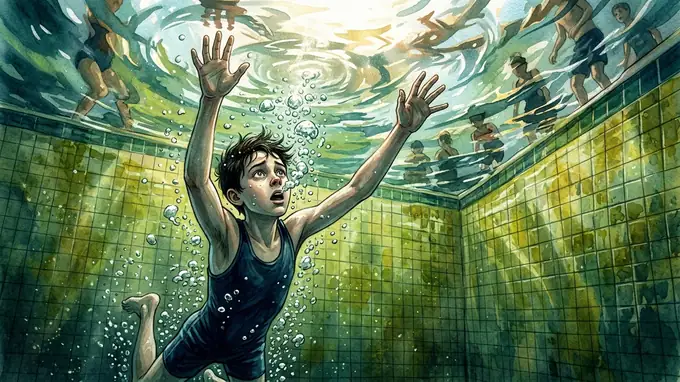
Frail eleven-year-old William Douglas submerged in the deep end of the YMCA swimming pool

Submerged into the nine-foot yellow abyss: William Douglas fighting for breath at the YMCA pool.

The Cruel Prank:

A muscular eighteen-year-old “big bruiser of a boy” approached, yelled “Hi, Skinny! How’d you like to be ducked?” and tossed the skinny eleven-year-old Douglas straight into the nine-foot deep end. Douglas landed in a sitting posture, swallowed gulps of water, and plummeted helplessly toward the tiled floor.

3. The Three Descents: An Underwater Nightmare

During the descent, Douglas retained enough presence of mind to formulate a survival strategy: when his feet touched the bottom, he would summon all his strength, make a giant spring upward, pop to the surface like a cork, lie flat, and paddle safely to the edge.

First Descent: Failed Spring
The nine feet felt like ninety. His lungs ached to bursting. His spring produced only a slow rise; opening his eyes, he saw only dirty yellow water. His hands clutched futilely for ropes. His nose and eyes surfaced, but not his mouth.
Second Descent: Stark Terror
He swallowed water and sank again. His legs hung rigid like dead weights. Stark terror seized him like an electric shock. He screamed, but only water heard him. A second jump failed, and the yellow light vanished.
Third Descent: The Peace of Death
Sucking for air, he sucked in water. Blackness extinguished all terror. A peaceful numbness washed over his body; no panic, no struggle. As the curtain of life fell, he slipped into tranquil unconsciousness.

4. The Traumatic Aftermath and Ruined Joy

Douglas awoke lying on his stomach beside the pool, vomiting water, while the older boy mumbled sheepishly, “I was only fooling.” That night, Douglas could neither eat nor sleep. For years afterward, the slightest exertion revived the terror, making his knees tremble and his stomach sick.

The haunting phobia ruined his youth: whenever he fished for landlocked salmon in Maine, trout on the Metolius, or bass in the Cascades, the icy grip of water paralyzed him. Canoeing, boating, and swimming were entirely forbidden by his terror. Finally, he decided he could bear it no longer.

5. The Instructor’s Craft: Building a Swimmer Piece by Piece

In October, Douglas hired a professional swimming instructor. Practicing five days a week, one hour each day, the instructor devised a meticulous, scientific pedagogical regimen:

Pulley & Belt Rig
A belt was attached around Douglas’s waist connected by a rope running through an overhead pulley on an overhead cable. For three months, he swam back and forth safely held by the instructor.
Breathing Coordination
Douglas was taught to submerge his face to exhale and raise his nose above water to inhale, repeating the exercise hundreds of times until panic subsided.
Leg Kicking Discipline
Holding the pool edge, he kicked his legs continuously for weeks until his rigid muscles finally obeyed his conscious command.

In April, after seven months, the instructor pronounced: “Now you can swim. Dive off and swim the length of the pool, crawl stroke.” Piece by piece, the instructor had built a swimmer.

6. Independent Conquest: Lake Wentworth & Warm Lake

Though the instructor was finished, Douglas’s personal quest was not. Tiny vestiges of the old terror returned when he swam alone in the empty pool. Addressing his fear defiantly—“Trying to scare me, eh? Well, look at this!”—he stroked away.

William Douglas swimming freely across Lake Wentworth under bright summer sunshine

Conquering the two-mile expanse across Lake Wentworth: total liberation from the phantom of fear.

In July, he traveled to New Hampshire and dived into Lake Wentworth at Stamp Act Island, swimming two miles across to Triggs Island using crawl, breaststroke, and backstroke. When terror returned in the middle of the lake, he laughed in its face. Later, at Warm Lake in the High Cascades, he stripped and swam across to the far shore and back. As he emerged, he shouted in pure ecstasy, and Gilbert Peak returned the triumphant echo: he had completely conquered his fear of water!

7. Roosevelt’s Dictum: The Philosophy of Fear and Freedom

Reflecting on his victory, Douglas extracts a profound philosophical truth accessible only to those who have faced stark terror and conquered it:

“All we have to fear is fear itself.” — Franklin D. Roosevelt

Douglas realized that in death there is absolute peace; terror exists exclusively in the anticipation and fear of dying. Because he had experienced both the sensation of dying and the terror that fear produces, his will to live grew exponentially in intensity. At last, he felt released—free to walk mountain trails, scale alpine peaks, and brush aside fear forever.

Key Grammatical Rules, Literary Devices & Core Principles

Psychological Maxim: Roosevelt’s Dictum
“All we have to fear is fear itself.”
Fear is a mental paralysis; in physical death there is peace, but in fear of death lies terror.
Metaphor of the Cork
Douglas’s futile underwater plan to pop to the surface like a buoyant cork.
Represents human optimism and rational logic clashing with the brutal physical laws of hydrodynamics.
Sensory Imagery: The Yellow Water & The Blackout
Dirty yellow light turning into total blackness and peaceful release.
Depicts the psychological stages of asphyxiation and transition into unconsciousness.
Pedagogical Model: “Piece by Piece”
Pulley/cable rig + Submersion breathing + Leg kick conditioning = Complete integrated swimmer.
Demonstrates that monolithic fears are overcome by isolating and mastering component sub-skills.
Auditory Symbol: Gilbert Peak Echo
Gilbert Peak returning Douglas’s shout of joy after swimming across Warm Lake.
Symbolizes nature acknowledging the human triumph of will over irrational phobia.
Autobiographical Motif: Rebirth and Release
From paralyzed invalid to intrepid mountaineer and US Supreme Court Justice.
Overcoming childhood trauma unlocked Douglas’s lifelong courage in law and environmental advocacy.

Conceptual Solved Examples & Case Studies

Example 1
What is the “misadventure” that William Douglas speaks about? (Think as you read)
Step-by-Step Solution:

The “misadventure” refers to the harrowing incident that occurred when ten-or-eleven-year-old William Douglas went to the YMCA swimming pool in Yakima. While sitting alone on the edge waiting for other boys to arrive, an eighteen-year-old muscular bully (“a big bruiser of a boy”) picked him up playfully and tossed him straight into the nine-foot deep end. Unable to swim, Douglas landed in a sitting posture, swallowed water, and nearly drowned after three agonizing, unsuccessful underwater attempts to spring to the surface, leaving him deeply traumatized for years.

Example 2
What were the series of emotions and fears that Douglas experienced when he was thrown into the pool? What plans did he make to come to the surface? (Think as you read)
Step-by-Step Solution:

Emotions & Fears:

  1. Initial shock and fear, yet he was not yet frightened out of his wits.
  2. As he descended, suffocation, dizziness, and lung-bursting panic set in.
  3. Upon failing his first jump, stark, paralyzing terror seized him like an electric charge, rendering his legs and vocal cords completely frozen.
  4. During the third descent, panic gave way to an uncanny, tranquil numbness—all effort ceased, the blackness closed in, and he experienced the peaceful sensation of dying.

Survival Plan: On his way down, Douglas rationally planned that when his feet struck the tiled floor, he would summon all his energy to make a great spring upward, pop to the surface like a buoyant cork, lie flat on the water, and paddle safely to the pool edge.

Example 3
How did this experience affect him? (Think as you read)
Step-by-Step Solution:

The YMCA misadventure inflicted severe, long-term psychological and physical damage:

  1. Immediate Physical Trauma: For days after being rescued, he was haunted by a lingering weakness, unable to eat, and wept uncontrollably in bed; the slightest physical exertion made his knees tremble and upset his stomach.
  2. Persistent Hydrophobia: A crippling dread of water gripped his mind, preventing him from enjoying water-based sports—fishing for salmon and trout, canoeing on lakes, and swimming.
  3. Emotional Deprivation: It cast a suffocating shadow over his youth, rendering him a prisoner to an irrational fear.
Example 4
Why was Douglas determined to get over his fear of water? (Think as you read)
Step-by-Step Solution:

Douglas was determined to conquer his hydrophobia because it systematically ruined his life and leisure. An avid lover of the wilderness, he found that whenever he visited scenic waters—such as the Cascades, the Metolius, or Bumping Lake—the icy grip of terror returned to paralyze his limbs. It robbed him of the pure joy of canoeing, boating, swimming, and fishing for salmon and bass. Refusing to live as a lifelong hostage to fear, he resolved to eradicate it completely.

Example 5
How did the instructor “build a swimmer” out of Douglas? (Think as you read)
Step-by-Step Solution:

The instructor built a swimmer “piece by piece” over seven months through a systematic, scientific training program:

  1. Pulley & Cable Apparatus: Fitted Douglas with a waist belt connected to a rope running through an overhead pulley on a steel cable, allowing him to swim back and forth across the pool with safety assurance.
  2. Breathing Mechanics: Taught him to put his face underwater to exhale and raise his nose above water to inhale, repeating this fundamental rhythm hundreds of times.
  3. Leg Conditioning: Made him hold the edge of the pool and kick his legs continuously for weeks until his stiff, paralyzed muscles relaxed.
  4. Integration: Once each component skill was perfected, the instructor integrated them into a seamless swimming stroke.
Example 6
How did Douglas make sure that he conquered the old terror? (Think as you read)
Step-by-Step Solution:

Douglas did not rely solely on the instructor’s clearance; he subjected himself to rigorous independent trials:

  1. He swam alone across the full length of the empty YMCA pool, confronting tiny vestiges of returning fear with defiant laughter.
  2. In July, he went to New Hampshire and dived into Lake Wentworth, swimming two miles across from Stamp Act Island to Triggs Island using various strokes (crawl, breaststroke, backstroke).
  3. Finally, he camped at High Meadows, dived into Warm Lake, and swam across to the opposite shore and back. When he emerged triumphant and Gilbert Peak echoed his celebratory shout, he knew with absolute certainty that his fear was conquered.
Example 7
How does Douglas make clear to the reader the sense of panic that gripped him as he almost drowned? Describe the details that have made the description vivid. (Understanding the text)
Step-by-Step Solution:

Douglas creates an unforgettable portrait of panic through visceral sensory imagery and psychological realism:

  1. Distortion of Time and Depth: Describing nine feet as feeling like “ninety feet,” evoking suffocating depth.
  2. Visual Imagery: The recurring nightmare of “dirty water with a yellowish tinge” that obscured all light.
  3. Somatic Paralysis: Physical descriptions of lungs aching, head throbbing with dizziness, and limbs hanging as “dead weights, paralyzed and rigid.”
  4. Auditory Helplessness: Screaming under water where “only the water heard me” and discovering that screams froze in his throat.
  5. The Shift to Peaceful Numbness: The chilling transition from wild panic to tranquil unconsciousness (“the curtain of life fell”) brings the reader directly into the experience of near-death.
Example 8
Why does Douglas as an adult recount a childhood experience of terror and his conquering of it? What larger meaning does he draw from this experience? (Understanding the text)
Step-by-Step Solution:

Douglas recounts this childhood ordeal because it carries a universal philosophical epiphany beyond a mere swimming lesson:

  1. The Nature of Fear vs Death: Having hovered on the precipice of death, Douglas discovered that in death there is absolute peace; the terror resides entirely in the fear of death.
  2. Roosevelt’s Wisdom: He validates President Roosevelt’s famous statement, “All we have to fear is fear itself.” Fear is an internal illusion that can be completely dismantled by willpower and disciplined action.
  3. Intensified Will to Live: Surviving the trauma caused his will to live to grow exponentially in strength and vibrancy, empowering him to live an intrepid, fearless life in public service and mountaineering.
Example 9
“All we have to fear is fear itself.” Discuss how this philosophy applies to everyday human challenges. (Talking about the text)
Step-by-Step Solution:
Roosevelt’s maxim encapsulates the profound psychological truth that our anticipatory dread of failure, rejection, or pain is far more debilitating than the challenge itself. When confronted with daunting obstacles—such as academic examinations, public speaking, career transitions, or personal adversity—panic magnifies difficulties and paralyzes our faculties, just as hydrophobia paralyzed Douglas. By confronting the root fear with rational deconstruction, disciplined preparation, and defiant resilience, the phantom of fear dissolves, leaving the individual liberated, empowered, and mentally invincible.

Common Misconceptions & Examiner Traps

Common Misconception

Thinking Douglas conquered his fear immediately when the instructor finished training him in April.

Scientific Reality & Correction

The instructor finished building the swimmer, but Douglas had to independently test himself in Lake Wentworth and Warm Lake to eliminate the remaining psychological traces of terror.

Common Misconception

Believing Douglas drowned in the Yakima River.

Scientific Reality & Correction

His mother warned him about the treacherous Yakima River; Douglas actually had his misadventure in the seemingly safe YMCA pool.

Common Misconception

Interpreting Roosevelt’s quotation as meaning death is terrible and frightening.

Scientific Reality & Correction

Douglas explicitly argues the opposite: in death there is complete peace and rest; only the fear of death generates terror.

The Psychology of Phobia & Mastery Over Terror in Deep Water

DEEP WATER: THE PSYCHOLOGY OF PHOBIA & CONQUEST OF FEAR William O. Douglas's 4-Stage Journey: From Paralyzing Hydrophobia to Indomitable Will 1. THE DROWNING TRAUMA YMCA Pool Misadventure • Big bruiser throws him in • Sinks 9 feet into void • Lungs ache, head throbs • Paralyzed yellow panic “Blackout curtain fell; In death there is peace.” 2. THE HAUNTING HANDICAP Years of Deprivation • Haunting terror returns • Ruined canoeing trips • Spoiled trout fishing • Deprived of swimming Turning Decision: Hires an instructor in Oct 3. SYSTEMATIC REBUILDING Piece-by-Piece Training • Belt attached to cable • Overhead pulley safety • Exhale under / inhale up • Weeks of leg kicking April Landmark: “Now you can swim!” 4. ABSOLUTE CONQUEST Lake Wentworth (2 Miles) • Dives off Triggs Island • Swims to Stamp Act • Confronts terror laughingly “Well, Mr Terror, what can you do to me?” Complete Liberation! Roosevelt's Dictum: “All we have to fear is fear itself.” Will to live always triumphs over death’s shadow.

Chapter Summary & 10 Key Takeaways

Takeaway 1
California Trauma: A childhood wave at age 3–4 knocked Douglas down, planting the subconscious seed of water aversion.
Takeaway 2
YMCA Misadventure: An 18-year-old bully hurled eleven-year-old Douglas into the 9-foot deep end of the pool.
Takeaway 3
Three Underwater Descents: Failed survival springs, paralyzing somatic terror, suffocation, and final surrender to peaceful blackout.
Takeaway 4
Years of Hydrophobia: Phobia ruined his youth, preventing fishing, boating, canoeing, and swimming in the Pacific Northwest.
Takeaway 5
The Instructor’s Method: Built a swimmer piece by piece over 7 months using a pulley/cable rig, breathing exercises, and kicking drills.
Takeaway 6
Defying Residual Doubts: Douglas practiced alone in the pool, mocking returning fear and commanding his limbs.
Takeaway 7
Conquest at Lake Wentworth & Warm Lake: Swam 2 miles across Lake Wentworth and conquered Warm Lake, echoed by Gilbert Peak.
Takeaway 8
Philosophical Release: Validated Roosevelt’s “All we have to fear is fear itself,” discovering peace in death and intensified will in life.

Check Your Understanding (Diagnostic Practice Questions)

Diagnostic questions testing core conceptual clarity. Answers are hidden initially — solve each problem first, then click to reveal the step-by-step verified solution.

1
At what age did Douglas experience his first childhood scare in the water, and where?
Reveal Answer & Explanation
Answer: At age three or four, at the beach in California, when waves knocked him down and swept over him.
California beach with father.
2
What was Douglas’s strategy while sinking to the bottom of the YMCA pool?
Reveal Answer & Explanation
Answer: To make a great jump when his feet hit bottom, pop to the surface like a cork, lie flat, and paddle to the edge.
Spring like a cork.
3
What sensation replaced panic during Douglas’s third descent into the water?
Reveal Answer & Explanation
Answer: A quiet, peaceful numbness and relaxation; the blackness wiped out all terror and fear as he lost consciousness.
Peaceful curtain of death.
4
How did the instructor ensure Douglas did not drown during early swimming lessons?
Reveal Answer & Explanation
Answer: He attached a belt around Douglas with a rope running through an overhead pulley on a cable spanning the pool.
Overhead pulley and cable harness.
5
Across which lake in New Hampshire did Douglas swim two miles to test his fear?
Reveal Answer & Explanation
Answer: Lake Wentworth, swimming from Stamp Act Island to Triggs Island.
Lake Wentworth.
6
What did Franklin D. Roosevelt say regarding fear, which Douglas cites at the conclusion?
Reveal Answer & Explanation
Answer: “All we have to fear is fear itself.”
Roosevelt’s famous inaugural quotation.
Finished Studying This Chapter?
READY TO PRACTICE?

Timed CBT Practice Tests (Exam Simulator)

Put your concepts to the test with official curriculum-aligned Foundation and Advanced practice tests. Get instant accuracy scores, time metrics, and step-by-step verified explanations.

STAY UPDATED

Get the Latest Updates

New test series, syllabus updates, exam notifications and more.

Syllabus
Updates
Exam
Alerts
Study
Resources