
Follow Us
CBSE • Class XII • English • Ch 2
Estimated Time: 45 Mins
Study Progress: In Progress

Lost Spring

“Lost Spring: Stories of Stolen Childhood” by renowned Indian author and journalist Anees Jung is a devastating sociological critique of generational poverty, child labour, and institutional neglect in contemporary India. Through poignant investigative vignettes, Jung documents the harrowing lives of millions of underprivileged children robbed of their spring—the joyful, formative years of youth and education. The narrative is bifurcated into two stark worlds: Part I profiles Saheb-e-Alam, a barefoot child migrant living among 10,000 ragpickers in Seemapuri on the squalid periphery of Delhi, where garbage is treated as “wrapped in wonder” and daily bread. Part II takes us into the blazing glass furnaces of Firozabad, India’s bangle-making capital, where 20,000 children sacrifice their eyesight welding glass bangles under toxic conditions, trapped in an inescapable web of moneylenders, middlemen, corrupt police, and politicians. Against this bleak fatalism shines the solitary, rebellious spark of Mukesh, who dares to dream of becoming a motor mechanic.

🗑️ Can a child whose name means “Lord of the Universe” ever escape the garbage heaps of Delhi?

Imagine bearing the grandiose name “Saheb-e-Alam” while scavenging barefoot through mountain heaps of urban garbage just to survive. In “Lost Spring,” Anees Jung takes readers into the hidden underbelly of Indian society—from the tin shanties of Seemapuri to the blinding glass furnaces of Firozabad—revealing how centuries of caste determinism, bureaucratic corruption, and systemic apathy conspire to steal the springtime of childhood.

Why This Chapter Matters

Prescribed as the second prose chapter of NCERT Class 12 English (Flamingo), “Lost Spring” is an indispensable text in modern Indian social literature. It confronts students with raw socio-economic realities—child labour, refugee displacement, bonded servitude, and the transformative power of literacy. The chapter regularly yields high-weightage extract analysis, character contrasts (Saheb vs Mukesh), and thematic questions on child rights in CBSE and State Board examinations.

Before You Begin (Prerequisites)

  • Historical background of the 1971 Bangladesh Liberation War and subsequent mass refugee migration to Delhi.
  • Socio-economic awareness of child labour laws in hazardous industries (Factories Act & Child Labour Prohibition Act).
  • Literary concepts: situational irony, hyperbole, metaphor, social realism, and contrast.

What You Will Learn (Core Objectives)

  • Deconstruct the profound situational irony behind the protagonist’s name “Saheb-e-Alam” (Lord of the Universe).
  • Contrast the dual perception of garbage in Seemapuri: “daily bread and survival” for desperate parents versus “wrapped in wonder” for children.
  • Trace Saheb’s tragic loss of autonomy: exchanging the light plastic ragpicking bag for the oppressive steel milk canister at the tea stall.
  • Examine the hazardous working conditions in Firozabad’s glass factories and the health catastrophe of premature blindness.
  • Analyze the vicious nexus (moneylenders, middlemen, policemen, keepers of law, bureaucrats, politicians) perpetuating generational bondage.
  • Evaluate Mukesh’s defiant ambition to become a motor mechanic as a courageous rupture from ancestral caste fatalism.

Chapter Roadmap & Progression

1 1. The Irony of Saheb-e-Alam: Scave...
2 2. The Barefoot Army and the Excuse...
3 3. Seemapuri: The Wilderness of 10,...
4 4. The Steel Canister: The Death of...
5 5. Firozabad: Blazing Furnaces and...
6 6. Savita, Auspicious Bangles, and...
7 7. The Two Oppressive Worlds and th...
8 8. Mukesh’s Defiant Dream: The Moto...

Complete Concept Guide (100% Curriculum Coverage)

1. The Irony of Saheb-e-Alam: Scavenging for “Gold”

Every morning, the author encounters a young barefoot boy scrounging through neighborhood garbage dumps for coins. When asked his name, he announces with quiet pride: “Saheb-e-Alam.” The author observes the painful, excruciating irony: if he knew its literal meaning—“Lord of the Universe”—he would have a hard time believing it! Instead of ruling worlds, this young king roams the burning streets of Delhi barefoot with an army of companion ragpickers who appear like morning birds and disappear by noon.
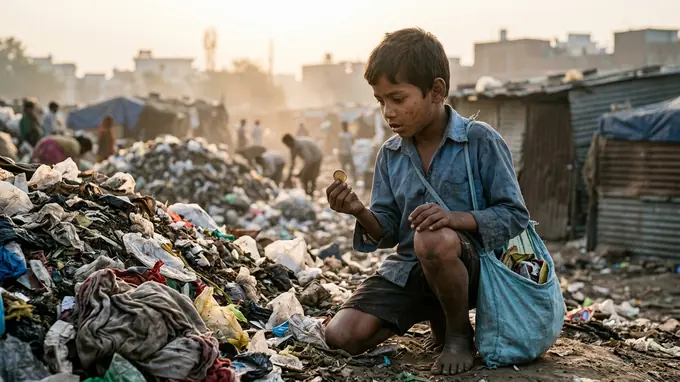
Barefoot young boy Saheb-e-Alam searching through garbage dump in Seemapuri

Saheb-e-Alam scrounging through garbage heaps for stray coins: “wrapped in wonder” amidst poverty.

The Hollow Promise of Education:

When the author casually asks, “Why don’t you go to school?” Saheb replies that there is none in his neighborhood. The author half-jokingly asks if he will attend if she starts one. A few days later, Saheb runs up breathlessly: “Is your school ready?” The author feels deeply embarrassed for making a promise that was never meant—yet recognizes that empty promises like hers abound in every corner of his bleak world.
2. The Barefoot Army and the Excuse of “Tradition”

Observing Saheb and his companions walking barefoot, the author enquires why they never wear chappals. One boy replies his mother did not bring them down from the shelf; another remarks that even if she had, he would throw them off. A third boy wears mismatched shoes discarded by a wealthy child due to a hole—to a boy who has always walked barefoot, even shoes with a hole are a dream come true!

The Udipi Priest’s Son Anecdote:

The author recalls a story from Udipi: thirty years ago, a young boy prayed to the goddess at a temple for a pair of shoes. Thirty years later, the author revisited the town—the priest’s new young son now wore socks and grey uniform shoes. The goddess had granted that prayer. Yet thousands of ragpickers like Saheb across India remain perpetually barefoot. Dismissing this deprivation as an ancient “tradition of walking barefoot” is merely a convenient intellectual excuse to mask chronic, grinding poverty.

3. Seemapuri: The Wilderness of 10,000 Dhaka Ragpickers

Seemapuri is a squalid settlement situated on the territorial periphery of Delhi, yet metaphorically miles away from its prosperity. Over 10,000 ragpickers have inhabited this wasteland since 1971, when sweeping storms devastated their green fields and homes in Dhaka, Bangladesh. They live in mud structures with roofs of tin and tarpaulin, devoid of sewage, drainage, or running water.

Identity vs Survival
They possess no legal permits, but hold ration cards that put their names on voters’ lists and enable them to buy grain. To them, food is far more essential for survival than an abstract identity.
Garbage: Wonder vs Bread
For the elders, ragpicking is pure livelihood (daily bread and shelter). For the children, garbage is “wrapped in wonder”—the thrilling possibility of finding a 1-rupee coin or a 10-rupee note keep their hopes alive.

4. The Steel Canister: The Death of Independence

One winter morning, the author spots Saheb on his way to the milk booth, holding a shiny steel canister. He has abandoned ragpicking to work at a roadside tea stall for ₹800 a month and all his meals. Yet the author notices with a pang of sorrow that his face has lost its vibrant, carefree look.

The Symbolic Weight of the Canister:

The heavy steel milk canister feels agonizingly heavier than the plastic bag he once slung over his shoulder. The bag belonged to him; the canister belongs to the tea shop master. Saheb-e-Alam is no longer his own master—he has traded his youthful freedom for wage slavery.

5. Firozabad: Blazing Furnaces and Blinded Childhoods

The scene shifts dramatically to Firozabad, the epicenter of India’s glass-blowing industry, where every other family is engaged in fabricating glass bangles for women across the subcontinent. Unknown to the residents, it is entirely illegal under Indian law for children to work in high-temperature glass furnaces with dim light and no ventilation.

The Horror of the Glass Cells:

Over 20,000 children slog during daylight hours around blazing furnaces in dark, suffocating cells. Their eyes adapt more readily to the darkness of the dingy rooms than to the natural light outside. As a devastating medical consequence, the majority lose their eyesight completely before reaching adulthood.

6. Savita, Auspicious Bangles, and the Stigma of Destiny

The author visits Mukesh’s dilapidated home through stinking, garbage-choked lanes lined with crumbling hovels. Inside, Mukesh’s sister-in-law (bahu) cooks frail meals on firewood. In another corner sits Savita, an adolescent girl in a drab pink dress, deftly soldering spirals of glass beside an elderly woman whose sight has failed.

The author marvels at the profound irony: Savita’s nimble hands work mechanically like machine tongs, unaware of the sacred cultural sanctity of the bangles she creates—symbolizing an Indian woman’s suhaag (matrimonial auspiciousness). The elderly woman beside her laments in broken tones that in her entire lifetime she never enjoyed even one full meal (“Ek waqt ser bhar khana bhi nahin khaya”). Her husband sighs that he knows nothing of bangles, but takes pride in having built a thatched roof over their heads.

7. The Two Oppressive Worlds and the Vicious Nexus

Listening to the hopeless resignation of the bangle-makers, the author discerns two distinct, inescapable socio-political prisons enclosing these children:

Prison 1: The Stigma of Caste & Karam
Born into the caste of bangle-makers, they are conditioned to believe that poverty and glass-welding are their predetermined ancestral destiny (karam), impossible to challenge.
Prison 2: The Vicious Circle of Exploitation
A ruthless syndicate of sahukars (moneylenders), middlemen, corrupt policemen, bureaucrats, and politicians. Whenever the youth attempt to form a cooperative union, they are assaulted, framed, and jailed by the police for “illegal activity.”

8. Mukesh’s Defiant Dream: The Motor Mechanic

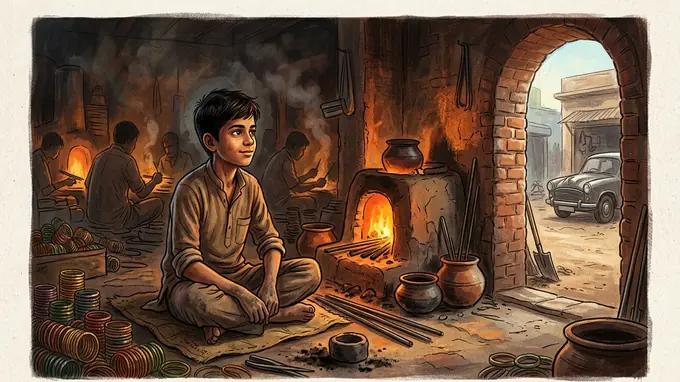
In this suffocating environment where daring is forbidden, the author detects a sudden, electrifying ray of hope in young Mukesh. Looking straight into the author’s eyes, Mukesh declares with unshakeable resolve: “I want to be a motor mechanic. I will go to a garage and learn!”

Young Mukesh in Firozabad glass bangle workshop dreaming of becoming a motor mechanic

Mukesh amidst the glowing glass furnaces of Firozabad: daring to dream of becoming a motor mechanic.

Grounded Defiance: Cars vs Planes:

When the author asks if the garage is far, Mukesh insists: “I will walk.” When asked if he also dreams of flying an airplane, Mukesh goes quiet and stares at the ground, murmuring a polite “No.” His dream is practical and grounded—he dreams of the motor cars he watches hurtling through Firozabad’s dusty streets. Few airplanes ever fly over the impoverished skies of Firozabad.

Key Grammatical Rules, Literary Devices & Core Principles

Situational & Verbal Irony: Saheb-e-Alam
Name means “Lord of the Universe” vs reality of scavenging garbage dumps.
Daudet and Jung utilize irony to highlight the tragic chasm between human dignity and socio-economic deprivation.
Dual Metaphor: Garbage in Seemapuri
Elders = “Daily bread and shelter” | Children = “Wrapped in wonder”.
To adults it is harsh material survival; to children it offers the magical anticipation of finding a rupee or coin.
Symbolic Contrast: The Plastic Bag vs Steel Canister
Light plastic bag = Personal freedom | Heavy steel canister = Bonded wage servitude.
At the tea stall, Saheb earns ₹800 but forfeits his independence and carefree childhood spirit.
Symbolic Paradox: Bangles of Firozabad
Sacred symbol of auspicious marriage (Suhaag) forged at the cost of children’s eyesight.
Those who craft radiance and marital fortune for the nation live in perpetual blindness and misery.
The Sociological Vicious Circle
Nexus: Sahukars + Middlemen + Policemen + Bureaucrats + Politicians.
Systemic institutional oppression preventing the formation of workers’ cooperatives in Firozabad.
Thematic Motif: Lost Spring
Spring = Season of bloom, joy, and youth | Lost Spring = Stolen childhood.
Poverty and exploitative child labour rob India’s underprivileged youth of education and growth.

Conceptual Solved Examples & Case Studies

Example 1
What is Saheb looking for in the garbage dumps? Where is he and where has he come from? (Think as you read)
Step-by-Step Solution:

Saheb is scrounging for “gold” in the garbage dumps—which metaphorically represents anything of monetary or survival value, such as stray coins, a ten-rupee currency note, discarded footwear, or recyclable plastic and metal scraps. He is currently residing in Seemapuri, an impoverished slum on the outer fringe of Delhi. Originally, he and his family hailed from the lush green fields of Dhaka, Bangladesh, which they were forced to abandon in 1971 after catastrophic storms and floods destroyed their homes and crops, leaving them destitute.

Example 2
What explanations does the author offer for the children not wearing footwear? (Think as you read)
Step-by-Step Solution:

The author observes multiple perspectives regarding the children’s lack of footwear:

  1. The Children’s Justifications: One boy remarks that his mother did not bring his chappals down from the shelf, while another claims he would have kicked them off anyway. A third boy wearing mismatched shoes simply finds immense joy in having any footwear, even with a hole.
  2. The Societal Rationalization: Many middle-class observers conveniently explain that walking barefoot is not due to lack of money, but represents an ancient “perpetual Indian tradition.”
  3. The Author’s Critical Verdict: The author strongly refutes the tradition argument, identifying it as a flimsy, comfortable rationalization used by privileged society to mask chronic, grinding, generational poverty.
Example 3
Is Saheb happy working at the tea-stall? Explain why or why not. (Think as you read)
Step-by-Step Solution:

No, Saheb is decidedly not happy working at the tea stall, despite receiving regular wages of ₹800 per month and all his meals. The author keenly observes that his face has lost its light-hearted, carefree radiance. While ragpicking, the plastic garbage bag belonged entirely to him, granting him complete personal autonomy. In contrast, the shiny steel milk canister belongs to the tea shop proprietor. The physical weight of the canister is emblematic of emotional enslavement: Saheb is no longer his own master, having traded his youthful freedom for commercial subjugation.

Example 4
What makes the city of Firozabad famous? Mention the hazards of working in the glass bangles industry. (Think as you read)
Step-by-Step Solution:

Firozabad’s Fame: Firozabad in Uttar Pradesh is world-renowned as the beating heart of India’s glass-blowing industry. Virtually every family in the city has spent generations working around fiery glass furnaces, manufacturing colourful bangles for women across the nation.

Hazards of the Industry:

  1. Extreme Temperatures & Toxic Air: Over 20,000 children work near blazing furnaces inside dark, airless, unventilated cells filled with toxic fumes and glass particles.
  2. Premature Blindness: Prolonged exposure to dark rooms causes the workers’ eyes to adapt to dimness rather than natural sunlight; the glare of welding glass dust severely damages corneas, causing the majority to lose their eyesight before reaching adulthood.
  3. Stunted Growth & Health Degradation: Working in cramped, crouching positions near intense heat leads to severe respiratory illnesses, burn scars, and premature physical aging.
Example 5
How is Mukesh’s attitude to his situation different from that of his family? (Think as you read)
Step-by-Step Solution:

Mukesh’s family and neighbours display an attitude of utter fatalism and passive resignation. They believe that being born into the caste of bangle-makers is their immutable destiny (their karam), and that creating bangles is the only trade ordained for them by fate.

In radical contrast, Mukesh dares to rebel against caste determinism. He looks straight into the author’s eyes with resolute conviction and declares: “I want to be a motor mechanic.” He refuses to accept the inherited burden of blindness and poverty, asserting his individuality by offering to walk miles to an automotive garage to learn an entirely independent trade.

Example 6
What could be some of the reasons for the migration of people from villages to cities? (Understanding the text)
Step-by-Step Solution:

The text highlights several profound socio-economic push and pull factors driving rural-urban migration:

  1. Natural Disasters & Agrarian Destitution: Like Saheb’s family in Dhaka, recurrent floods, storms, and droughts wipe out rural crops, destroying farming livelihoods and leaving families on the brink of starvation.
  2. Search for Basic Livelihood: Cities represent hope for food and daily bread. As Saheb’s mother states, living in a squalid city slum where one goes to bed without an aching, empty stomach is vastly preferable to starving amidst scenic rural fields.
  3. Aspiration for Modern Services: Migrants move toward urban centers hoping for employment opportunities, health infrastructure, and educational avenues for their offspring, even if those dreams often dissolve into informal slum settlements.
Example 7
Would you agree that promises made to poor children are rarely kept? Why do you think this happens in the incidents narrated in the text? (Understanding the text)
Step-by-Step Solution:

Agreement: Yes, promises made to underprivileged children are overwhelmingly hollow, casual, and routinely broken.

Reasons Highlighted in the Text:

  1. Casual Insincerity of the Privileged: When the author off-handedly asked Saheb if he would attend if she built a school, she spoke without serious commitment. Middle-class people frequently utter well-meaning platitudes to poor children without recognizing how desperately the child clings to that slender hope.
  2. Systemic Exploitation & Institutional Apathy: Society and government institutions make grandiose declarations about child rights, free education, and anti-child-labour legislation, yet politicians and bureaucrats treat poor children merely as invisible ciphers or vote banks. Consequently, empty promises abound in every corner of their bleak world.
Example 8
What forces conspire to keep the workers in the bangle industry of Firozabad in poverty? (Understanding the text)
Step-by-Step Solution:

Anees Jung exposes a deeply entrenched, dual-layered conspiracy that traps Firozabad’s workers in perpetual poverty:

  1. The Cultural Stigma of Caste: Bangle-makers are psychologically trapped by the fatalistic belief that poverty is their divine karam (karma), leading to complete apathy and paralysis of will.
  2. The Ruthless Vicious Syndicate: A powerful nexus consisting of sahukars (moneylenders) who charge exorbitant interest, predatory middlemen who pocket all profits, and corrupt policemen who physically assault and imprison any worker attempting to form an organized union.
  3. Administrative Complicity: Keepers of law, bureaucrats, and self-serving politicians ensure that labour laws prohibiting child labour are never enforced, permanently saddling children with a baggage they cannot put down.
Example 9
How, in your opinion, can Mukesh realise his dream of becoming a motor mechanic? (Talking about the text)
Step-by-Step Solution:

Mukesh can transform his dream into reality through a combination of personal fortitude and structural intervention:

  1. Unwavering Determination: Mukesh already possesses the core psychological foundation—he is clear-eyed, practical, and willing to walk long distances to the nearest garage.
  2. Vocational Skill Training & Mentorship: Enrolling in an apprentice program under a skilled mechanic or a government skill development initiative (such as PMKVY) will provide him with formal automotive expertise.
  3. Breaking Free from Family Debt: By severing ties with the ancestral glass furnaces and refusing moneylender loans, Mukesh can pave an independent financial path, inspiring other youth in Firozabad to shatter the cycle of generational bondage.
Example 10
Explain the literary significance of the title “Lost Spring”. Why does the author call childhood “Spring”? (Deep Analytical Question)
Step-by-Step Solution:

In literature, Spring universally symbolizes youth, rebirth, vitality, innocence, joy, and intellectual blooming. Just as spring is the most glorious and promising season of the year, childhood represents the formative, carefree springtime of human existence, meant for play, education, and boundless imagination.

By titling the work “Lost Spring,” Anees Jung employs a tragic, sorrowful metaphor: for millions of Indian children like Saheb and Mukesh, this precious springtime is brutally stolen by poverty, forced child labour, and social apathy. They are thrust into adult responsibilities, dingy slums, and hazardous furnaces long before they can ever blossom, rendering their spring forever lost.

Common Misconceptions & Examiner Traps

Common Misconception

Assuming Saheb took the tea-stall job out of career ambition or that he is happier now.

Scientific Reality & Correction

Saheb took the job purely out of financial desperation; the text explicitly notes his face lost its carefree look and the heavy steel canister represents the tragic loss of his personal freedom.

Common Misconception

Believing walking barefoot is genuinely an ancient Indian spiritual tradition among the ragpickers.

Scientific Reality & Correction

The author explicitly exposes the “tradition” claim as a convenient middle-class excuse to disguise perpetual, grinding poverty and institutional neglect.

Common Misconception

Confusing Mukesh’s dream of becoming a motor mechanic with an unrealistic fantasy of flying airplanes.

Scientific Reality & Correction

Mukesh explicitly rejects flying airplanes because his dream is pragmatic and grounded in the motor cars he observes in Firozabad, unlike unrealistic fantasies.

The Cycle of Stolen Childhood: Saheb (Seemapuri) vs Mukesh (Firozabad)

LOST SPRING: THE SOCIOLOGICAL FRAMEWORK OF STOLEN CHILDHOOD Anees Jung's Comparative Study of Seemapuri (Refugee Scavengers) vs Firozabad (Glass Bangle Bondage) PART I: SAHEB-E-ALAM (SEEMAPURI, DELHI) Irony of Identity: “Lord of the Universe” Barefoot child of Dhaka refugees; 10,000 ragpickers in mud shanties The Dual Meaning of Garbage: • For Elders: Daily bread, tin roof, bare survival • For Children: “Wrapped in wonder” (searching for coins) The Tragic Turning Point: The Steel Canister Leaves scavenging for roadside tea stall (₹800/mo + meals) Heavy canister belongs to master; he is no longer his own master! Tragic Outcome: Surrender to Wage Servitude Carefree look vanishes; loss of childhood independence PART II: MUKESH (FIROZABAD, UP) The Crucible of Glass: 20,000 Child Labourers Dingy cells, scorching furnaces; children go blind before adulthood The Two Imprisoning Webs: • Web 1: Stigma of caste & “Karam” (destined to make bangles) • Web 2: Vicious nexus of Sahukars, Police, Bureaucrats, Politicians The Rebellious Spark: “I Will Be a Motor Mechanic” Mukesh dares to break the ancestral cycle; will walk to a garage Dreams of motorcars hurtling in streets; practical and grounded Hopeful Outcome: The Courage to Dream A solitary glimmer of defiance against generational fatalism Central Thesis: While Saheb yields his liberty to economic survival, Mukesh preserves the human spirit by daring to break caste determinism.

Chapter Summary & 10 Key Takeaways

Takeaway 1
Saheb-e-Alam: Poignant irony of a boy whose name means “Lord of the Universe” scavenging barefoot in Delhi garbage dumps.
Takeaway 2
Seemapuri Slum: 10,000 Dhaka migrants surviving without drainage or sanitation since 1971; food and ration cards matter more than legal identity.
Takeaway 3
Dual Meaning of Garbage: Survival and daily bread for adult ragpickers; mystery and excitement “wrapped in wonder” for children.
Takeaway 4
The Tea Stall Servitude: Saheb earns ₹800 but loses his carefree independence, symbolized by the heavy steel milk canister.
Takeaway 5
Firozabad Glass Industry: 20,000 children working illegally around blazing furnaces in dark, suffocating cells, courting blindness.
Takeaway 6
Savita & The Bangles: Mechanical hands soldering auspicious bridal bangles (suhaag) while living in perpetual malnutrition and squalor.
Takeaway 7
The Vicious Syndicate: Sahukars, middlemen, corrupt police, and politicians actively suppress any attempt to form workers’ cooperatives.
Takeaway 8
Mukesh’s Defiance: Daring to dream beyond caste destiny by aspiring to become a motor mechanic and walk to a garage to learn.

Check Your Understanding (Diagnostic Practice Questions)

Diagnostic questions testing core conceptual clarity. Answers are hidden initially — solve each problem first, then click to reveal the step-by-step verified solution.

1
What is the literal translation of the name “Saheb-e-Alam” and why is it ironic?
Reveal Answer & Explanation
Answer: It means “Lord of the Universe.” It is deeply ironic because Saheb is a destitute, barefoot ragpicker wandering garbage heaps for survival.
Ruler of the cosmos vs scavenger of trash.
2
How many ragpickers live in Seemapuri, and where did they originate from?
Reveal Answer & Explanation
Answer: Over 10,000 ragpickers, who migrated from Dhaka, Bangladesh in 1971 after storms destroyed their fields.
Dhaka storms in 1971.
3
Why does the steel milk canister feel heavier to Saheb than his plastic garbage bag?
Reveal Answer & Explanation
Answer: Because the canister belongs to the tea shop owner, symbolizing servitude and loss of freedom, whereas the bag belonged to him.
Ownership and loss of autonomy.
4
What severe physical disability commonly afflicts child workers in Firozabad’s glass factories before adulthood?
Reveal Answer & Explanation
Answer: Loss of eyesight (blindness), caused by welding glass in dark unventilated cells and constant exposure to furnace glare.
Eye damage in dark furnaces.
5
What happens if the bangle-makers of Firozabad attempt to organize themselves into a cooperative?
Reveal Answer & Explanation
Answer: They are hauled up, beaten, and dragged to jail by the police for allegedly doing something illegal.
Police brutality and suppression.
6
Why does Mukesh remain silent when the author asks if he also dreams of flying an airplane?
Reveal Answer & Explanation
Answer: Because his ambition is grounded and realistic; he is content to dream of cars that run on the streets, whereas planes rarely fly over Firozabad.
Practical realism vs distant fantasy.
Finished Studying This Chapter?
READY TO PRACTICE?

Timed CBT Practice Tests (Exam Simulator)

Put your concepts to the test with official curriculum-aligned Foundation and Advanced practice tests. Get instant accuracy scores, time metrics, and step-by-step verified explanations.

STAY UPDATED

Get the Latest Updates

New test series, syllabus updates, exam notifications and more.

Syllabus
Updates
Exam
Alerts
Study
Resources