
Follow Us
CBSE • Class XII • English • Ch 15
Estimated Time: 45 Mins
Study Progress: In Progress

The Tiger King

“The Tiger King” by celebrated Tamil writer and political satirist Kalki (R. Krishnamurthy, 1899–1954) is a brilliant, biting political satire on the arrogance, vanity, and mortal conceit of rulers, set against the backdrop of colonial princely India. The story recounts the eccentric life and fatalistic downfall of the Maharaja of Pratibandapuram, Sir Jilani Jung Jung Bahadur. Upon his birth, chief royal astrologers prophesied that the infant prince was born under the hour of the Bull, and because the Bull and Tiger are enemies, his death would come from a tiger. Miraculously, the ten-day-old infant spoke articulate words of defiance: “Let tigers beware!” Grown to manhood, the King embarked on a ruthless quest to slaughter one hundred tigers to defy fate. Along the way, he banned tiger hunting for citizens, bribed a British officer’s wife with fifty diamond rings worth three lakh rupees to save his throne, and married a princess purely for her state’s tiger population. Having killed ninety-nine tigers, the King’s obsession blinded him to reality—the hundredth tiger was a toothless beast brought secretly from Madras that merely fainted from the bullet’s shock. In a crowning stroke of dramatic irony, the prophecy was fulfilled not by a ferocious wild predator, but by a cheap, poorly carved wooden toy tiger whose microscopic wood splinter infected the King’s hand, proving that no human tyrant can outwit destiny.

🐅 Can a king kill ninety-nine ferocious tigers and still be assassinated by a wooden toy?

Imagine a royal despot who spends his entire life waging war against wild tigers to disprove an astrologer’s prophecy, only to meet his doom in the nursery of his three-year-old son. In “The Tiger King,” Kalki uses sparkling wit and devastating dramatic irony to expose the folly of human power and the arrogance of exploiting nature.

Why This Chapter Matters

Prescribed as Chapter 2 of NCERT Class 12 English (Vistas), “The Tiger King” is a classic study in political parody, dramatic irony, and ecological ethics. It satirizes the sycophancy of courtiers, the absurd privileges of colonial-era princely rulers, and humanity’s callous subjugation of innocent wildlife. It is a frequent staple in board exams for questions on dramatic irony, the British officer’s wife episode, the dewan’s comedic panic, and the symbolic significance of the wooden toy tiger.

Before You Begin (Prerequisites)

  • Historical setting: British Raj, princely states of India, royal privileges and British Residents.
  • Literary concepts: dramatic irony, political satire, parody, hyperbole, foil characters.
  • Ecological context: trophy hunting, wildlife extermination, human vanity versus natural order.

What You Will Learn (Core Objectives)

  • Analyze the miraculous infancy of the Tiger King and the astrologer’s prophecy.
  • Deconstruct the satire on colonial princely upbringings (English cows, tutors, films).
  • Examine the political diplomacy: sending 50 diamond rings to the British officer’s wife to save his throne.
  • Analyze the absurd utilitarian marriage: selecting a bride based strictly on her state’s tiger population.
  • Trace the comedy of the 100th tiger: the Madras circus tiger fainting from bullet shock.
  • Evaluate the dramatic irony of the climax: the microscopic wood sliver of a toy tiger causing fatal sepsis.

Chapter Roadmap & Progression

1 1. The Miraculous Infant & The Astr...
2 2. The Royal Upbringing & The First...
3 3. The British Officer & The Fifty...
4 4. Marriage for Tigers: The Hunt fo...
5 5. The Fainting Hundredth Tiger of...
6 6. Dramatic Irony: The Wooden Toy T...

Complete Concept Guide (100% Curriculum Coverage)

1. The Miraculous Infant & The Astrologer’s Prophecy

When the Crown Prince of Pratibandapuram was born, royal astrologers predicted that although the child would grow into a warrior of warriors and hero of heroes, he must one day die. Suddenly, an extraordinary miracle occurred: the ten-day-old infant spoke with distinct clarity! Rebuking the astrologers for stating the obvious—that all who are born must die—the infant demanded to know the manner of his death.
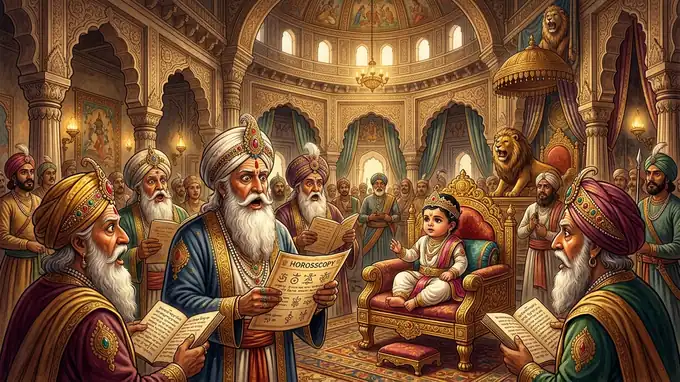
Ten-day-old infant prince defying royal astrologers in Pratibandapuram palace

The ten-day-old infant prince miraculously speaks and issues his famous defiance: “Let tigers beware!”

The Prophecy of the Bull & Tiger:

The chief astrologer explained that the prince was born under the hour of the Bull. Since the Bull and the Tiger are cosmic enemies, death would come from a tiger. Far from trembling, the royal infant let out a deep growl: “Let tigers beware!”
2. The Royal Upbringing & The First Kill

Like other Indian princely heirs under the British Raj, the boy drank the milk of an English cow, was tutored in English by an Englishman, and watched only English films. At age twenty, he was crowned Maharaja. Remembering the prophecy, he killed his first tiger and summoned the chief astrologer in triumph. The astrologer bowed: “Your Majesty may kill ninety-nine tigers in exactly the same manner. But you must be very careful with the hundredth tiger!”

3. The British Officer & The Fifty Diamond Rings

The King issued a royal decree banning tiger hunting by anyone else in the state; anyone throwing even a stone at a tiger would have all property confiscated. Soon, a high-ranking British officer (a durai) visited, passionate about hunting tigers and being photographed holding a gun over a tiger carcass. The Maharaja refused permission. Facing the imminent danger of losing his throne for offending the Crown, the King devised a diplomatic bribe:

He ordered fifty diamond rings of varied designs from a famous British jeweler in Calcutta and sent them to the officer’s wife (the duraisani), expecting her to select one or two. Instead, she kept all fifty and sent a polite note: “Thank you very much for your lovely gifts.” The bill came to three lakh rupees, but the Maharaja was delighted that he had saved his kingdom!

4. Marriage for Tigers: The Hunt for Ninety-Nine

Within ten years, the Maharaja had shot seventy tigers, exhausting the tiger population of Pratibandapuram. Undaunted, he summoned his Dewan and instructed him to draw up statistics of tiger populations in neighbouring princely states and find a royal princess to marry whose father owned vast forest lands. The strategy succeeded: each time the King visited his in-laws, he shot five or six tigers, eventually reaching ninety-nine tiger skins adorning his reception hall!

5. The Fainting Hundredth Tiger of Madras

Only one tiger remained to complete the tally of one hundred, but tigers were extinct even in his father-in-law’s forests. The King grew feverish with rage, doubling land taxes and dismissing officials. Terrified for his own life, the elderly Dewan secretly retrieved an old, decrepit tiger from the People’s Park in Madras, hauled it in the backseat of his car into the forest, and abandoned it near the King’s hunting camp.

The next day, the King took careful aim and fired; the beast crumpled to the ground. The Maharaja celebrated in wild ecstasy and ordered a grand royal funeral. But after the King departed, the hunters inspected the carcass and discovered that the bullet had missed! The decrepit tiger had merely collapsed from the shock of the gunshot! Afraid of the King’s wrath, a hunter shot the tiger at point-blank range, killing it secretly.

6. Dramatic Irony: The Wooden Toy Tiger’s Revenge

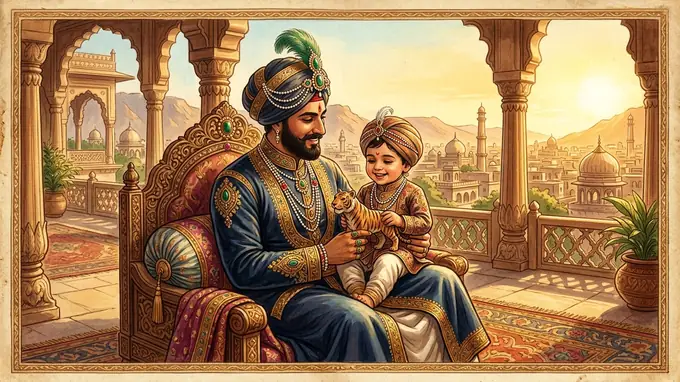
Free from anxiety, the Maharaja turned his attention to his three-year-old son’s birthday. Wishing to give him a special gift, he purchased a cheap, handcrafted wooden toy tiger from a local shop for two annas and a quarter (though the shopkeeper charged three hundred rupees to avoid punishment). The wooden tiger was roughly carved by an unskilled carpenter, its surface covered in tiny, protruding wood slivers.

The Maharaja playing with his son holding the rough wooden toy tiger

The King celebrates his son’s third birthday with a crude wooden tiger whose tiny sliver delivers the fatal 100th blow.

Sepsis & The Surgical Climax:

While playing with his son, one tiny wood sliver pierced the King’s right hand. He pulled it out and continued playing. The next day, severe infection developed; within four days, it flared into a suppurating, gangrenous sore that spread up his entire arm. Three famous surgeons were summoned from Madras. They operated for hours, emerged from the theater, and announced: “The operation was successful. The Maharaja is dead.” In this manner, the hundredth tiger took its final revenge.

Key Grammatical Rules, Literary Devices & Core Principles

Primary Literary Device: Dramatic Irony
King believes he killed 100 wild tigers vs death caused by a wooden toy splinter.
Kalki’s masterpiece device exposing the futility of human pride against destiny.
Political Satire: The Duraisani’s 50 Rings
Bribing the British officer’s wife with ₹3 lakh worth of diamonds to keep his throne.
Mocks the corrupt, sycophantic survival tactics of colonial-era princely rulers.
Satirical Motif: Utilitarian Marriage
Marrying a princess purely for her father’s forest tiger population.
Exposes the commodification of royal relationships driven by megalomania.
Farce & Parody: The Madras Circus Tiger
Decrepit zoo tiger fainting from the sound of gunfire.
Transforms the King’s supposed heroic climax into an absurd, pathetic farce.
Ecological Critique: Callous Extermination
Slaughtering 99 innocent wild animals to soothe an individual human ego.
Condemns the anthropocentric conceit of destroying wildlife for sport and vanity.
Black Humour: The Surgeons’ Proclamation
“The operation was successful. The Maharaja is dead.”
Capping the narrative with brilliant medical satire on clinical triumph over life.

Conceptual Solved Examples & Case Studies

Example 1
The story is a satire on the conceit of those in power. How does the author employ the literary device of dramatic irony in the story? (Reading with Insight)
Step-by-Step Solution:

Kalki masterfully employs dramatic irony—where the reader and characters know contradictory truths—to expose the absurd conceit of the Maharaja:

  1. The Fainting 100th Tiger: The King rejoices that he has conquered destiny by shooting his hundredth tiger. However, the reader knows that the decrepit tiger merely fainted from the bullet’s acoustic shock, and that a subordinate hunter secretly killed it. The King’s triumph is an utter illusion.
  2. The Instrument of Death: Having survived encounters with 99 ferocious, man-eating beasts, the King meets his death from an inanimate, two-anna wooden toy tiger. A tiny, microscopic wood sliver causes fatal infection, fulfilling the prophecy in the most humiliating, anti-climactic manner possible.
Example 2
What is the author’s indirect comment on subjecting innocent animals to the willfulness of human beings? (Reading with Insight)
Step-by-Step Solution:

Kalki presents a searing ecological critique of humanity’s callous, anthropocentric subjugation of wildlife:

  1. The Maharaja slaughters ninety-nine majestic, innocent tigers not out of self-defense, food necessity, or community safety, but purely to soothe his personal vanity and prove an astrologer wrong.
  2. Nature eventually avenges this ecological massacre: human arrogance is laid low by the symbolic spirit of the tiger manifested in a crude wooden toy, demonstrating that nature cannot be tyrannized indefinitely.
Example 3
How would you describe the behaviour of the Maharaja’s minions towards him? Do you find them truly sincere towards him or are they driven by fear? (Reading with Insight)
Step-by-Step Solution:

The courtiers, Dewan, and hunters display abject sycophancy rooted entirely in terror rather than genuine loyalty:

  1. When the King’s fury escalates, officials praise his reckless whims to save their jobs and lives. The astrologer only reveals the full truth when pressured.
  2. The Dewan secretly procures an old tiger from Madras because he fears execution if the hundredth tiger is not found.
  3. When the hunters discover that the hundredth tiger was not killed by the King, they conceal the truth and shoot the animal themselves out of terror. Their servility mirrors the spineless flattery found in autocratic political regimes.
Example 4
How did the Maharaja manage to retain his throne when threatened by the British high-ranking officer? (Reading with Insight)
Step-by-Step Solution:

When the British officer was denied permission to hunt tigers or pose with a carcass, the Maharaja faced the threat of losing his kingdom. He resolved the crisis through lavish financial bribery:

  1. He ordered fifty exquisite diamond rings from a premier British jeweler in Calcutta and dispatched the entire collection to the officer’s wife (the duraisani).
  2. She greedily kept all fifty rings and sent a note of thanks. The bill came to a staggering three lakh rupees, but the Maharaja gladly paid it, celebrating that he had successfully preserved his royal throne.

Common Misconceptions & Examiner Traps

Common Misconception

Assuming the Maharaja actually killed the hundredth tiger with his rifle.

Scientific Reality & Correction

The King’s bullet missed; the old tiger fainted from the shock of the sound, and a subordinate hunter shot it later to hide the truth from the King.

Common Misconception

Believing the wooden toy tiger was expensive or beautifully crafted.

Scientific Reality & Correction

It was a cheap, poorly carved two-anna toy with rough wood slivers; the shopkeeper overcharged three hundred rupees only out of fear of punishment.

Common Misconception

Thinking the astrologer’s prophecy failed.

Scientific Reality & Correction

The prophecy proved 100% accurate: the hundredth tiger (represented by the wooden toy) caused the King’s death.

Dramatic Irony & Fate Trajectory in The Tiger King

THE TIGER KING: THE ANATOMY OF DRAMATIC IRONY & FATE How Kalki Uses 4 Stages of Satirical Narrative to Subvert Human Pride STAGE 1: THE PROPHECY 10-Day-Old Prodigy • Born in hour of the Bull • Bull & Tiger are enemies • Death decreed by Tiger Royal Infant Defiance: “Let tigers beware!” Astrologer warns: 100th! STAGE 2: 99 SLAUGHTERS Ego-Driven Tyranny • Hunting banned for public • Bribed Duraisani: ₹3 Lakh (50 diamond rings) • Strategic Marriage for tiger-rich forests 99 Tigers Exterminated STAGE 3: THE 100TH FARCE Illusion of Triumph • Dewan brings old circus tiger from Madras park • King fires: BULLET MISSES! • Beast faints from sound • Servants kill it in secret King assumes he won STAGE 4: RETRIBUTION The Wooden Tiger • Gift for son’s 3rd birthday • Rough uncarved sliver • Pierces King’s right hand • Lethal bacterial sepsis “Operation successful; Maharaja is dead!” Key Takeaway: Fate cannot be outmaneuvered by autocratic power, bloodlust, or political wealth.

Chapter Summary & 10 Key Takeaways

Takeaway 1
The Astrologer’s Prophecy: Infant prince prophesied to die by a tiger; the ten-day-old infant miraculously speaks defiance.
Takeaway 2
The Royal Upbringing: Tutored in English, drinks milk of an English cow, crowned Maharaja at age twenty.
Takeaway 3
The Vow of Extermination: Kills his first tiger; astrologer warns him to beware of the hundredth tiger; bans hunting for all citizens.
Takeaway 4
Bribery of the Duraisani: Sends 50 diamond rings worth ₹3 lakh to the British officer’s wife to save his throne.
Takeaway 5
Marriage for Tigers: Marries a princess with vast tiger forests to slaughter tigers, reaching a tally of ninety-nine.
Takeaway 6
The Madras Zoo Tiger: Dewan procures an old tiger from People’s Park; King fires, but the beast only faints; hunters secretly shoot it.
Takeaway 7
The Wooden Toy Splinter: King buys a cheap wooden toy tiger for his son’s birthday; a tiny wood sliver pierces his hand.
Takeaway 8
The Fatal Sepsis: Sepsis spreads across his arm; surgeons operate, and the hundredth tiger takes its final revenge.

Check Your Understanding (Diagnostic Practice Questions)

Diagnostic questions testing core conceptual clarity. Answers are hidden initially — solve each problem first, then click to reveal the step-by-step verified solution.

1
At what age did the infant prince miraculously speak in Pratibandapuram?
Reveal Answer & Explanation
Answer: At ten days old.
Ten days old.
2
Under which astrological star was the prince born, making the tiger his cosmic enemy?
Reveal Answer & Explanation
Answer: The star of the Bull.
The Bull.
3
How much did the fifty diamond rings sent to the British officer’s wife cost?
Reveal Answer & Explanation
Answer: Three lakh rupees (₹3,00,000).
Three lakh rupees.
4
From where did the Dewan procure the hundredth tiger?
Reveal Answer & Explanation
Answer: From the People’s Park in Madras (Chennai).
People’s Park in Madras.
5
What caused the fatal infection in the Maharaja’s hand?
Reveal Answer & Explanation
Answer: A tiny, rough wood sliver from a cheap wooden toy tiger.
Wood sliver from a toy tiger.
Finished Studying This Chapter?
READY TO PRACTICE?

Timed CBT Practice Tests (Exam Simulator)

Put your concepts to the test with official curriculum-aligned Foundation and Advanced practice tests. Get instant accuracy scores, time metrics, and step-by-step verified explanations.

STAY UPDATED

Get the Latest Updates

New test series, syllabus updates, exam notifications and more.

Syllabus
Updates
Exam
Alerts
Study
Resources