“On the Face of It” by contemporary British playwright and novelist Susan Hill (born 1942) is a deeply moving, transformative two-character drama exploring physical disability, social alienation, and the psychology of loneliness. The play revolves around an accidental encounter in a secluded garden between two contrasting individuals: Derry (Derek), a bitter, hyper-sensitive 14-year-old boy whose half-face was permanently disfigured by acid, and Mr. Lamb, an elderly, eccentric amputee who lost his real leg in a wartime bomb blast and walks on an artificial tin leg (“Lamey-Lamb”). While Derry has retreated behind a psychological wall of anger, convinced that the entire world recoils from his hideous face, Mr. Lamb lives in a house without curtains, welcoming anyone who enters. Through patient, gentle dialogue, Mr. Lamb dismantles Derry’s self-pity, teaching him that physical beauty is merely on the surface (“on the face of it”)—true life resides in what one sees, hears, and thinks. When Derry finally breaks free from his mother’s overprotective control to return to the garden, he discovers that Mr. Lamb has fallen from his ladder while picking crab apples and lies dead on the grass. Though Derry weeps over his fallen mentor, his spirit has been permanently healed and emancipated.
🍏 Can a lonely old man with a tin leg teach a boy with an acid-burned face how to love life?
Imagine hiding from the entire world because half your face is melted by acid, believing nobody will ever kiss you except your mother on the unburned cheek. In “On the Face of It,” Susan Hill brings two outcasts together in a sunny garden to show that physical scars are nothing compared to the walls we build inside our minds.
Why This Chapter Matters
Prescribed as Chapter 5 of NCERT Class 12 English (Vistas), this play is a sensitive exploration of disability studies, adolescent alienation, and the transformative power of compassionate mentorship. It teaches empathy toward differently-abled individuals and exposes the cruelty of casual social prejudice. It is a recurring high-weightage topic in board exams for character sketches (Derry vs Mr. Lamb), the symbolism of weeds and apples, and the play’s tragicomic climax.
Literary concepts: symbolism, character foils, psychological transformation.
What You Will Learn (Core Objectives)
Analyze Derry’s deep psychological trauma stemming from his acid-burned face.
Deconstruct Mr. Lamb’s inclusive worldview: the open garden, houses without curtains, and embracing weeds.
Evaluate the parables shared by Mr. Lamb: the timid man who locked himself in a room, and the beauty of bees buzzing/humming.
Trace Derry’s emotional evolution from aggressive defensiveness to trust and hope.
Examine Derry’s confrontation with his mother as an assertion of newfound independence.
Interpret the poignant ending: Mr. Lamb’s death and Derry’s irreversible spiritual emancipation.
Chapter Roadmap & Progression
11. The Garden Intrusion: Derry’s Bi...
22. Mr. Lamb’s Philosophy: Weeds and...
33. Lamey-Lamb & The Tin Leg
44. The Story of the Timid Man
55. The Defiant Return & The Tragic...
Complete Concept Guide (100% Curriculum Coverage)
1. The Garden Intrusion: Derry’s Bitter Isolation
Fourteen-year-old Derry sneaks into a large, overgrown garden by climbing over the boundary wall, believing the property to be deserted. He is startled when Mr. Lamb, the elderly owner, speaks gently from the crab-apple tree. Derry reacts with fierce, hostile panic, assuming he is about to be scolded. He explains bitterly that he did not come to steal apples—he came because he hates being around people who stare at him with revulsion.
The Acid Trauma:
Derry’s left face was eaten away by acid. He is haunted by cruel comments from strangers—such as a woman whispering at a bus stop: “Look at that, that’s a terrible thing. That’s a face only a mother could love!” Derry believes that no girl will ever kiss him, and that even his mother kisses only the unburned right side of his face.
2. Mr. Lamb’s Philosophy: Weeds and Curtains
Mr. Lamb does not display shock or pity toward Derry’s face. Instead, he shares his eccentric, open-hearted philosophy:
Weeds are Flowers
Mr. Lamb points out that green weeds are living plants just like flowers. The difference between a weed and a flower is purely an arbitrary label created by human prejudice.
No Curtains on Windows
Mr. Lamb has no curtains in his house because he dislikes shutting things out. He loves the light, the darkness, and the sound of wind and rain.
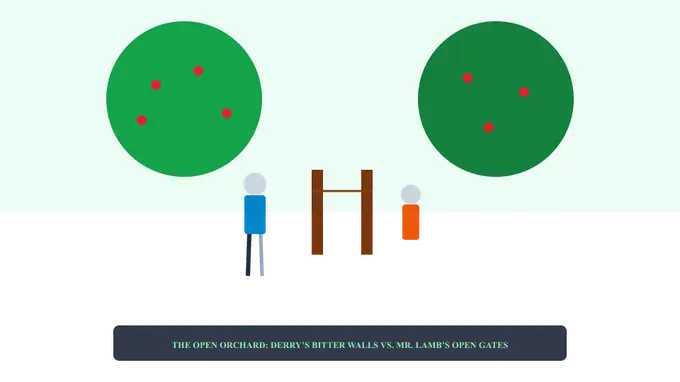
The open orchard: Mr. Lamb welcoming Derry, preaching the philosophy of weeds, flowers, and open gates.
3. Lamey-Lamb & The Tin Leg
Mr. Lamb reveals that he has a tin leg, having lost his real leg blown off in a war years ago. Children in the street mockingly taunt him as “Lamey-Lamb,” but it does not distress him: “Lamey-Lamb suits me. It doesn’t hurt!” He points out that he can cover his tin leg with trousers, but even if people notice, what matters is not what one looks like on the outside, but what one chooses to feel inside.
4. The Story of the Timid Man
To help Derry understand the folly of isolation, Mr. Lamb tells him a tragicomic parable:
A man was terrified of everything in the world—afraid a bus might run him over, a donkey might kick him to death, lightning might strike him, or he might slip on a banana skin and be laughed at. So he locked himself in his bedroom, climbed into bed, and stayed there forever. Derry asks, “Forever?” Mr. Lamb replies: “For a while. Then a picture fell off the wall onto his head and killed him!” Derry bursts into genuine laughter—the first crack in his emotional armor.
5. The Defiant Return & The Tragic Climax
Inspired by Mr. Lamb, Derry promises to return after informing his mother. Back home, his mother angrily forbids him from returning to the eccentric old man’s house. But Derry fiercely defies her: “If I don’t go back there, I’ll never go anywhere in the world again!”
The Fallen Ladder:
Derry runs breathlessly all the way back to the garden, only to hear a sickening creak and crash. Mr. Lamb’s ladder has slipped while picking crab apples; the old man lies dead on the grass with his tin leg twisted. Kneeling beside him, Derry weeps bitterly: “I came back, Lamey-Lamb. I did come back!” Though his mentor has passed away, Derry’s soul has been permanently freed from the prison of self-loathing.
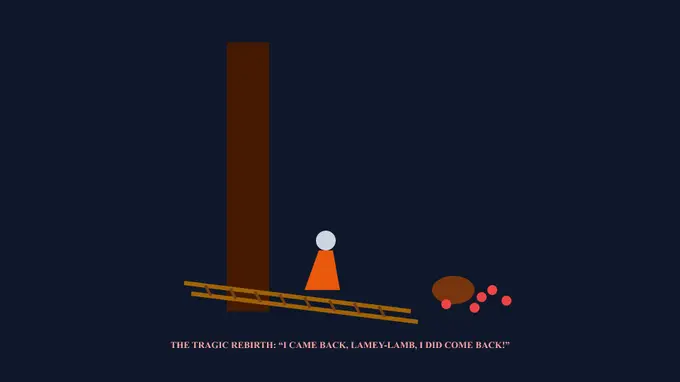
The tragic climax: “I came back, Lamey-Lamb, I did come back!” — Derry reborn through transformative grief.
Superficial outward appearances vs inward spiritual reality.
Outer physical scars do not define true human character and worth.
Botanical Metaphor: Weeds vs Flowers
Weeds are living green growing life just like flowers.
Demonstrates that differences in value are artificial constructs of human prejudice.
Architectural Symbol: Houses Without Curtains
Living with open windows to let in light, wind, and visitors.
Symbolizes an open, inclusive, non-judgmental mind embracing the world.
Character Dynamic: Mutual Emancipation
Mr. Lamb needs Derry to alleviate loneliness | Derry needs Mr. Lamb to overcome self-hatred.
Two wounded souls finding mutual redemption across generational divides.
Parable of the Timid Man
The man who locked himself in a room to escape death and was killed by a picture.
Teaches that self-isolation to avoid emotional pain guarantees spiritual death.
Tragicomic Climax: The Fallen Ladder
Mr. Lamb dies physically, but Derry is born spiritually into freedom.
Highlights the bittersweet triumph of human transformation surviving physical mortality.
Conceptual Solved Examples & Case Studies
Example 1
What is it that draws Derry towards Mr Lamb in spite of himself? (Reading with Insight)
Step-by-Step Solution:
Derry is drawn toward Mr. Lamb by several unique qualities that he had never encountered in any other adult:
Absence of Pity or Revulsion: Unlike others who stared with horror or spoke in patronizing tones, Mr. Lamb treated Derry completely normally, neither flinching from his burnt face nor offering hypocritical sympathy.
Inspirational Philosophy: Mr. Lamb’s positive outlook on life—treating weeds as flowers, listening to bees singing, and keeping doors open—challenged Derry’s bitter cynicism.
Shared Vulnerability: Knowing that Mr. Lamb also possessed a physical disability (a tin leg) and was taunted as “Lamey-Lamb” made Derry feel understood and respected.
Example 2
In what sense is the friendship between Mr Lamb and Derry fruitful? (Reading with Insight)
Step-by-Step Solution:
The friendship is profoundly fruitful and transformative for both characters:
For Derry: It completely cures his self-hatred, bitterness, and social paranoia. Mr. Lamb liberates him from his psychological prison, empowering him to defy his overprotective mother and claim his rightful place in the world.
For Mr. Lamb: It breaks through his agonizing, silent loneliness. Having Derry enter his garden and promise to return gives the elderly man a rare taste of genuine human friendship and purpose before his death.
Example 3
What is the significance of the title “On the Face of It”? (Reading with Insight)
Step-by-Step Solution:
The idiom “on the face of it” means superficial outward appearance before deeper examination:
On the face of it, Derry appears to be a frightening, hideous monster due to his acid-burnt cheek, but internally he is a sensitive, vulnerable boy longing for love and acceptance.
On the face of it, Mr. Lamb appears to be a jolly, eccentric old man with an open garden, but internally he battles deep, silent loneliness and physical disability.
The title serves as a moral reminder that human worth must never be judged by external physical appearance, but by inward character.
Common Misconceptions & Examiner Traps
Common Misconception
Assuming Derry was born with a deformed face.
Scientific Reality & Correction
Derry was not born disfigured; acid was spilled over half his face, burning it away permanently.
Common Misconception
Thinking Mr. Lamb was bitter or angry about being called “Lamey-Lamb”.
Scientific Reality & Correction
Mr. Lamb cheerfully embraced the nickname, noting that it didn’t hurt him and that it suited an old man with a tin leg.
Common Misconception
Believing Derry returned to find Mr. Lamb alive and they lived together happily.
Scientific Reality & Correction
The play has a tragic climax: Derry returns to find that Mr. Lamb has fallen from his ladder while picking apples and died on the grass.
Chapter Summary & 10 Key Takeaways
Takeaway 1
Garden Intrusion: Fourteen-year-old Derry snatches into Mr. Lamb’s garden seeking isolation from stares.
Takeaway 2
Acid Trauma: Half of Derry’s face melted by acid; haunted by cruel comments that only his mother could love him.
Takeaway 3
Weeds & Flowers: Mr. Lamb teaches that all growing things are life; difference is merely in human prejudice.
Takeaway 4
Lamey-Lamb: The old man reveals his tin leg from the war, refusing to let children’s taunts darken his soul.
Takeaway 5
The Timid Man Parable: A man who locked himself in a room to escape danger is killed by a falling picture.
Takeaway 6
Defying His Mother: Derry returns home and fiercely rebels against his mother’s ban to run back to the garden.
Takeaway 7
The Tragic Fall: Arrives to find Mr. Lamb dead beside the fallen ladder, weeping yet permanently emancipated in spirit.
Check Your Understanding (Diagnostic Practice Questions)
Diagnostic questions testing core conceptual clarity. Answers are hidden initially — solve each problem first, then click to reveal the step-by-step verified solution.
1
How old is Derry, and how was his face disfigured?
Reveal Answer & Explanation
Answer: He is 14 years old, and half of his face was burned away by acid. 14 years old, acid burn.
2
What artificial limb does Mr. Lamb have, and why?
Reveal Answer & Explanation
Answer: A tin leg, because his real leg was blown off in a war bomb explosion. Tin leg from the war.
3
Why does Mr. Lamb have no curtains on the windows of his house?
Reveal Answer & Explanation
Answer: Because he dislikes shutting things out; he loves the light, darkness, and sound of wind. Dislikes shutting things out.
4
What fruit does Mr. Lamb pick in his garden to make jelly?
Reveal Answer & Explanation
Answer: Crab apples. Crab apples.
5
How does Mr. Lamb die at the end of the play?
Reveal Answer & Explanation
Answer: He falls from his ladder while picking crab apples in his garden. Fell from the ladder.
Finished Studying This Chapter?
READY TO PRACTICE?
Timed CBT Practice Tests (Exam Simulator)
Put your concepts to the test with official curriculum-aligned Foundation and Advanced practice tests. Get instant accuracy scores, time metrics, and step-by-step verified explanations.