
Follow Us
CBSE • Class XII • English • Ch 1
Estimated Time: 45 Mins
Study Progress: In Progress

The Last Lesson

“The Last Lesson” by French novelist Alphonse Daudet (1840–1897) is a poignant historical narrative set against the backdrop of the Franco-Prussian War (1870–1871). Following the defeat of France by Prussian forces led by Otto von Bismarck, the French border districts of Alsace and Lorraine were annexed into the Prussian Empire. Through the innocent perspective of a young Alsatian schoolboy named Franz, the story recounts the unforgettable final day of French instruction in a quaint village schoolhouse. When a harsh imperial decree from Berlin abruptly bans the French language from local schools in favour of German, Franz and the villagers experience a sudden, heartbreaking awakening. The chapter explores the devastating emotional impact of colonial occupation, the universal human tendency to procrastinate until opportunities are lost forever, and the sacred relationship between native language, cultural identity, and human liberty.

🇫🇷 Can a military conqueror ever enslave your soul if you hold fast to your mother tongue?

Imagine walking into your familiar classroom expecting routine scolding, only to discover that foreign invaders have banned your native mother tongue forever. Through the unforgettable story of young Franz and devoted schoolmaster M. Hamel, Alphonse Daudet demonstrates that a nation's language is not merely a set of grammatical rules—it is the ultimate fortress of freedom and the eternal soul of a people.

Why This Chapter Matters

Prescribed as the opening chapter of NCERT Class 12 English (Flamingo), "The Last Lesson" is one of the most widely taught literary classics in the world. It provides profound insights into Linguistic Chauvinism—the aggressive imposition of one language over another—while serving as a timeless cautionary tale against taking education, cultural roots, and national freedom for granted.

Before You Begin (Prerequisites)

  • Historical background of the Franco-Prussian War (1870–1871) and Bismarck's unification of Germany.
  • Geographical and cultural significance of Alsace and Lorraine on the Franco-German border.
  • Understanding of core literary concepts: narrator perspective, dramatic irony, symbolism, and linguistic chauvinism.

What You Will Learn (Core Objectives)

  • Comprehend the narrative arc, historical context, and thematic depth of Alphonse Daudet’s classic short story.
  • Trace the psychological transformation of young Franz from an indifferent, truant schoolboy into an emotionally conscious patriot.
  • Analyze M. Hamel’s multifaceted character: his strict pedagogical discipline, deep remorse, and noble dignity as a custodian of culture.
  • Deconstruct the central concept of "Linguistic Chauvinism" and the metaphor of language as the "key to their prison".
  • Interpret key symbolic elements: the ceremonial green coat, the cooing pigeons, the town-hall bulletin board, and the final blackboard declaration "Vive La France!".
  • Master NCERT textual solutions, extract-based questions, and board exam analytical answers with textual citations.

Chapter Roadmap & Progression

1 1. The Reluctant Morning and the Al...
2 2. The Bulletin-Board and the Black...
3 3. The Uncanny Silence and M. Hamel...
4 4. The Ceremonial Green Coat & The...
5 5. The Thunderclap: The Order from...
6 6. Collective Guilt and the Sacred...
7 7. The Writing Lesson, The Floating...
8 8. Forty Years of Devotion and Haus...
9 9. The Climax: Twelve O'Clock, Prus...

Complete Concept Guide (100% Curriculum Coverage)

1. The Reluctant Morning and the Allure of Nature

The story opens on a crisp, bright morning in an Alsatian village. The narrator, young schoolboy Franz, has started for school unusually late and is gripped by "great dread of a scolding." His strict schoolmaster, M. Hamel, had declared that he would test the class on the rules of French participles, and Franz confesses with disarming honesty that he did not know the first word about them.

The Outdoor Allure
The morning was warm and sunny; birds chirped invitingly at the edge of the woods, offering an idyllic escape from schoolwork.
Prussian Troops Drilling
In the open meadow behind the sawmill, Prussian soldiers were actively drilling—a subtle sign of the foreign military occupation.

Franz is sorely tempted to skip school altogether and spend the day outdoors in nature. However, he demonstrates the strength of will to overcome this temptation and hurries off toward the schoolhouse.
2. The Bulletin-Board and the Blacksmith’s Remark

As Franz runs past the village Town Hall, he notices a somber crowd gathered in front of the public bulletin-board. For the past two years of the Franco-Prussian War, this board had been the harbinger of exclusively terrible news for the townspeople: reports of lost battles, compulsory military drafts, and harsh administrative orders from the Prussian commanding officers.

Wachter the Blacksmith

Franz wonders anxiously to himself: "What can be the matter now?" As he rushes past, the village blacksmith, Wachter, who is standing there reading the bulletin with his apprentice, calls out after him: "Don’t go so fast, bub; you’ll get to your school in plenty of time!" Franz assumes Wachter is poking cruel fun at his tardiness and arrives breathless at M. Hamel’s enclosed garden.

3. The Uncanny Silence and M. Hamel’s Gentle Welcome

On ordinary school mornings, the classroom was defined by a deafening commotion that could be heard far out in the village street: desks opening and slamming shut, lessons being loudly chanted in unison with students holding their hands over their ears to concentrate better, and M. Hamel’s heavy iron ruler rapping impatiently on the table for silence. Franz had planned to use this habitual bedlam to slip into his seat unnoticed.

Quiet as a Sunday Morning

To his shock, an eerie, solemn quietness hangs over the schoolroom, as still as a Sunday Sabbath. Looking through the window, Franz sees his classmates already seated in their places, and M. Hamel walking pensively back and forth with his terrible iron ruler tucked beneath his arm. Terrified and blushing furiously, Franz is forced to open the door and enter before the entire room. Instead of the anticipated reprimand, M. Hamel looks at him with gentle sorrow and says softly: "Go to your place quickly, little Franz. We were beginning without you."

4. The Ceremonial Green Coat & The Solemn Village Elders

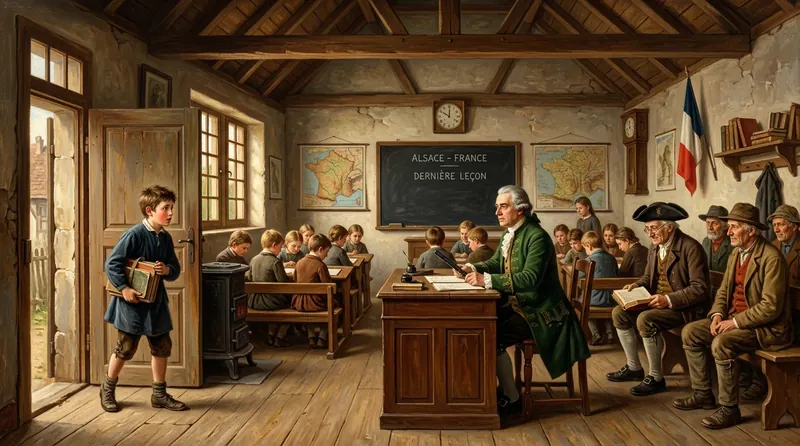
Little Franz entering the silent classroom with M. Hamel and village elders on the back benches
Scene 1: An Uncanny Sunday Silence — Franz Enters the Village Classroom Alsace 1870

Once seated, Franz recovers from his initial panic and notices something extraordinary about his teacher. M. Hamel is dressed in his finest ceremonial attire: his beautiful green coat, his frilled shirt, and his little black silk cap, all intricately embroidered—garments he wore exclusively on official inspection and prize distribution days.

The Presence of the Village Elders

Even more astonishing to Franz is the sight of the back benches—which were normally left vacant. Today, they are occupied by elderly villagers sitting silently like schoolboys: Old Hauser wearing his three-cornered hat, the former Mayor, the former Postmaster, and several other venerable community members. Old Hauser had brought an ancient spelling primer, thumbed and frayed at the edges, which he held open across his knees with his heavy spectacles laid across the pages. Their presence is a silent, communal gesture of gratitude for M. Hamel’s forty years of devoted service and an act of grieving respect for their conquered homeland.

5. The Thunderclap: The Order from Berlin

While Franz is bewildered by these strange occurrences, M. Hamel mounts his wooden chair and addresses the room in a grave, tender voice that carries immense emotional weight:

“My children, this is the last lesson I shall give you. The order has come from Berlin to teach only German in the schools of Alsace and Lorraine. The new master comes tomorrow. This is your last French lesson. I want you to be very attentive.”

These fateful words strike Franz like a thunderclap. In an instant, the puzzle pieces fall into place: this was the devastating notice posted on the town-hall bulletin board! Franz is instantly overcome by an agonizing wave of remorse and self-reproach:

Regret for Wasted Time
He barely knew how to write French! He had squandered precious days searching for birds' eggs in the woods and sliding on the frozen banks of the Saar.
Books as "Old Friends"
His grammar book and History of the Saints, which had seemed such heavy nuisances moments earlier, suddenly feel like beloved old friends he cannot bear to part with.

All bitterness toward M. Hamel evaporates instantly. The dread of his iron ruler and complaints about his cranky temperament vanish before the tragic reality that their teacher is being banished forever.

6. Collective Guilt and the Sacred Gift of Language

While Franz is absorbed in these thoughts, M. Hamel calls his name to recite the rule for participles. Franz would have given anything in the world to recite the dreaded rules flawlessly—loud, clear, and without a single mistake. But he stumbles on the very first words, standing motionless, clutching his bench, his heart pounding in utter humiliation, not daring to lift his eyes.

The Great Trouble with Alsace: Procrastination

Instead of scolding him, M. Hamel speaks with sorrowful compassion. He identifies Alsace's fatal flaw: chronic procrastination. “Every day we have said to ourselves, ‘Bah! I’ve plenty of time. I’ll learn it tomorrow.’ And now you see where we’ve come out. Now those fellows out there will have the right to say to you, ‘How is it; you pretend to be Frenchmen, and yet you can neither speak nor write your own language?’”

M. Hamel refuses to place the blame solely on the children. He highlights the collective guilt of the entire community:

  • Parents: Were not anxious enough to educate their children; they preferred putting them to work on farms or in textile mills to earn a few extra sous.
  • M. Hamel himself: Often sent students to water his garden flowers instead of studying, and declared arbitrary school holidays whenever he wanted to go trout fishing.

The Key to Their Prison

M. Hamel then delivers his unforgettable tribute to the French language, declaring it to be “the most beautiful language in the world — the clearest, the most logical.” He exhorts his people to guard it sacredly among themselves and never forget it, imparting a profound sociolinguistic truth:

“Because when a people are enslaved, as long as they hold fast to their language it is as if they had the key to their prison.”

7. The Writing Lesson, The Floating Flags, and The Cooing Pigeons

M. Hamel then opens the grammar textbook and reads through the lesson. To Franz’s immense astonishment, he understands every single concept with crystal clarity! Franz realizes that he had never listened so attentively in his life, and M. Hamel had never explained the material with such infinite patience. It seemed as if the devoted teacher wished to pour every grain of knowledge he possessed into their young minds in one final stroke.

France, Alsace: The Little Flags

Following grammar, the class moves to penmanship. M. Hamel had prepared brand-new copy-books inscribed in an elegant, flowing round hand: “France, Alsace, France, Alsace.” As the students trace these sacred words, the copy-books resemble tiny national flags floating proudly across the schoolroom, suspended from the brass rods of their desks. An extraordinary stillness settles over the room; the only audible sound is the steady, rhythmic scratching of steel nibs over paper.

“Will they make them sing in German, even the pigeons?”

When some large beetles fly through the open windows, not a single child pays them any attention; even the youngest toddlers remain intensely focused on tracing their pen strokes. Up on the roof, the pigeons coo softly in their eaves, prompting Franz to reflect in one of the most celebrated thoughts in world literature: “Will they make them sing in German, even the pigeons?” This poignant rhetorical thought exposes the ultimate futility and unnatural arrogance of totalitarian conquest: foreign despots may occupy geographical land and silence human speech, but they can never subjugate the voice of nature or extinguish the inner spirit of living beings.

8. Forty Years of Devotion and Hauser’s Tearful Chanting

Whenever Franz looks up from his writing, he sees M. Hamel sitting motionless in his high-backed chair, gazing intently first at one object, then at another, as if trying to engrave every inch of that rustic schoolroom onto his memory forever. For forty dedicated years, he had lived and taught in that very room, looking out upon the identical garden:

  • The wooden desks and benches had been worn silky-smooth by generations of village students.
  • The walnut-trees he had planted in the garden had grown tall and mature.
  • The fragrant hopvine he had personally sown had twined around the window-frames all the way to the cottage roof.

The Heartbreak of Exile

Above their heads, the students can hear M. Hamel’s sister walking back and forth across the ceiling, packing their travel trunks. They have received orders to leave their homeland forever on the following morning. Yet despite his shattered heart, M. Hamel displays monumental courage, hearing every single lesson through to the very end.

Following writing, the class takes up history, after which the smallest children chant their alphabet syllables: “ba, be, bi, bo, bu.” In the back of the room, Old Hauser puts on his spectacles, holds his primer in both trembling hands, and spells the letters alongside the toddlers. Tears stream down the old man’s weathered cheeks, and his voice quavers with such profound emotion that the children feel an overwhelming urge to laugh and weep at the same time.

9. The Climax: Twelve O'Clock, Prussian Trumpets, and Vive La France!

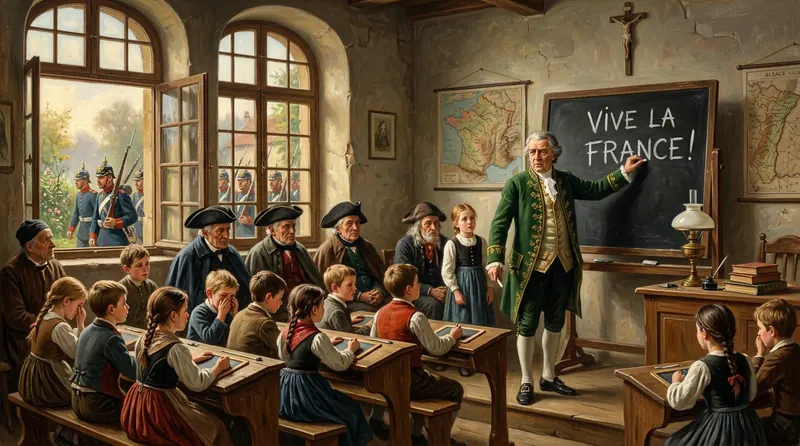
M. Hamel standing at the blackboard writing Vive La France as Prussian soldiers drill outside
Scene 2: The Climax — M. Hamel Writes "VIVE LA FRANCE!" on the Blackboard Unyielding Patriotism

Suddenly, the church tower clock strikes the fateful hour of twelve. The solemn bells of the midday Angelus begin to chime. At the exact same instant, the shrill trumpets of the Prussian soldiers returning from their morning drill sound beneath the schoolhouse windows, heralding the arrival of foreign dominion.

The Supreme Act of Defiance: VIVE LA FRANCE!

M. Hamel rises from his chair, deathly pale. Franz remarks that he had never seen his teacher look so tall and commanding. M. Hamel attempts to deliver his farewell: “My friends,” said he, “I—I—” But grief chokes his throat, and words fail him completely.

Without a spoken word, he turns to the blackboard, grips a piece of chalk, and bearing down upon it with all the physical might and moral passion left in his body, he writes in gigantic, towering letters:

“VIVE LA FRANCE!”

Overcome by the gravity of the moment, he stops, leans his forehead against the stone wall, and without speaking, gestures feebly with his hand: “School is dismissed — you may go.”

Key Grammatical Rules, Literary Devices & Core Principles

Major Theme: Linguistic Chauvinism
The aggressive imposition of a conqueror’s language over a defeated nation's mother tongue.
Bismarck’s Prussian decree aimed to culturally subjugate Alsace and Lorraine by replacing French with German.
Central Metaphor: The Key to the Prison
Language as the ultimate safeguard of national liberty and cultural identity.
M. Hamel proclaims that as long as an enslaved people preserve their native language, they retain the key to their liberation.
Symbol: The Cooing Pigeons on the Roof
Nature’s innate, inviolable freedom versus artificial military tyranny.
Franz’s thought (“Will they make them sing in German, even the pigeons?”) highlights the limits of imperialist dominion.
Symbol: The Ceremonial Green Coat & Frilled Shirt
Tribute to 40 years of dedicated service and solemn respect for French heritage.
Reserved for prize days and inspections; worn here to honour the final lesson of the mother tongue.
Symbol: The Blackboard Inscription (“Vive La France!”)
The triumph of patriotic spirit and moral defiance over armed occupation.
M. Hamel’s final physical act immortalizes the unyielding identity of the French nation.
Grammar Focus: Participles (Class 12 Syllabus)
Present Participle (-ing) | Past Participle (-ed/-en) | Perfect Participle (Having + V3)
Franz’s dread of participle rules mirrors the universal procrastination students face in mastering linguistic fundamentals.

Conceptual Solved Examples & Case Studies

Example 1
What was Franz expected to be prepared with for school that day? (Think As You Read - NCERT)
Step-by-Step Solution:

Franz was expected to be prepared with the grammatical rules governing French participles. His schoolmaster, M. Hamel, had announced on the previous day that he would question the class on this topic. Franz was in great dread of a scolding because he was unprepared and did not know even the very first word about participles.

Example 2
What did Franz notice that was unusual about the school that day? (Think As You Read - NCERT)
Step-by-Step Solution:

Franz observed three highly unusual occurrences:

  1. The Silence: Instead of the customary morning commotion of slamming desks, chanting in unison, and the ruler rapping on the table, the school was as quiet and solemn as a Sunday morning.
  2. The Teacher’s Attire: M. Hamel was dressed in his ceremonial fine Sunday clothes—his embroidered green coat, frilled shirt, and black silk embroidered cap—which he only wore on inspection and prize distribution days.
  3. The Village Elders: The usually vacant back benches were occupied by solemn village elders, including Old Hauser with a three-cornered hat and thumbed primer, the former mayor, and the former postmaster, all gathered in silent grief.
Example 3
What had been put up on the bulletin-board at the Town Hall? (Think As You Read - NCERT)
Step-by-Step Solution:

An official imperial decree from the Prussian capital of Berlin had been posted on the bulletin-board. It ordered that only the German language would henceforth be taught in the schools of the annexed French provinces of Alsace and Lorraine, effectively banning the teaching and usage of French.

Example 4
What changes did the order from Berlin cause in school that day? (Think As You Read - NCERT)
Step-by-Step Solution:

The order from Berlin produced a profound, emotional transformation in the school:

  • It cast a deep, sorrowful silence over the entire room.
  • It brought elderly villagers into the classroom to express their repentance for neglected learning and pay homage to M. Hamel's forty years of service.
  • It dissolved M. Hamel's harshness, replacing his iron ruler with gentle patience.
  • It transformed Franz from an indifferent student into an ardent learner who valued his books as old friends and understood every word of his grammar lesson.
Example 5
How did Franz’s feelings about M. Hamel and school change after the announcement? (Think As You Read - NCERT)
Step-by-Step Solution:
Franz experienced an instantaneous emotional revolution. His dread of school and participles turned into deep remorse for having wasted his time seeking birds' eggs or sliding on the Saar. His textbooks, which had felt like heavy burdens moments before, transformed into beloved old friends. Furthermore, his resentment of M. Hamel’s strictness, crankiness, and iron ruler vanished, replaced by profound sympathy, respect, and sorrow for the teacher who was being forced to leave his home and school forever.
Example 6
The people in this story suddenly realise how precious their language is to them. What shows you this? Why does this happen? (Understanding the Text - NCERT)
Step-by-Step Solution:

What shows this:

  1. The presence of village elders (Hauser, former mayor, postmaster) attending school with old spelling primers.
  2. M. Hamel dressing in his finest ceremonial attire to honour the French language.
  3. The extraordinary dedication and pin-drop silence with which all students, young and old, focused on their writing exercises.
  4. Old Hauser weeping openly as he spelled out letters with the toddlers.
  5. M. Hamel’s impassioned eulogy proclaiming French as the clearest and most beautiful language in the world, culminating in his bold inscription: “VIVE LA FRANCE!”.

Why this happens: Human psychology often takes privileges for granted until they are threatened with extinction. Under the chronic habit of procrastination ("I’ve plenty of time; I’ll learn it tomorrow"), the people of Alsace neglected their language. When the brutal Prussian decree stripped them of their linguistic liberty, they suddenly realized that their native language was the core of their cultural identity and the single greatest badge of their sovereignty.

Example 7
Franz thinks, “Will they make them sing in German, even the pigeons?” What could this mean? (Understanding the Text - NCERT)
Step-by-Step Solution:

Franz’s thought conveys a deep, multifaceted philosophical commentary:

  1. The Inviolability of Nature: Human conquerors can capture physical territory, erect borders, and enforce political laws, but they cannot subdue the laws of nature. Pigeons coo by divine instinct; no military decree can command them to sing in German.
  2. The Futility of Totalitarian Imposition: Imposing an alien language upon an indigenous populace is as unnatural and absurd as compelling pigeons to change their song. True cultural and linguistic identity stems from the soul and cannot be eradicated by political decrees.
  3. Satirical Critique of Imperial Hubris: Franz instinctively exposes the foolish arrogance of Prussian authorities who mistakenly believe that military triumph over French armies grants them the power to control human conscience, nature, and thought.
Example 8
“When a people are enslaved, as long as they hold fast to their language it is as if they had the key to their prison.” Explain the significance of this statement with historical and contemporary relevance. (Talking about the Text - NCERT)
Step-by-Step Solution:

M. Hamel’s statement underscores that language is the living embodiment of a community’s culture, memory, history, and collective identity.

Significance:

  • Psychological Shield: When a country is militarily subjugated, physical chains bind the body. However, as long as the conquered people preserve their mother tongue, their mind and culture remain free from colonial brainwashing.
  • Unifying Rallying Point: Language unites enslaved populations across generations, providing the shared vocabulary needed to mobilize resistance and sustain the flame of freedom.
  • Historical Parallels: Throughout world history, colonial powers have sought to extinguish native tongues to consolidate rule—such as the imposition of English during the British Raj in India, the suppression of Gaelic in Ireland and Scotland, and the eradication of indigenous languages in the Americas. In all these cases, communities that clung steadfastly to their indigenous languages retained the inner key to their eventual revival and liberation.
Example 9
Give a comprehensive character sketch of M. Hamel as depicted in “The Last Lesson”. (Board Exam Analytical Long Answer)
Step-by-Step Solution:

1. A Dedicated and Strict Traditional Pedagogue: For forty uninterrupted years, M. Hamel served the village school with unfailing commitment. Though feared for his strict discipline and "terrible iron ruler", his harsh exterior was rooted in an earnest desire to instill knowledge and character in his pupils.

2. A Person of Honest Self-Critique: M. Hamel possesses noble humility. He does not scapegoat the students alone; he openly acknowledges his own shortcomings, confessing that he frequently dispatched students to water his garden or granted holidays when he wished to go trout fishing.

3. An Ardent Patriot and Cultural Custodian: He reveres French as the "most beautiful, clearest, and most logical language in the world". On his final day, he dresses in his ceremonial green coat not for vanity, but to confer dignity upon his mother tongue.

4. A Tragic Figure of Monumental Emotional Fortitude: Despite the heartbreak of hearing his sister pack trunks overhead and facing lifelong exile, he teaches every lesson to the end. In his final moments, choked by tears, he summons his remaining strength to write "VIVE LA FRANCE!" on the blackboard—transcending the role of a schoolmaster to become an immortal symbol of national resistance.

Example 10
Explain the contextual meaning and literary significance of the idiomatic expressions used in the chapter: (a) “in great dread of”, (b) “counted on”, (c) “thunderclap”. (Working with Words - NCERT)
Step-by-Step Solution:

(a) “In great dread of”:

  • Meaning: Living in extreme, agonizing fear or terror of an impending consequence.
  • Context: Franz was in great dread of M. Hamel’s interrogation on participles because he was completely unprepared.

(b) “Counted on”:

  • Meaning: Depended on or banked upon an expected circumstance to achieve a goal.
  • Context: Franz counted on the usual noisy bedlam of the classroom to slip into his seat without being caught.

(c) “A thunderclap”:

  • Meaning: A sudden, startling, and devastating shock that leaves one utterly dumbfounded.
  • Context: M. Hamel’s announcement that Berlin had banned French hit Franz like a thunderclap, shattering his complacency.

Common Misconceptions & Examiner Traps

Common Misconception

Misjudging M. Hamel as a cruel, unfeeling tyrant due to his iron ruler.

Scientific Reality & Correction

M. Hamel was a strict, traditional teacher whose discipline was motivated by duty; his profound vulnerability, kindness on the final morning, and heartbreak over his pupils reveal a deeply compassionate soul.

Common Misconception

Confusing the Franco-Prussian War (1870–71) with World War I (1914–18) or World War II (1939–45).

Scientific Reality & Correction

The story is set specifically during the Franco-Prussian War of 1870–1871, when the Prussian coalition led by Chancellor Otto von Bismarck defeated Emperor Napoleon III and annexed Alsace and Lorraine.

Common Misconception

Interpreting Franz’s thought about the pigeons literally rather than symbolically.

Scientific Reality & Correction

Franz’s thought is not an enquiry into animal ornithology; it is a profound philosophical metaphor criticizing the absurd arrogance of colonial powers trying to regulate natural instincts and human identity.

Linguistic Chauvinism & Cultural Resistance in The Last Lesson

THE LAST LESSON: LINGUISTIC CHAUVINISM & CULTURAL RESISTANCE Alphonse Daudet's Anatomy of Annexation, Regret, and the Sacred Key to Freedom 1. LINGUISTIC OCCUPATION The Berlin Decree • Franco-Prussian War (1870) • Alsace & Lorraine annexed • French banned in schools • German forced on citizens Linguistic Chauvinism: Imposing conqueror's tongue 2. THE COLLECTIVE AWAKENING Procrastination & Sorrow • Franz postponed learning • Village elders fill back benches • Old Hauser's tear-stained primer • Sudden love for native books Franz's Philosophical Cry: “Make pigeons sing in German?” 3. THE IMMORTAL EMBLEM Language as Identity • French: Most beautiful, clearest • M. Hamel's 40-year devotion “Key to their prison”: Holding fast to mother tongue Climax: VIVE LA FRANCE! Written huge across blackboard Core Message: When an enslaved people cling to their language, they hold the key to their prison.

Chapter Summary & 10 Key Takeaways

Takeaway 1
Historical Setting: Franco-Prussian War (1870–71) results in the Prussian annexation of Alsace and Lorraine and an imperial decree banning French education.
Takeaway 2
Franz’s Reluctance: Young Franz fears school due to unpreparedness in French participles, but resists natural outdoor temptations to attend class.
Takeaway 3
The Ominous Atmosphere: The town-hall bulletin board warns of trouble, and an eerie Sunday stillness replaces everyday schoolroom commotion.
Takeaway 4
Ceremonial Homage: M. Hamel wears his fine green inspection coat; village elders quietly occupy back benches with old primers to honor 40 years of service.
Takeaway 5
The Berlin Decree: M. Hamel announces the last French lesson; Franz experiences instant remorse for past negligence, realizing the priceless value of his language.
Takeaway 6
Linguistic Chauvinism: M. Hamel proclaims French as the most beautiful, clear, and logical language, declaring that holding fast to one’s language is the key to escaping the prison of enslavement.
Takeaway 7
The Inviolable Spirit: Franz ponders whether Prussians can force even pigeons to sing in German; students write “France, Alsace” with undivided focus.
Takeaway 8
The Climax: Noon strikes, Prussian trumpets sound, and an overwhelmed M. Hamel writes “VIVE LA FRANCE!” across the blackboard before dismissing the class.

Check Your Understanding (Diagnostic Practice Questions)

Diagnostic questions testing core conceptual clarity. Answers are hidden initially — solve each problem first, then click to reveal the step-by-step verified solution.

1
What was the historical backdrop of Alphonse Daudet’s story “The Last Lesson”?
Reveal Answer & Explanation
Answer: The Franco-Prussian War (1870–1871)
War led by Bismarck resulting in the annexation of Alsace and Lorraine.
2
Why was Franz terrified of going to school on that particular morning?
Reveal Answer & Explanation
Answer: He was late and did not know the rules of participles which M. Hamel was to examine.
Unprepared for grammar rules.
3
Why were the elderly villagers sitting on the back benches of the classroom?
Reveal Answer & Explanation
Answer: To show respect for M. Hamel’s 40 years of service and repent for not attending school more in their youth.
Silent gratitude and communal grief for their lost mother tongue.
4
What metaphor did M. Hamel use to describe the power of language for an enslaved people?
Reveal Answer & Explanation
Answer: It is as if they had the key to their prison.
A key that unlocks captivity.
5
What words did M. Hamel write on the blackboard before dismissing the final class?
Reveal Answer & Explanation
Answer: “VIVE LA FRANCE!”
Long Live France in French.
6
What profound meaning is conveyed by Franz’s thought: “Will they make them sing in German, even the pigeons?”
Reveal Answer & Explanation
Answer: Tyrants can capture land, but they can never subjugate natural instincts and human identity.
The limits of military power over nature and conscience.
Finished Studying This Chapter?
READY TO PRACTICE?

Timed CBT Practice Tests (Exam Simulator)

Put your concepts to the test with official curriculum-aligned Foundation and Advanced practice tests. Get instant accuracy scores, time metrics, and step-by-step verified explanations.

STAY UPDATED

Get the Latest Updates

New test series, syllabus updates, exam notifications and more.

Syllabus
Updates
Exam
Alerts
Study
Resources