
Follow Us
CBSE • Class XII • English • Ch 4
Estimated Time: 45 Mins
Study Progress: In Progress

The Rattrap

“The Rattrap” by celebrated Swedish novelist Selma Lagerlöf (1858–1940)—the first woman to win the Nobel Prize in Literature (1909)—is a poignant, fairy-tale-like allegory exploring the latent goodness residing in every human soul. Set against the historic backdrop of the iron-rich mining communities of central Sweden, the narrative follows a penniless vagabond who survives by manufacturing small wire rattraps, begging, and petty thievery. Cynical toward humanity, he entertains the philosophical notion that the entire world is nothing more than a giant rattrap offering lures—wealth, food, shelter, and warmth—to trap greedy mortals. After betraying the hospitality of a generous old crofter by stealing thirty kronor, the peddler becomes ensnared in a labyrinthine forest. Rescued by a mistaken identity at the Ramsjö Ironworks, he is brought into the home of the Ironmaster and his daughter, Edla Willmansson. While the Ironmaster turns hostile upon discovering the deception, Edla’s unconditional compassion, empathy, and respect redeem the vagabond, elevating him to act with the nobility of a true Captain.

🪤 Is the entire universe just a giant rattrap waiting for you to touch the bait?

Imagine wandering the bitter winter roads in tattered rags, convinced that all human joys are merely cheese and pork placed on a wire hook to trap unsuspecting souls. In “The Rattrap,” Selma Lagerlöf presents a timeless fable of moral redemption, showing how genuine human compassion can transform a thieving vagabond into an honourable gentleman.

Why This Chapter Matters

Prescribed in NCERT Class 12 English (Flamingo), “The Rattrap” is renowned for its rich allegorical texture, moral philosophy, and profound psychological insight into human redemption. It emphasizes that basic human goodness is never extinguished, only buried, and can always be awakened through unconditional love, trust, and understanding. The chapter is a central pillar for board examination questions on character dynamics (Edla vs Ironmaster), philosophical metaphors, and moral transformation.

Before You Begin (Prerequisites)

  • Geographical setting: Mining and ironworks districts of central Sweden (Bergslagen region).
  • Traditional Swedish customs: Christmas Eve celebrations, mjölis card game, crofter tenancy.
  • Literary concepts: allegory, dramatic irony, extended metaphor, character foils, moral redemption.

What You Will Learn (Core Objectives)

  • Deconstruct the central extended metaphor: the world as a colossal rattrap with tempting worldly baits.
  • Analyze the contrast between the lonely crofter’s generous hospitality and the peddler’s treacherous theft of thirty kronor.
  • Examine the symbolic descent into the dense winter forest as the peddler’s literal ensnarement within his own trap.
  • Compare the Ironmaster’s conditional, transactional welcome with Edla Willmansson’s selfless, unconditional compassion.
  • Trace the peddler’s moral awakening: being treated as a real captain inspires him to behave like one.
  • Evaluate the symbolic significance of the Christmas gift: the rattrap, the returned thirty kronor, and the signature “Captain von Stahle”.

Chapter Roadmap & Progression

1 1. The Vagabond and the Rattrap Phi...
2 2. The Lonely Crofter and the Thirt...
3 3. The Theft and the Maze of the Gl...
4 4. Ramsjö Ironworks and the Mistake...
5 5. Edla Willmansson’s Compassionate...
6 6. The Daylight Revelation & The Cl...
7 7. The Miraculous Transformation &...

Complete Concept Guide (100% Curriculum Coverage)

1. The Vagabond and the Rattrap Philosophy

The protagonist is an unnamed, destitute vagabond who wanders from village to village selling small rattraps crafted from scrap wire. Because his trade is unprofitable, he resorts to both begging and petty thievery to keep body and soul together. His clothes are in tatters, his cheeks sunken, and hunger gleams in his eyes. Trudging along lonely roads, he spends his hours in solitary, bitter rumination.

The Central Philosophy:

One gloomy day, he is struck by an amusing philosophical epiphany: the whole world with its lands, seas, cities, and villages is nothing but a giant rattrap. It exists solely to set baits for people. Just as a small trap offers cheese and pork, the world offers riches, joys, shelter, food, heat, and clothing. As soon as anyone yields to temptation and touches the bait, the trap snaps shut, closing in on them forever.

2. The Lonely Crofter and the Thirty Kronor

One dark evening, the peddler knocks on the door of a small roadside cottage seeking shelter. Instead of the usual sour grimaces and slamming doors, he is warmly received by a lonely old crofter who lived alone without wife or child. Delighted to have company, the crofter boils hot porridge, cuts off a massive slice of tobacco for their pipes, and plays a Swedish card game called mjölis late into the night.

The Fatal Boast and the Tempting Baits:

In his cheerful openness, the crofter boasts that his extraordinary cow supplied milk to the creamery, earning him thirty kronor the previous month. Seeing skepticism on the vagabond’s face, the old man fetches a leather pouch hanging from a nail near the window frame, takes out three wrinkled 10-kronor notes, shows them proudly, and stuffs them back.

3. The Theft and the Maze of the Gloomy Forest

The following morning, both men depart amiably. However, half an hour later, the peddler returns to the cottage alone. Smashed by greed, he breaks the windowpane, thrusts his hand inside, seizes the leather pouch, pockets the thirty kronor, and hangs the pouch back.

Tattered vagabond peddler lost in the dense snow-covered Swedish pine forest

Caught in the universal trap: the peddler wandering in the impassable winter forest of Sweden.

Trapped in the World’s Rattrap:

Afraid of being apprehended on the public highway, he enters a vast, pathless forest. As night falls in freezing December, he realizes he has been walking in circles. The dense trunks, heavy branches, and tangled thickets close around him like an impenetrable prison. He realizes with bitter clarity: he has taken the bait, and the world’s rattrap has snapped shut upon him. Sinking exhausted to the frozen ground, he awaits death.

4. Ramsjö Ironworks and the Mistaken Identity

As he lay awaiting death, his ear caught a regular, rhythmic thumping—the heavy strokes of a forge hammer. Summoning his remaining strength, he staggered toward Ramsjö Ironworks, a bustling iron mill with blast furnaces and charcoal kilns. Sneaking into the warm forge, the master blacksmith indifferently granted him permission to sleep near the furnace.

Soon, the prominent Ironmaster entered on his nightly inspection. In the uncertain glow of the furnace coals, he scrutinized the filthy, bearded peddler and mistook him for his former regiment comrade, Captain Nils Olof (von Stahle). Pitying his supposed decline, the Ironmaster warmly invited him to spend Christmas at the grand manor house. But the peddler—well aware that carrying stolen money into the manor house was voluntarily entering a lion’s den—adamantly refused the invitation.

5. Edla Willmansson’s Compassionate Intervention

Assuming his friend was embarrassed by his tattered clothes, the Ironmaster sent his eldest daughter, Edla Willmansson, in a carriage accompanied by a valet carrying a luxurious fur coat. Edla was not pretty, but possessed a quiet modesty and extraordinary compassion.

The Power of Unconditional Trust:

Finding the vagabond asleep, Edla gently woke him. Noticing his startled terror, she astutely deduced: “Either he has stolen something or else he has escaped from jail.” Yet speaking with genuine tenderness, she said: “You will be allowed to leave us just as freely as you came. Only please stay with us over Christmas Eve.” Her unpretentious sincerity and kindness won his confidence, and he accepted the fur coat.

6. The Daylight Revelation & The Clashing Reactions

The following morning on Christmas Eve, the guest was washed, shaved, and groomed by the valet, dressed in the Ironmaster’s finest white shirt and tailored suit. But in the clear light of day, the illusion vanished completely.

The Ironmaster’s Fury
Realizing the stranger was an impostor, the Ironmaster struck the table angrily, accused him of deceit, and threatened to call the Sheriff. The peddler replied with his rattrap philosophy: “The whole world is nothing but a big rattrap... one day you too may be caught!” Contemptuous, the Ironmaster ordered him out.
Edla’s Noble Defense
Edla stepped in and locked the door. She pleaded that they had promised Christmas joy to a homeless soul chased by everyone all year round. Having invited him, they had no moral right to turn him out into the freezing snow on Christmas Eve. The Ironmaster reluctantly yielded.

7. The Miraculous Transformation & Captain von Stahle’s Letter

Throughout Christmas Eve, the stranger did nothing but sleep deeply and undisturbed. On Christmas morning, the Ironmaster and Edla attended church, where they received a shocking report: an old crofter had been robbed of thirty kronor by a man selling wire rattraps! Horrified, the Ironmaster berated Edla, expecting the stranger had looted their silver spoons.

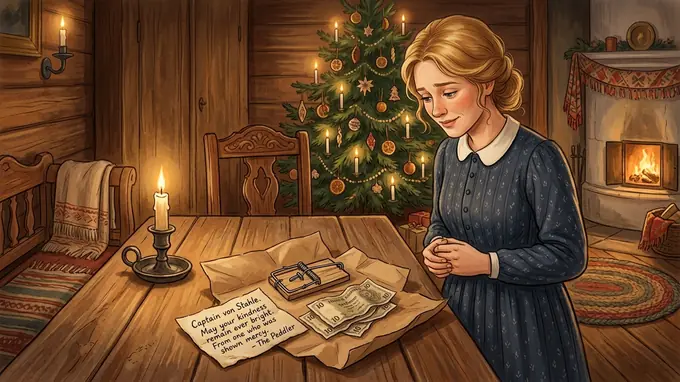
Edla Willmansson opening the peddler’s Christmas package containing a tiny rattrap, money and letter

Awakening the Captain within: Edla reading the peddler’s touching Christmas letter of redemption.

Arriving home, the valet informed them that the stranger had departed—taking nothing, but leaving behind a modest Christmas package for Miss Willmansson. Inside, Edla found a small, clumsy wire rattrap containing three wrinkled ten-kronor notes and a letter written in jagged characters:

“Honoured and noble Miss... Since you have been so nice to me all day long, as if I was a captain, I want to be nice to you, in return, as if I was a real captain... The rattrap is a Christmas present from a rat that would have been caught in this world’s rattrap if he had not been raised to captain, because in that way he got power to clear himself... Written with friendship and high regard, Captain von Stahle.”

Key Grammatical Rules, Literary Devices & Core Principles

Central Allegory: The World as a Rattrap
World = Giant rattrap | Riches/Pleasures = Baits (cheese/pork) | Sin = Snapping trap.
Selma Lagerlöf’s overarching metaphor depicting the snare of material temptations.
Thematic Principle: The Latent Human Goodness
Basic goodness can never be destroyed; it is awakened through unconditional love and trust.
Edla’s selfless respect dignifies the peddler and inspires him to redeem himself.
Dramatic Irony: Mistaken Identity at Ramsjö
The Ironmaster mistakes the tramp for his comrade Captain Nils Olof in the dim forge.
Creates tension between the tramp’s guilt over the 30 kronor and the Ironmaster’s invitation.
Character Foils: Ironmaster vs Edla Willmansson
Ironmaster = Conditional, status-driven, punitive | Edla = Unconditional, empathetic, forgiving.
The father judges by social appearance and threatens the law; the daughter acts with Christian grace.
Symbolic Gift: The Returned Thirty Kronor
The 3 wrinkled 10-kronor notes returned to the crofter via Edla.
Signifies complete moral restitution and release from the world’s rattrap.
Symbolic Transformation: The Signature
Signed as “Captain von Stahle” instead of an anonymous vagabond.
Represents the peddler rising to the noble stature accorded to him by Edla’s faith.

Conceptual Solved Examples & Case Studies

Example 1
From where did the peddler get the idea of the world being a rattrap? (Think as you read)
Step-by-Step Solution:

The peddler derived the idea entirely from his own desolate existence and profession. While trudging along the lonely roads manufacturing and peddling wire rattraps, his mind naturally engaged in solitary rumination. Observing that a rattrap offers appetizing baits like cheese and pork to lure rats, he suddenly perceived that the entire world operates on the exact same predatory principle. The world’s riches, food, shelter, and warmth are merely glittering baits designed to ensnare greedy mortals; the instant someone touches the bait, the trap snaps shut, bringing inescapable ruin.

Example 2
Why was the peddler amused by this idea? (Think as you read)
Step-by-Step Solution:

The peddler was deeply amused by the rattrap philosophy because the world had always treated him with unmitigated unkindness, cruelty, and contempt. Being an impoverished outcast who was routinely chased away and scorned, it gave him malicious, vindictive pleasure to think ill of society. He took grim satisfaction in envisioning prosperous, respected people already trapped within the snare or circling perilously around the tempting baits.

Example 3
Did the peddler expect the kind of hospitality that he received from the crofter? (Think as you read)
Step-by-Step Solution:

No, the peddler never expected such warmth and hospitality. Accustomed to receiving cold, sour grimaces and having doors slammed in his face wherever he went, he was astonished when the old crofter opened the cottage door with delight. The lonely crofter, living without wife or child, craved human companionship and joyfully welcomed him, serving hot porridge, sharing a generous roll of tobacco, and playing the Swedish card game mjölis late into the night.

Example 4
Why was the crofter so talkative and friendly with the peddler? Why did he show the thirty kronor to the peddler? (Think as you read)
Step-by-Step Solution:

Talkative & Friendly: The crofter was an old man who lived entirely alone in severe isolation. Having no family to talk to, he was exceedingly glad to find another human being to relieve his loneliness and converse with on a gloomy evening.

Showing the Thirty Kronor: While proudly explaining how his prized cow provided milk to the creamery, the crofter noticed an expression of doubt on the peddler’s face. To prove his veracity and boast of his modest wealth, he fetched the leather pouch from the nail by the window and displayed the three wrinkled ten-kronor notes before the peddler’s eyes.

Example 5
Did the peddler respect the confidence reposed in him by the crofter? (Think as you read)
Step-by-Step Solution:

No, the peddler flagrantly violated and betrayed the crofter’s trust. The very next morning, despite having partaken of the old man’s porridge and hospitality, the peddler returned to the cottage after the crofter departed. He smashed the windowpane, reached into the cottage, stole the thirty kronor from the leather pouch, and ran into the woods, succumbing completely to the tempting bait.

Example 6
What made the peddler accept Edla Willmansson’s invitation after refusing the Ironmaster? (Think as you read)
Step-by-Step Solution:

While the Ironmaster had been domineering, assuming, and persistent, Edla Willmansson approached the peddler with genuine empathy, tenderness, and respect:

  1. She noticed his frightened eyes and spoke to him in a soft, non-judgmental tone.
  2. Most importantly, she gave him a solemn, unshakeable guarantee: “You will be allowed to leave us just as freely as you came. Only please stay with us over Christmas Eve.”
    Her complete absence of arrogance, combined with sincere Christian warmth, dissolved his suspicions and won his confidence.
Example 7
What made the peddler finally change his ways? (Understanding the text)
Step-by-Step Solution:

The peddler’s profound moral transformation was catalyzed entirely by Edla Willmansson’s unconditional love, compassion, and respect:

  1. Elevation to Dignity: Even when her father discovered the deception in broad daylight and angrily threatened him with the law, Edla staunchly defended the stranger, insisting that they honour their promise of Christmas peace to a homeless wanderer.
  2. Treated Like a Real Captain: Edla treated him not as a despised thief or tramp, but with the courtly respect due to an honoured Captain.
  3. Awakening of Latent Conscience: Experiencing selfless respect for the first time in his life, the peddler felt morally elevated. He realized he could not disgrace the faith placed in him, which gave him the psychological power to clear himself from the world’s rattrap, return the stolen thirty kronor, and sign his letter as Captain von Stahle.
Example 8
How does the metaphor of the rattrap serve to highlight the human predicament? (Understanding the text)
Step-by-Step Solution:

The rattrap metaphor serves as a brilliant allegory for the universal human condition:

  1. The Nature of Baits: Human beings are constantly surrounded by worldly lures—wealth, fame, luxury, power, and physical pleasures—which mimic the pork and cheese in a trap.
  2. The Snare of Greed: When individuals compromise their moral conscience to grasp these material baits (as the peddler did by stealing the crofter’s 30 kronor), they become ensnared in guilt, psychological anxiety, and social isolation.
  3. The Inescapable Maze: Just as the peddler became trapped in the dense forest where all paths led back to the center, sinners find themselves trapped in their own deceptions.
  4. The Path to Liberation: Selma Lagerlöf demonstrates that only grace, unselfish love, and moral restitution can open the jaws of the world’s rattrap and release the trapped human spirit.
Example 9
Why did the peddler sign himself as “Captain von Stahle”? (Talking about the text)
Step-by-Step Solution:

The peddler signed his farewell letter as Captain von Stahle to signify that he had truly become the noble person Edla had treated him as:

  1. Had Edla treated him as a common tramp, he would have remained a hardened thief. But by treating him with the courtly honour of a Captain, she awakened his slumbering dignity.
  2. He explicitly writes that the rattrap is a present from a rat that was raised to the stature of a Captain, giving him the inner nobility to rise above petty thievery. The signature is his proud declaration of spiritual rebirth.

Common Misconceptions & Examiner Traps

Common Misconception

Believing the peddler deliberately deceived the Ironmaster at Ramsjö to get a free meal.

Scientific Reality & Correction

The peddler never claimed to be Captain Nils Olof; the Ironmaster mistook him in the dark forge, and the peddler repeatedly refused the manor invitation until Edla persuaded him.

Common Misconception

Assuming the peddler stole silver spoons or valuables from the Ironmaster’s manor house.

Scientific Reality & Correction

The peddler did not steal anything from the manor; on the contrary, he left behind the stolen 30 kronor to be returned to the crofter along with a gift rattrap.

Common Misconception

Thinking the Ironmaster’s anger softened on Christmas Day when he learned the truth.

Scientific Reality & Correction

The Ironmaster was furious and ready to call the Sheriff; it was solely Edla’s compassion that sheltered the peddler and secured his transformation.

The Allegory of Temptation & Moral Redemption in The Rattrap

THE RATTRAP: THE ALLEGORY OF TEMPTATION & MORAL REDEMPTION Selma Lagerlöf's Tale of Human Frailty, the Universal Snare, and the Transforming Power of Grace 1. THE PHILOSOPHY World is a Rattrap • Wire rattraps sold • Life of begging & petty theft • World offers baits: Riches, joy, pork & cheese “Touch the bait and the door snaps shut!” 2. THE TEMPTATION Crofter's 30 Kronor • Hospitable old crofter • Porridge, tobacco, mjölis • Shows 30 kronor in pouch • Peddler smashes window pane Trapped by the Bait: Steals money & flees woods 3. THE FOREST MAZE Impenetrable Prison • Wanders in snow circles • Trees close in like bars • Ramsjö forge thumping • Mistaken for Nils Olof Ironmaster Threat: Calls the sheriff on him 4. REDEMPTION Edla's Pure Grace • Intercedes for the tramp • Treats him like a captain • Awakens latent nobility Gift of 30 Kronor: Returned with note signed “Captain von Stähle” Moral Thesis: Essential goodness in human beings can be awakened through unconditional love and understanding.

Chapter Summary & 10 Key Takeaways

Takeaway 1
The Rattrap Philosophy: Destitute vagabond perceives the entire world as a giant rattrap setting material baits.
Takeaway 2
Crofter’s Hospitality: Generous lonely old man offers porridge, tobacco, mjölis, and displays thirty kronor.
Takeaway 3
The Betrayal: Peddler steals the thirty kronor and becomes trapped in the labyrinthine winter forest.
Takeaway 4
Ramsjö Forge Encounter: Ironmaster mistakes the tramp for his former comrade Captain Nils Olof in the dim light.
Takeaway 5
Edla’s Intervention: Modest, compassionate daughter persuades the terrified peddler to stay for Christmas Eve with unconditional trust.
Takeaway 6
Daylight Revelation: Groomed peddler is revealed as an impostor; Ironmaster threatens police, but Edla insists on protecting him.
Takeaway 7
Christmas Redemption: The peddler sleeps peacefully, surrounded by genuine respect and dignity.
Takeaway 8
The Gift of Redemption: Departs leaving the 30 kronor for the crofter, a wire rattrap, and a letter signed “Captain von Stahle”.

Check Your Understanding (Diagnostic Practice Questions)

Diagnostic questions testing core conceptual clarity. Answers are hidden initially — solve each problem first, then click to reveal the step-by-step verified solution.

1
What did the peddler make his small rattraps from, and how did he acquire the materials?
Reveal Answer & Explanation
Answer: He made them from scrap wire, which he gathered by begging in stores and on big farms.
Wire gathered through begging.
2
How much money did the peddler steal from the old crofter’s cottage?
Reveal Answer & Explanation
Answer: Thirty kronor, consisting of three wrinkled ten-kronor notes.
Three ten-kronor notes.
3
Why did the peddler refuse the Ironmaster’s initial invitation to the manor house?
Reveal Answer & Explanation
Answer: Because he had the stolen thirty kronor in his pocket, and entering the manor house felt like walking voluntarily into the lion’s den.
Fear of discovery with stolen money.
4
What did Edla deduce about the stranger when she first encountered him sleeping at the forge?
Reveal Answer & Explanation
Answer: She noticed his intense terror and deduced that he had either stolen something or escaped from prison.
Either a thief or escaped prisoner.
5
What news did the Ironmaster and Edla hear at church on Christmas morning?
Reveal Answer & Explanation
Answer: That an old crofter of the ironworks had been robbed of thirty kronor by a man selling wire rattraps.
Robbery of the crofter.
6
How did the peddler sign his farewell letter to Edla Willmansson, and why?
Reveal Answer & Explanation
Answer: As “Captain von Stahle,” because Edla’s respect and nobility had elevated him to act with the honour of a true Captain.
Captain von Stahle.
Finished Studying This Chapter?
READY TO PRACTICE?

Timed CBT Practice Tests (Exam Simulator)

Put your concepts to the test with official curriculum-aligned Foundation and Advanced practice tests. Get instant accuracy scores, time metrics, and step-by-step verified explanations.

STAY UPDATED

Get the Latest Updates

New test series, syllabus updates, exam notifications and more.

Syllabus
Updates
Exam
Alerts
Study
Resources